BLOG POST
Home services has the most local-search-driven review dynamics of any business category. Customers search "plumber near me" with sewage backing up, "roofer near me" with active leaks, "HVAC company near me" when their AC goes out at 2pm on a 95-degree Saturday. The decision window is minutes, sometimes seconds. The local 3-pack on Google determines who gets the call. Reviews — count, velocity, recency, content, response activity — are the primary signal that determines 3-pack ranking.
The economic stakes are unusually high. A typical emergency call in home services generates $200-1,500 in immediate revenue. A new HVAC system installation runs $5,000-20,000. A roof replacement runs $10,000-40,000. The difference between capturing the local 3-pack for emergency searches versus losing those calls to competitors translates directly into substantial revenue impact, year over year. The math means home services contractors who systematically build review depth dominate their local markets while contractors who treat reviews as an afterthought pay $30-150+ per lead through HomeAdvisor, Angi, and Google Local Service Ads while their better-reviewed competitors capture organic traffic for free.
But home services isn't one industry. A plumber's review collection workflow is different from a remodeler's. An HVAC company's review program has different dynamics than a roofing contractor's. A restoration company faces different customer emotional contexts than a general contractor. Generic "ask for reviews after every job" advice misses the trade-specific timing, customer dynamics, and operational considerations that determine whether a review program actually works in a given home services business.
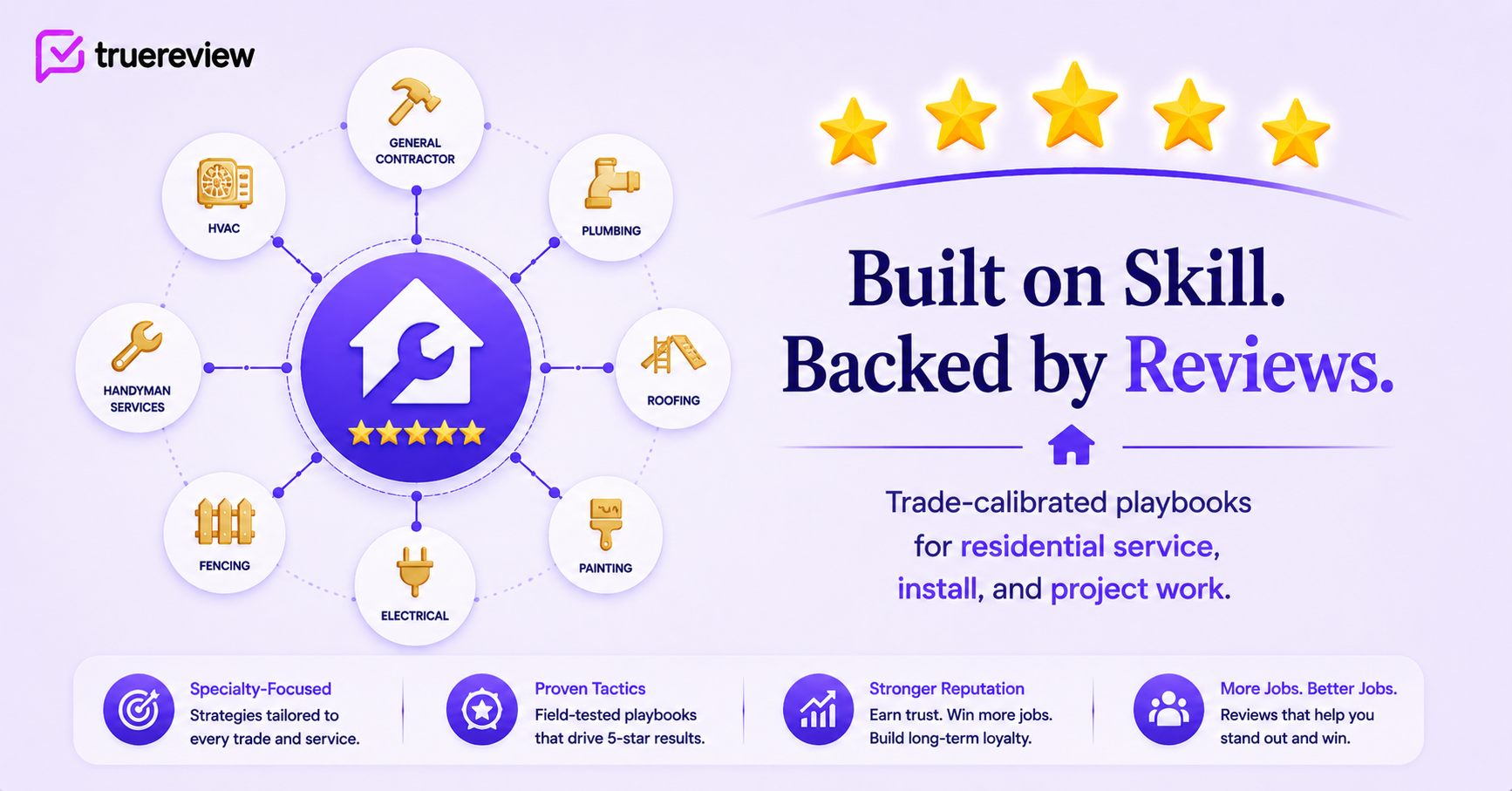
This post is the home services cluster hub. It pulls together the cross-cutting dynamics that apply across all home services trades with concise summaries of how seven specific trade categories differ — and links to the full deep-dive playbook for each. Identify your trade, read the brief summary for the structural insight, then click through to the full playbook for the specific timing, templates, software integrations, and pitfalls that apply to your business.
A broader companion post on home services marketing strategy beyond reviews — lead generation, branding, advertising, the full marketing mix — applies to most trades. Reviews specifically — what this post covers — are the highest-leverage local SEO investment most home services contractors can make.
Home services has structural characteristics that distinguish review collection from other local services categories:
Local search dominates lead generation. Home services categories show some of the highest search-driven decision behavior in local services. Customers facing problems Google for solutions and choose from the local 3-pack. This is true for emergency calls (the highest-urgency dynamic), scheduled installations (researched more carefully), maintenance work (often customer-loyalty driven), and even commercial work (B2B customers Google contractors before requesting bids). Review profiles directly shape what customers find.
Emergency vs. scheduled work has different review dynamics. Most home services trades have both modes. Emergency calls produce stress-decision customers and reviews focused on response time, fast resolution, and fair after-hours pricing. Scheduled work produces deliberative customers and reviews focused on quality, professionalism, and value. Templates and timing should differentiate between these modes.
The technician-as-trust-driver dynamic. Customers form relationships with specific technicians who come to their homes. Reviews often mention specific technicians by name, and customers increasingly request specific technicians for follow-up work. This dynamic affects how trades should structure their review attribution and how they should think about technician training and retention.
Recurring vs. one-shot relationships vary by trade. HVAC has annual maintenance (recurring); roofing is once every 25 years (one-shot). Plumbing has emergency calls every few years (sporadic-recurring). Restoration is one major event in a homeowner's life (one-shot). The recurring-vs-one-shot distinction shapes whether reviews drive primarily new customer acquisition or both new acquisition and retention.
Field service management software is unusually concentrated. Most home services trades run on similar software platforms (ServiceTitan dominant for residential service-and-replace, Housecall Pro for smaller operations, Jobber for cross-trade), with several other significant platforms (FieldEdge, Service Fusion, FieldPulse, Workiz). The cluster's software commonality means review automation patterns transfer cleanly across trades.
Lead-generator competition shapes economics. HomeAdvisor, Angi, Thumbtack, Google Local Service Ads — these platforms compete for home services lead flow at $30-150+ per lead. Strong organic review profiles help contractors capture leads at much lower marginal cost; weak profiles force dependence on paid channels.
The combined effect: home services contractors who systematically build review depth typically capture 4-6x the inbound emergency call volume of contractors with thin review profiles in the same service area, with substantial impact on lead acquisition costs and overall margin.
While timing, customer dynamics, and trade-specific considerations vary, several principles apply universally across the home services cluster:
Local 3-pack capture is the dominant goal for most trades. Most home services contractors should orient their review programs around the local 3-pack rankings for their specific service-area-plus-query combinations. Reviews are the highest-leverage local SEO signal in most trades. For the SEO mechanics, see how Google reviews affect local SEO.
Emergency and scheduled work need different templates. A homeowner with a flooding basement getting an SMS that says "thanks for your routine maintenance" feels disconnected. A homeowner who scheduled a tune-up months in advance getting a "hope everything's back to normal" emergency-tone message feels confused. Trade-specific templates that match customer emotional state convert better.
Technician attribution matters. Most successful home services review programs route reviews to specific technicians for personal review-profile development. This serves multiple purposes — it builds the technician's relationship with their customer base, identifies high-performing technicians, and creates the per-technician dashboard that supports management oversight.
Verbal asks at job completion outperform digital alone. A technician finishing a job has spent 30-90 minutes with the customer in conversation. The natural moment of saying goodbye is the highest-converting verbal-ask opportunity in any business category. Combined with digital follow-up arriving hours or days later, the conversion rates are substantially better than either alone.
Job-type-specific automation produces results. Most home services FSM platforms support tagging jobs by type (emergency, scheduled, install, maintenance, etc.). Configuring different automated review request workflows for different job types — with different timing and template tone — produces meaningfully better conversion than one-size-fits-all automation.
Year-round velocity beats seasonal sprints. Some home services have natural seasonal patterns (HVAC peaks in summer; restoration peaks during storm seasons). Maintaining steady review velocity across seasons — even if quarterly volume varies — supports stable rankings throughout the year. Concentrated bursts followed by months of inactivity look worse to Google's algorithms than steady accumulation.
Filtering matters for review quality. Customers in active warranty disputes, with billing concerns, after callbacks or rework, in major equipment-failure shock, or in lead-generator-platform contexts (where they may have already left a review on the platform) should be excluded from automated request workflows. Misfires produce negative reviews; appropriate filtering protects review profile quality.
Response activity is a positive signal. Responding to every review (positive and negative) within 24-48 hours produces ranking benefit and signals attentive operations to prospects researching the business. This is the lowest-effort, highest-leverage operational discipline in home services review management.
Review schemes don't work. Buying reviews, asking employees for reviews, mass-flagging negative reviews, review gating that filters by satisfaction — these violate Google's policies and the FTC's 2024 Rule on Consumer Reviews and Testimonials. The detection rates have improved dramatically; the enforcement consequences have intensified. For the compliance framework, see our post on review incentives and Google's policies.
What follows are concise summaries of how seven specific trade categories differ in their review collection dynamics.
General contractors handle multi-stage projects with multiple distinct ask windows: project completion, post-completion 30-day check-in, end-of-warranty year (typically 1 year). The structural insight: ask 5-7 days after substantial completion when the customer has lived with the finished work and any small punch-list items have been resolved. Reviews from this window tend to be detailed because the customer has been through a multi-week or multi-month project and has substantive feedback. General contractors also benefit from project-photo reviews, which add visual content that aids both SEO and conversion. The wide trade-mix means general contractors often need workflows that handle plumbing, electrical, framing, finishing, and project management feedback distinctly.
Full playbook: Google reviews for general contractors
Roofing has unusually high local search intent — homeowners with active leaks or storm damage Google "roofer near me" with near-100% conversion intent. The structural insight: review collection in roofing is fundamentally an SEO play. Companies that build 80-150 reviews per year, with content describing specific services (storm damage, hail repair, full replacement) and neighborhoods served, with consistent response activity, systematically dominate the local 3-pack for high-intent searches. This drives the inbound emergency call volume that competitors can't capture without paying $40-150 per lead through HomeAdvisor and Angi. Storm-season velocity discipline is critical — sustained off-season review accumulation supports rankings when storm season hits.
Full playbook: Google reviews for roofing contractors
Restoration has the most emotionally complex customer context in home services. Customers facing water damage, fire damage, smoke damage, mold remediation, or biohazard cleanup are in active crisis when they call. The structural insight: timing has to respect what customers are going through. Asking immediately after acute crisis intervention often captures reviews shaped by stress; waiting too long (months later when insurance settlements are still in dispute) catches them in litigation mode. The right window: 3-4 weeks after job completion when the customer is back in their home and the worst is behind them. Insurance company referral relationships also affect dynamics — restoration companies on insurance preferred provider lists have different review needs than independent operators.
Full playbook: Google reviews for restoration companies
Home remodeling has multi-stage projects spanning weeks to months. The structural insight: there are multiple natural ask windows across the project lifecycle, not just one. Initial design phase completion (when the customer signs off on plans), demolition completion (when the project becomes physical), substantial completion (when the customer can use the space), and end-of-warranty (typically 1 year out) all represent legitimate ask moments. Multi-touchpoint review programs in remodeling typically produce 2-3 reviews per project compared to single-touchpoint programs that produce 1. Houzz reviews matter alongside Google in this category — customers research extensively across both platforms before committing to substantial remodeling investments.
Full playbook: Google reviews for home remodelers
HVAC has a recurring service relationship that distinguishes it from one-shot home services: annual tune-ups, periodic emergency repairs, system replacement every 10-15 years. The structural insight: reviews don't just acquire new customers — they retain existing ones, drive maintenance plan renewals, and shape system replacement decisions when old systems finally fail. Smart HVAC review programs run year-round (not just during summer AC peaks), use different templates for emergency vs. scheduled work, and attribute reviews to specific technicians who become trust-drivers in customer relationships. Direct integrations with ServiceTitan, Housecall Pro, and Jobber simplify the implementation.
Full playbook: Google reviews for HVAC companies
Plumbing has the most emergency-driven dynamic in home services. The structural insight: emergency calls (burst pipes, sewer backups, water heater failures) are won or lost in the local 3-pack on Google in 60-180 second decision windows. Companies with deep recent review profiles dominate emergency search; companies with thin profiles lose every emergency call to competitors. Reviews specifically mentioning fast response, fair after-hours pricing, and successful problem resolution capture the high-margin emergency call volume that makes plumbing a profitable business. The "honest plumber" review (countering plumbing's industry reputation for upselling and price-gouging) carries unusual conversion weight. ServiceTitan integration is particularly important for residential plumbing operations.
Full playbook: Google reviews for plumbing companies
Auto body shops sit between auto repair and home services operationally — they handle insurance claim work with multi-week customer experiences and emotional contexts shaped by recent accidents. The structural insight: ask at vehicle delivery, after the customer has seen the repaired vehicle and signed off on quality. The "looks better than before the accident" review converts enormously well for prospects searching for body shops after their own accidents. Insurance referral relationships affect review dynamics — body shops on preferred provider lists have different review needs than independent shops. While not strictly a home services trade, the operational similarities (technician-driven trust, multi-touch customer experience, emergency-context customer states, FSM software ecosystem overlap) make the playbook patterns transferable.
Full playbook: Google reviews for auto body and collision shops
Beyond the seven primary trade categories above, the home services review playbook extends to several adjacent verticals with light calibration:
Auto repair shops. Customer-facing review dynamics overlap heavily with home services trades — technician-driven trust, completion-event ask windows, FSM software ecosystem (Mitchell 1, ALLDATA, Shop-Ware overlap with home services platforms). Full playbook: Google reviews for auto repair shops.
Car dealerships. Service department reviews follow home services patterns; sales department reviews follow longer customer-journey patterns. Full playbook: Google reviews for car dealerships.
Auto detailing. Visual-results-driven trade with photo-review opportunities. Operates on similar customer-visit-completion patterns. Full playbook: Google reviews for auto detailing.
Towing services. Emergency-only customer dynamics with stressed-customer review contexts. Different from most home services in that the customer is rarely happy about needing the service in the first place. Full playbook: Google reviews for towing services.
Other adjacent trades not covered with dedicated posts but operating on similar principles: Electricians, painters, landscaping/lawn care, pool service, pest control, garage door repair, appliance repair, locksmith services, window installation, flooring installation, tree service, septic service, fence installation, pressure washing, gutter cleaning, snow removal, junk removal, moving services. The general home services patterns above (verbal ask at job completion, automated digital follow-up 24-48 hours later for service / 5-7 days for installation, technician attribution, response activity) work for all of these with light calibration to the specific trade dynamics.
Most home services trades use one of a few field service management (FSM) platforms. The major options:
ServiceTitan. The dominant residential service-and-replace platform — most large residential HVAC, plumbing, electrical, and general service operations run on ServiceTitan. TrueReview has direct integration with ServiceTitan that connects job completion events to automated review request workflows.
Housecall Pro. Particularly strong in smaller residential operations and trades with high mobile-tech needs. Direct integration with TrueReview.
Jobber. Cross-trade FSM for smaller and mid-size residential operations. Direct integration with TrueReview.
FieldEdge. Strong in HVAC and plumbing residential operations. Zapier integration available.
Service Fusion. Mid-market FSM across multiple trades. Zapier integration available.
FieldPulse. Growing in smaller residential operations.
Workiz. Designed for service-based small business operations.
ServSuite, SAWIN, others. Specialty platforms for specific trade subcategories.
For commercial operations: BuildOps, ServiceTrade, mhelpdesk, and other commercial-focused FSM platforms.
For new construction operations: CoConstruct, BuilderTrend, and project-specific construction management platforms.
For independent contractors and very small operations: QuickBooks-based workflows, Google Workspace-based operations, or simple scheduling tools (Acuity, Calendly) with manual follow-up.
Setup patterns:
Direct integrations where available (ServiceTitan, Housecall Pro, Jobber for TrueReview).
Zapier connections for the broader FSM ecosystem. Most modern home services platforms expose webhooks or have Zapier integration.
Direct API integration for larger operations with technical resources.
CSV import as a fallback for smaller operations on simpler systems.
Configure separate workflows by job type:
The configuration discipline produces high review velocity without misfires. A workflow that fires the same template at the same delay for every job type produces poor results in trades with as much job-type variation as most home services have.
For multi-technician operations, configure per-technician attribution so each tech sees their own customer reviews and the dispatch team can identify high-performing technicians.
For home services contractors building review programs in 2026, the path forward is clear: identify your trade, read the deep-dive playbook for that trade, implement the calibrated approach, layer the cross-cutting principles across everything, and integrate with your existing FSM software. The compounding effect over 12-18 months produces local 3-pack dominance and inbound call volume that contractors with thinner review profiles can't compete with.
The strategic mindset that produces results across the cluster:
For broader complementary frameworks, see our companion posts on the 5-star strategies that actually work in 2026, the local SEO mechanics behind reviews, and the cross-industry compliance reference on review incentives and Google policies. For complete industry-spanning playbooks beyond home services, see the industry-specific playbooks roundup.
Ready to build a Google review program calibrated to your trade? Start your free 14-day trial of TrueReview — direct integration with ServiceTitan, Jobber, and Housecall Pro plus Zapier connections to most other home services FSM platforms; automated SMS and email workflows with separate timing for emergency, scheduled, install, and major project jobs; per-technician dashboards for multi-tech operations; embeddable review widgets that filter by job type and surface emergency-response reviews where appropriate; AI-assisted response generation for systematic review engagement; TCPA-compliant SMS infrastructure with 10DLC registration handled for you; and source-tracked review collection that shows you which channels actually produce ranking-affecting review depth. No setup fees, no contracts.