BLOG POST
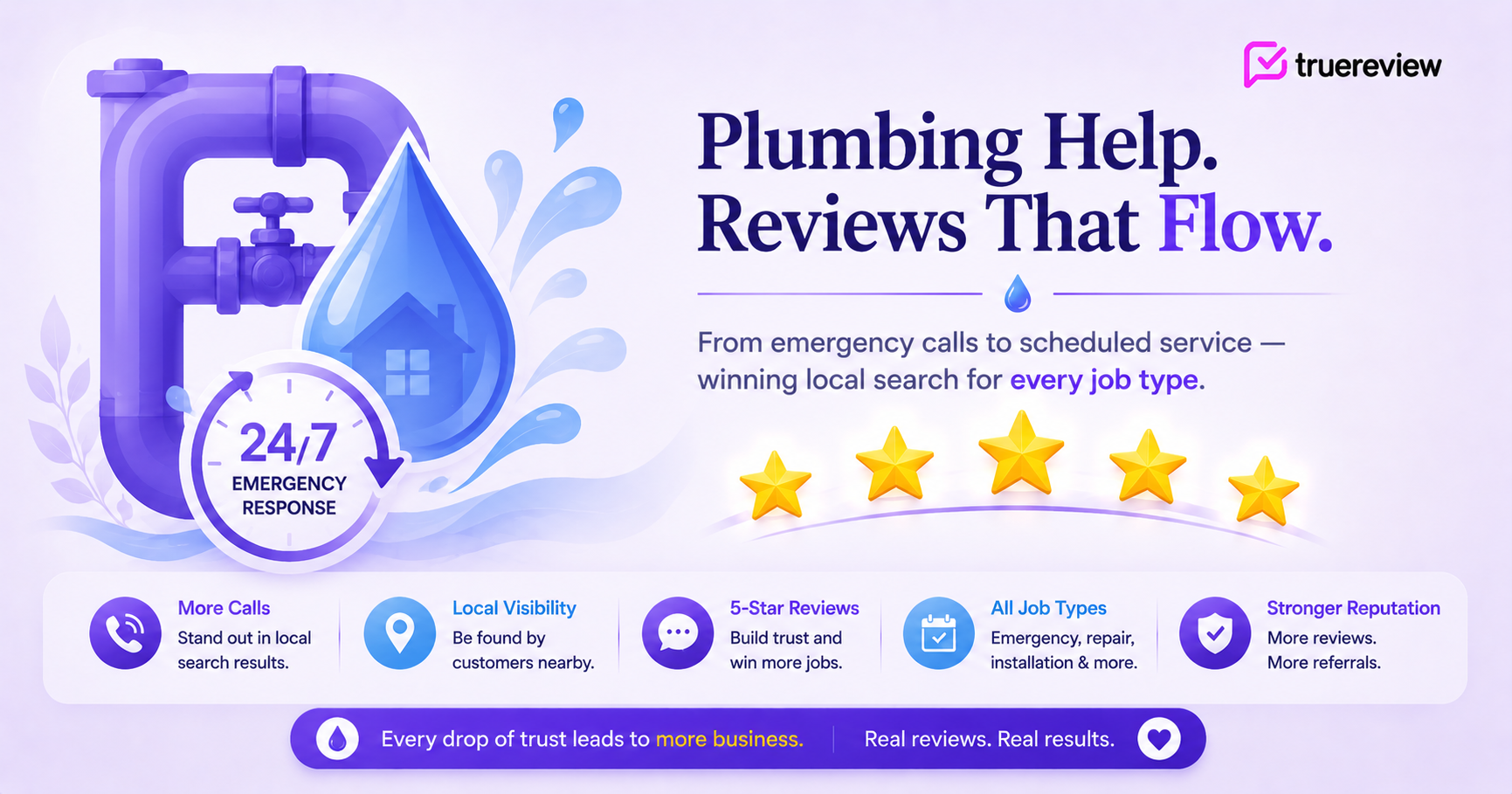
A homeowner with sewage backing up into their basement at 11pm doesn't shop carefully. They Google "plumber near me" or "emergency plumber [city]," they look at the local 3-pack, they read the most recent reviews of the top results, and they call within 60-180 seconds of typing the query. The decision is mostly made before they've spoken to anyone. The plumber that wins this 3-minute decision wins the call — and at after-hours emergency rates, that single call is often worth $400-$1,500 in revenue.
This is the mathematics of plumbing: the search intent is unusually high (genuinely emergency situations with active water damage), the decision window is unusually short (minutes, not hours or days), and the local 3-pack on Google is unusually decisive (almost no other home services category is as 3-pack-dominant as plumbing for emergency searches). Reviews are the primary mechanism that determines who wins the 3-pack. Companies with hundreds of recent reviews dominate; companies with thin or stale review profiles lose every emergency search to better-reviewed competitors, even when their service quality is identical.
The companies that have figured out systematic review collection — calibrated to plumbing's emergency-heavy work mix, the 24/7 dispatch realities, and the distinctive customer trust dynamics in this trade — end up with profiles that capture the high-margin emergency call volume that makes plumbing a profitable business. The companies that haven't tend to depend on lead-generator platforms (HomeAdvisor, Angi, Thumbtack), paying $40-150 per lead while their better-reviewed competitors capture organic search traffic for free.
This guide is the practical playbook for residential and commercial plumbing companies, drain cleaning specialists, water heater specialists, and sewer line contractors: how Google's local search algorithm rewards review depth specifically in plumbing, when in the service workflow to ask, how to handle the emergency-vs-scheduled split, how to build the review pipeline that wins local 3-pack rankings, and how to wire the whole thing into ServiceTitan and other field service management platforms.
A broader companion post on plumbing marketing strategy (lead generation, branding, advertising) is available at our marketing ideas for plumbing companies guide. This post stays focused on Google review acquisition and the local search dynamics specific to plumbing.
Plumbing is one of the most local-search-dominant categories in home services. A few reasons this is true:
Emergency intent compresses the decision window. When someone Googles "plumber near me" at 2am with a flooded basement, they're not deliberating across multiple websites. They're looking at the 3-pack, scanning for a company with strong recent reviews, and calling. The geographic and review-driven ranking signals that determine 3-pack placement determine which plumber gets the call.
The geographic radius is tight. Most plumbing companies serve a 15-25 mile radius (limited by drive time and after-hours dispatch logistics). Local search rankings are highly geographic — a plumber 5 miles from the customer outranks one 20 miles away in the 3-pack, almost regardless of other signals. This means competitive markets are fragmented by neighborhood: dominating "plumber near me" in one part of a metro doesn't help you win the same search in another part.
Review signals are weighted heavily for service categories. Google's local algorithm uses three signal categories — relevance, distance, and prominence. For service categories like plumbing where customers can't easily evaluate quality before hiring, prominence (which includes review count and rating) carries disproportionate weight. The same review depth that produces a moderate ranking improvement in retail can produce a substantial 3-pack ranking improvement in plumbing.
The combined effect: plumbing companies in the top 10% of Google reviews in their service area typically capture 5-7x the inbound emergency call volume of companies in the bottom 50%. The gap is wider in plumbing than in many trades because the search-driven decision is so concentrated and the local 3-pack is so dominant.
A few specific mechanics worth understanding:
Review count is a direct ranking signal. A plumber with 380 reviews consistently outranks a plumber with 38 reviews in the 3-pack, all else equal. The threshold of competitive review count varies by metro — 50-100 reviews is enough to compete in smaller markets; major metros require 200-500+ for top 3-pack placement.
Review velocity matters as much as review count. A plumber with 400 reviews accumulated over 8 years performs differently in current search than a plumber with 400 reviews accumulated over 18 months. Recent velocity signals current operational quality.
Review keyword content drives long-tail visibility. Reviews that mention "drain cleaning," "water heater installation," "slab leak," "sewer line replacement," and other specific services help your company surface for searches matching those terms. A plumber whose reviews disproportionately mention water heaters will rank better for "water heater installation [city]" than a plumber with the same total review count but generic reviews.
Geographic mentions in reviews reinforce service area signals. Reviews mentioning specific neighborhoods, suburbs, or zip codes ("they came out to our house in [neighborhood]") help reinforce your geographic relevance for searches in those areas.
Response activity is a positive signal. Plumbing companies that respond to every review within 24-48 hours rank better than equivalent companies that don't. Response activity is also a signal customers see when scanning your profile.
Photo activity in reviews compounds the SEO benefit. Reviews with photos (before/after of the work, the technician on site, the finished install) carry more visibility weight than text-only reviews.
The practical implication: a plumbing company that builds 80-150 reviews per year, with content that naturally describes specific services and neighborhoods served, with consistent response activity and occasional photo content, will systematically outrank competitors with similar service quality but thinner or slower-velocity review profiles. Local search wins are won at the review pipeline level.
Plumbing has multiple distinct service types, each with its own optimal review-ask window.
Emergency service calls (burst pipes, sewer backups, no water, no hot water, slab leaks, frozen pipe bursts). Wait 24-48 hours after the call. The customer was stressed when the technician arrived, relieved when the water was off and the situation was contained, and now needs time to settle before writing a thoughtful review. Reviews from this window tend to mention response time, technician professionalism, and the relief of having the problem solved fast — exactly what other emergency-prospect customers are searching for.
Scheduled service calls (fixture replacement, faucet repair, basic drain issues, water filter installation). Same-day or next-morning works. The customer wasn't stressed, the visit was completed cleanly, and asking soon while the experience is fresh produces good reviews. These reviews tend to be shorter than emergency reviews but more numerous because scheduled service volume is high.
Water heater installations (tank replacements, tankless installations). Wait 5-7 days after install completion. The customer needs to live with the new water heater — confirm hot water is consistent, check for leaks, evaluate energy efficiency. Tankless installations especially benefit from longer windows because customers want to confirm the recirc system, the gas line capacity, and the install quality before reviewing.
Repipes (whole-house repipe with PEX or copper). Multi-day major project. Wait 5-7 days after completion for cosmetic fixes (wall patching, paint touch-up if included) to be done and the customer to live with the new plumbing through normal use cycles.
Sewer line repairs (trenchless, traditional excavation, sewer line replacement). High-stakes major project, often with substantial yard or driveway disruption. Wait 1-2 weeks for site restoration to be complete and the customer to confirm the new line is functioning under various flow conditions.
Drain cleaning (residential). Same-day or next-morning works. Routine service, fast resolution.
Commercial plumbing service. Wait 24-48 hours after work completion. Commercial reviews tend to focus on schedule reliability, technician competence, and minimal disruption to operations.
Backflow testing (commercial and some residential). Annual or semi-annual recurring service. Use the recurring touchpoint as a periodic review-request opportunity.
Never during diagnostic uncertainty. When the technician left because additional parts were needed, the diagnosis is still unclear, or the issue requires return visits, don't ask. Wait until the issue is fully resolved.
Never after callback or rework. If the customer brought you back for an issue from a previous visit, skip them from the automated request batch entirely until the second-time fix has proven durable.
Never on the day of a major equipment failure with substantial financial impact. When a customer learns their water heater needs replacement, their sewer line is collapsed, or their slab leak requires major work, they're often processing an unexpected major expense. Wait until the work is complete and they've adjusted to the situation.
Emergency plumbing has unusually favorable economics. After-hours rates are typically 1.5-2x daytime rates. The customer is in active distress and price-shopping is minimal. The job is often urgent enough that the customer is willing to wait for a quality plumber rather than calling whoever can come fastest. Reviews shape who gets these calls.
A few practical implications:
Reviews mentioning emergency response specifically are unusually high-leverage. A review that says "they got here in 90 minutes at midnight on a Sunday and stopped the flooding" converts other emergency-prospect customers at extraordinary rates. These reviews are the primary content that captures emergency search traffic.
The "they didn't gouge me on the holiday rate" review is gold. Plumbing has a deserved reputation for emergency rate gouging — customers in panic situations are vulnerable to overcharging. Reviews that explicitly note fair pricing during emergencies counter this perception powerfully.
Encourage emergency-context specifics in your verbal asks. A technician finishing an emergency call can mention reviews more authentically than the office can: "If you have a minute when you get the text from us in a couple days, mentioning that we got here fast and didn't gouge you on the after-hours rate would help other people in the same situation find us."
Avoid coaching specific outcomes in templates. "If you could mention how fast we responded..." crosses into review manipulation. Instead, the verbal mention naturally invites the customer to share what they actually experienced — which, if you genuinely responded fast and didn't gouge, will be exactly what converts other prospects.
The strategic mindset: emergency plumbing is where reviews matter most, where the financial impact is highest, and where systematic review collection produces the most leveraged returns. A company that captures one extra emergency review per week ends up with a noticeable 3-pack ranking advantage within 12 months — and those rankings translate directly into emergency call volume that competitors don't capture.
Plumbing isn't one industry. The right approach varies by operation type.
Residential service-and-repair (the largest segment). Mixed mix of emergency calls, scheduled service, water heater work, drain cleaning, and occasional bigger jobs. The full review-collection toolkit applies — different templates for different service types, technician-attributed reviews, year-round velocity discipline.
Drain cleaning specialists. Sub-segment focused on drain and sewer cleaning — Roto-Rooter franchises, drain-focused independents, hydro-jetting specialists. Reviews tend to focus on speed and effectiveness of drain resolution. Standard timing applies, with same-day or next-morning ask for most work.
Water heater specialists. Some plumbing companies focus heavily on water heater work. Reviews tend to mention specific water heater brands, tankless installation quality, and energy efficiency outcomes. Wait 5-7 days for the customer to evaluate the new system.
Sewer line specialists. Trenchless sewer repair, pipe lining, sewer line replacement. High-ticket projects with substantial customer anxiety. Reviews from successful jobs are extraordinarily powerful — these are major investments, and prospects researching this work read reviews carefully. Wait 1-2 weeks after completion.
Commercial plumbing. Different customer (facilities managers, property managers, building owners), different review dynamics. B2B-focused reviews often appear on industry-specific platforms alongside Google. Reviews from major commercial customers carry weight but volume is lower.
Multi-family and property management plumbing. Routine service for apartment buildings, condos, HOA-managed properties. Reviews can come from individual unit residents (after specific service), from property managers (after major projects), or from HOA boards. Different review dynamics for each.
New construction plumbing. B2B work with general contractors and homebuilders. Reviews go to the builder's side rather than driving direct consumer demand. Companies focused on new construction have less consumer-facing review program need.
Multi-location plumbing operations. Each location typically has its own GBP and its own service area. Reviews need per-location attribution. The multi-location framework from the post on multi-office insurance agencies applies operationally.
Franchise operations (Roto-Rooter, Mr. Rooter, Benjamin Franklin Plumbing). Operate under specific corporate brand standards. Coordinate with franchisor's marketing requirements. Some franchisors provide review tools; leverage what's available.
The standard rules apply: short, personal, with a direct review link. A few plumbing-specific templates:
Post-emergency-call (24-48 hours after):
Hi {First Name}, hope everything's back to normal now. If you have a moment, a Google review of {Company Name} would mean a lot — it helps other people in {City} find us when they need help fast: {Review Link}
Post-scheduled-service:
Hi {First Name}, thanks for choosing {Company Name} today. If you have a minute, a Google review would help: {Review Link}
Post-water-heater-install (5-7 days after):
Hi {First Name}, hope the new water heater is working great! If you have a few minutes, a Google review of {Company Name} would mean a lot: {Review Link}
Post-sewer-line-work (1-2 weeks after):
Hi {First Name}, hope everything's settled and the new sewer line is working perfectly. If you have a moment, a Google review of {Company Name} would help others considering similar work: {Review Link}
The reminder (5-7 days after first request):
Hi {First Name}, just a quick reminder — if you have a minute, we'd really appreciate a Google review for {Company Name}: {Review Link}. Thanks again!
Subject line options:
Email body (post-service):
Hi {First Name},
Thanks again for calling {Company Name}. We hope everything's back to normal and you're not dealing with any new issues.
If you have a few minutes, would you mind leaving us a Google review? Honest feedback from customers like you is how other people in {City} find a plumber they can trust — especially when they need help in an emergency.
[Leave a Google Review →]
Thanks so much,{Your Name}{Company Name}
The "especially when they need help in an emergency" framing is doing real work — it nudges customers to write reviews that speak to the emergency-response context that captures emergency search traffic.
Verbal asks work particularly well in plumbing because the technician and the customer have just spent 30-90 minutes together (often more for emergency calls), often in conversation about the customer's home and water system. The natural moment of saying goodbye at the end of the visit is the right time for the review mention.
A standard script that works at emergency-call completion:
"All set — water's back on and you're good. Hey, before I head out — quick favor. We live and die by Google reviews in this business, especially with all the lead-generator companies trying to compete with us. If you've been happy with how we handled this, would you mind leaving us a Google review? I'll have the office text you the link in a couple hours. Even a sentence or two would help — your review is how the next family in your situation finds us when their basement's flooding at midnight."
For scheduled service calls, the script shifts slightly:
"All set — should be good for a long time. Hey, before I head out — if you've been happy with how this went, we'd really appreciate a Google review whenever you get the link from us. Word of mouth and Google reviews are honestly how we keep growing. The office will text you the link in a couple hours."
For water heater installations and bigger projects, the verbal ask happens at the punch-list completion (the final walkthrough at the end). The script shifts again:
"Looks great — should give you 12-15 years of reliable hot water. Hey, before we wrap up — if you're happy with how the install went, we'd really appreciate a Google review in the next week or two once you've used the system. The office will text you the link. Even a few sentences about how the team did would help."
The emergency-context framing in the first script invokes the future-prospect dynamic that produces story-rich reviews. The customer was just in an emergency; reminding them of that context — and asking them to help the next family in the same situation — gives them a real reason to write a review that converts other emergency prospects.
Train every technician on the same brief script. Plumbing tech turnover is common; consistency requires repeated training as new techs come on board. The companies that maintain strong review velocity year over year are the ones that bake the verbal ask into onboarding and reinforce it at regular team meetings.
Most residential plumbing companies in 2026 use ServiceTitan as their primary field service management platform. Other common options include Housecall Pro, Jobber, FieldEdge, Service Fusion, FieldPulse, and Workiz. Some larger operations use enterprise tools like Sera or proprietary systems integrated with their dispatch and accounting software.
For ServiceTitan specifically: ServiceTitan has direct integration with TrueReview, plus broad ecosystem support through their App Marketplace. The standard setup pattern: when a job is marked complete in ServiceTitan, the integration passes the customer's contact info plus job-type information to TrueReview, which routes the review request to the appropriate workflow (emergency vs. scheduled vs. install) with the configured delay.
ServiceTitan-specific configuration recommendations:
For other platforms: TrueReview connects via direct integration with Jobber and Housecall Pro, and via Zapier with FieldEdge, Service Fusion, FieldPulse, Workiz, and most other plumbing FSM platforms. The same workflow patterns apply.
For larger plumbing operations with custom systems: Direct API integration provides flexibility for complex routing logic by job type, technician, customer relationship status, and service area. Most operations doing 100+ jobs per day benefit from this.
The trigger that matters: pick the operational signal that means the job is genuinely complete from the customer's perspective. For service calls, "job complete" or "invoice closed" works once payment has been processed. For installations, "install complete with customer signoff" — the punch-list-cleared moment — is the right trigger. For sewer line and major projects, configure the delay to wait until site restoration is complete.
Configure separate workflows for different job types:
The configuration discipline is what produces high review velocity without misfires.
For multi-technician operations, configure per-technician attribution. ServiceTitan and most major platforms support this natively.
Plumbing companies benefit substantially from embedded reviews because emergency-prospect customers are evaluating multiple options quickly while in active distress. A homeowner with a flooding basement who lands on your website should see specific recent reviews that address what they care about — fast response, professional technicians, fair pricing, problem solved on first visit.
A few specifics:
Filter for reviews mentioning emergency response and after-hours service. Reviews like "they got here in 45 minutes at 11pm" are particularly powerful for emergency-prospect customers.
Display reviews mentioning specific technicians by name. Reviews that name technicians provide social proof and reinforce the trust relationship.
Date-stamp reviews visibly. Recent reviews matter heavily in plumbing because companies' service quality can shift with staffing changes, ownership changes, or training quality. A customer wants to see that the company is producing positive reviews this month, not just five years ago.
Surface reviews mentioning specific services. Water heater, sewer line, drain cleaning, slab leak — reviews mentioning specific services help prospects with those specific needs identify your company as the right call.
Show response activity. Embedded review widgets that include your responses to reviews demonstrate engagement and signal an active, attentive company.
For 24/7 emergency operations: surface reviews mentioning after-hours response. This is the specific content that captures emergency-prospect search traffic.
TrueReview's review widget supports filtering, source attribution, date display, response visibility, and per-technician organization, which makes the plumbing embed setup straightforward.
Plumbing generates a few specific types of negative review more than other home services categories: pricing complaints (the bill was higher than expected, especially for emergency or after-hours work), recommended-replacement vs. repair disputes (customer felt pushed toward a bigger fix when a smaller one would have worked), upselling complaints (technician tried to sell additional work the customer didn't think was needed), and post-service issues (something stopped working again, the fix didn't hold, water damage was discovered later).
A few principles:
Don't argue specific technical details publicly. A response that explains "Actually, your old water heater was beyond repair based on the technician's diagnostic" reads defensively. Even when factually correct, the response shifts the conversation into a public debate about technical judgment.
Don't argue pricing publicly. Pricing complaints in plumbing — especially for emergency and after-hours work — often involve customers who didn't fully understand the rate structure. Public response that explains the pricing reads as defensive and reinforces the "plumbers gouge customers" narrative that hurts the broader trade. Move it offline.
Don't argue replacement vs. repair recommendations publicly. This is one of the most contested dynamics in plumbing — homeowners who feel pushed toward replacement when they wanted to repair. Public response explaining the technician's reasoning compounds the dispute.
Don't argue alleged property damage publicly. This is a legal issue. Any public statement about whether your work caused water damage, sewer issues, or other property problems creates legal exposure. Move it offline immediately, ideally to your insurance carrier.
Reference your warranty and complaint resolution policies. Plumbing companies that prominently note their workmanship warranty and customer satisfaction policies in negative review responses signal accountability without admitting fault.
Move it offline. Provide a phone number — typically the operations manager or owner.
A safe response template for plumbing negative reviews:
Thank you for sharing your feedback, {Name}. We stand behind our work with our {warranty period} workmanship warranty and want to make sure your experience is reviewed properly. Please call our office at {phone number} so we can discuss your specific situation directly.
For positive reviews, keep responses warm:
Thanks so much, {Name}! We appreciate you taking the time to leave a review.
For positive reviews mentioning specific technicians:
Thanks so much, {Name}! We'll pass the kind words along to {Tech Name} — she'll be glad to hear it. We appreciate you taking the time to share your experience.
(Acknowledging the technician specifically reinforces the technician-as-trust-driver dynamic and encourages other reviewers to mention their technicians.)
A few practices that show up in plumbing review marketing but should be avoided:
Asking customers immediately after a major repair shock. Customers who learned their slab leak required $8,000 of repair, or that their sewer line needed replacement, are processing financial impact. Wait until the work is complete and they've adjusted.
Asking customers after callbacks or rework. Even when the second-time fix is clean, the experience is permanently affected.
Asking customers in the middle of warranty disputes. Whether the warranty claim ultimately resolves favorably or not, the experience affects the review.
Coaching customers on what to mention. "If you could mention how fast we got there..." crosses into review manipulation that violates Google policies.
Filtering by job size to bias your review base. Asking only customers whose tickets exceeded $X biases your review base toward higher-revenue customer segments.
Tying technician compensation directly to received star ratings. Compensation tied to asking (which the technician controls) is fine; compensation tied to receiving 5-star ratings (which depends on factors outside the technician's control) incentivizes review manipulation.
Asking customers from lead-generator platforms (HomeAdvisor, Angi, Thumbtack) for the same review the platform requested. Some platforms have their own review systems, and customers who left a review on those platforms shouldn't be asked again for Google.
Buying reviews. Plumbing is one of the categories Google watches for review fraud, partly because of the documented history of review manipulation in the broader home services space. The risk-reward math is terrible.
Letting one bad review go unanswered. Especially in emergency-prospect categories, where customers are scrutinizing your profile under stress, an unanswered negative review reads as either avoidance or absence.
A plumbing company running a well-built Google review program has all of these in place:
Companies that get all of this right typically dominate the local 3-pack on Google for "plumber near me," "emergency plumber [city]," "drain cleaning [city]," and similar searches within 12-18 months. The compounding effect on inbound calls — especially the high-margin emergency calls — shows up in months 4-6 and continues to grow.
Companies that don't get it right tend to keep paying for HomeAdvisor, Angi, and Local Service Ad leads at $40-150 each while their better-reviewed competitors capture organic search traffic for free.
The 3-pack dynamics and after-job trigger approach here apply across the home-service trades. For the broader cross-trade version, if you want the full playbook, read our guide on how to get google reviews for home service businesses.
Recurring-visit trades run on a slightly different rhythm worth tailoring for — for more tactics, see pool service companies get more google reviews. And cleaning companies face the same in-home trust dynamic that makes reviews decisive — related: our complete guide on cleaning services get more google reviews.
Ready to systematize Google reviews at your plumbing company? Start your free 14-day trial of TrueReview — direct integration with ServiceTitan, Jobber, and Housecall Pro, plus Zapier connections to most other plumbing field service management platforms; automated SMS and email workflows with separate timing for emergency, scheduled, and installation jobs; per-technician dashboards for multi-tech operations; embeddable review widgets that filter by job type and surface emergency-response reviews; and TCPA-compliant SMS infrastructure with 10DLC registration handled for you. No setup fees, no contracts.