BLOG POST
The contractor who finishes the job and walks off the site has just had the most concentrated burst of customer goodwill they're going to get all year — and most of them waste it.
Within an hour of project completion, the homeowner is standing in their newly renovated kitchen, looking at the work, feeling the relief of a long project being done, and they're more inclined to say something nice about you than they will be at any other point in your relationship. By tomorrow morning, the kids are running through the house, the dog is tracking dust everywhere, and the magic is already fading. By next week, you're a faint memory.
This is why "after every job" is the right frame for contractor review collection. It's not a strategy question — it's a timing question. The contractors generating 30-50+ Google reviews a month aren't asking better than their competitors. They're asking sooner, more consistently, and automatically.
This guide covers exactly how to set that up: the right moment to ask, what to say, how to handle the field-team logistics, and how to wire the whole thing into the CRM you're already using so it runs without you thinking about it.
Contractor work has three characteristics that make Google reviews unusually decisive in driving new business:
It's high-trust, high-dollar. Homeowners don't hire a $40,000 kitchen remodel from a contractor with 12 reviews when there's another contractor down the street with 280 reviews and a 4.9-star average. The dollar amount and the level of access (you're going to be in their home for weeks) raises the trust bar high enough that reviews become the primary way it gets cleared.
It's a one-time decision they research heavily. Unlike a recurring service, homeowners hire a contractor maybe once every 5-10 years for a major project. They have time to research. They will read 20+ reviews before calling. They will sort by lowest rating to see what people complained about. The depth of their research means review quantity matters as much as average rating.
It's geographically local and competitive. Almost every contractor competes with 5-15 others in the same metro area for the same jobs. The local 3-pack on Google search is where most leads come from, and review signals are one of Google's main inputs to who shows up there. More reviews = more local search visibility = more leads, in a fairly direct line.
The implication: contractors operating at 25-40 reviews are losing leads daily to contractors operating at 200+. The gap closes through systematic asking, not better marketing.
The single most important variable in contractor review response rates is timing relative to job completion.
The data is consistent across home services categories: review requests sent within 1-2 hours of the job being marked complete in the CRM convert at roughly 2-3x the rate of requests sent the next day, and 4-5x the rate of requests sent a week later. The reason is simple — that 1-2 hour window catches the customer when they're inspecting the finished work, feeling the relief of completion, and most likely to spend a minute writing a review while it's all still fresh.
This timing creates a small operational challenge for contractors that most other industries don't have: the moment of "completion" isn't always crisp. Was the job done when the crew packed up? When the final inspection passed? When the punch list was cleared? When the invoice was paid?
The right answer for review purposes is usually the moment your crew lead or PM marks the job as "complete" in the field service software. That's the operational signal that the customer-facing work is finished, even if the paperwork lags behind. Triggering review requests off that signal — rather than off invoice payment, which can be days or weeks later — captures the timing advantage cleanly.
Different jobs have different completion arcs. The optimal review-ask timing varies accordingly.
Same-day service calls (plumbing, electrical, HVAC). Ask within 1-2 hours of crew departure. The work is fresh, the homeowner just got back hot water or heat, and the relief is real. Same-day service has the highest review conversion of any contractor segment if the timing is right.
Multi-day jobs (smaller remodels, deck builds, roof replacements). Ask the evening of the final day, or first thing the next morning. The customer needs a few hours to walk through the finished space and form an opinion before they can write a meaningful review.
Multi-week renovations (kitchens, bathrooms, additions). Wait 24-48 hours after the punch list is cleared. Customers want time to use the new space — cook a meal in the kitchen, take a shower in the new bathroom — before reviewing. Reviews from this segment tend to be longer, more detailed, and more useful for converting future prospects, so the wait pays off.
Emergency calls (water damage, roof leaks, after-hours plumbing). Ask 1-2 days later, not immediately. Customers in emergency situations are stressed when you arrive and relieved when you leave, but they're often emotionally tapped. Wait until things are calm.
Recurring services (lawn care, pool service, pest control, HVAC maintenance). Ask after the third or fourth visit, not the first. New customers don't yet have enough basis for a meaningful review, but established customers can speak to consistency and reliability — which is what other prospects want to hear.
Warranty callbacks. Don't ask after warranty work. Even if the callback was handled well, asking for a review at that moment risks a negative review about the original problem. Skip these from the review pipeline entirely.
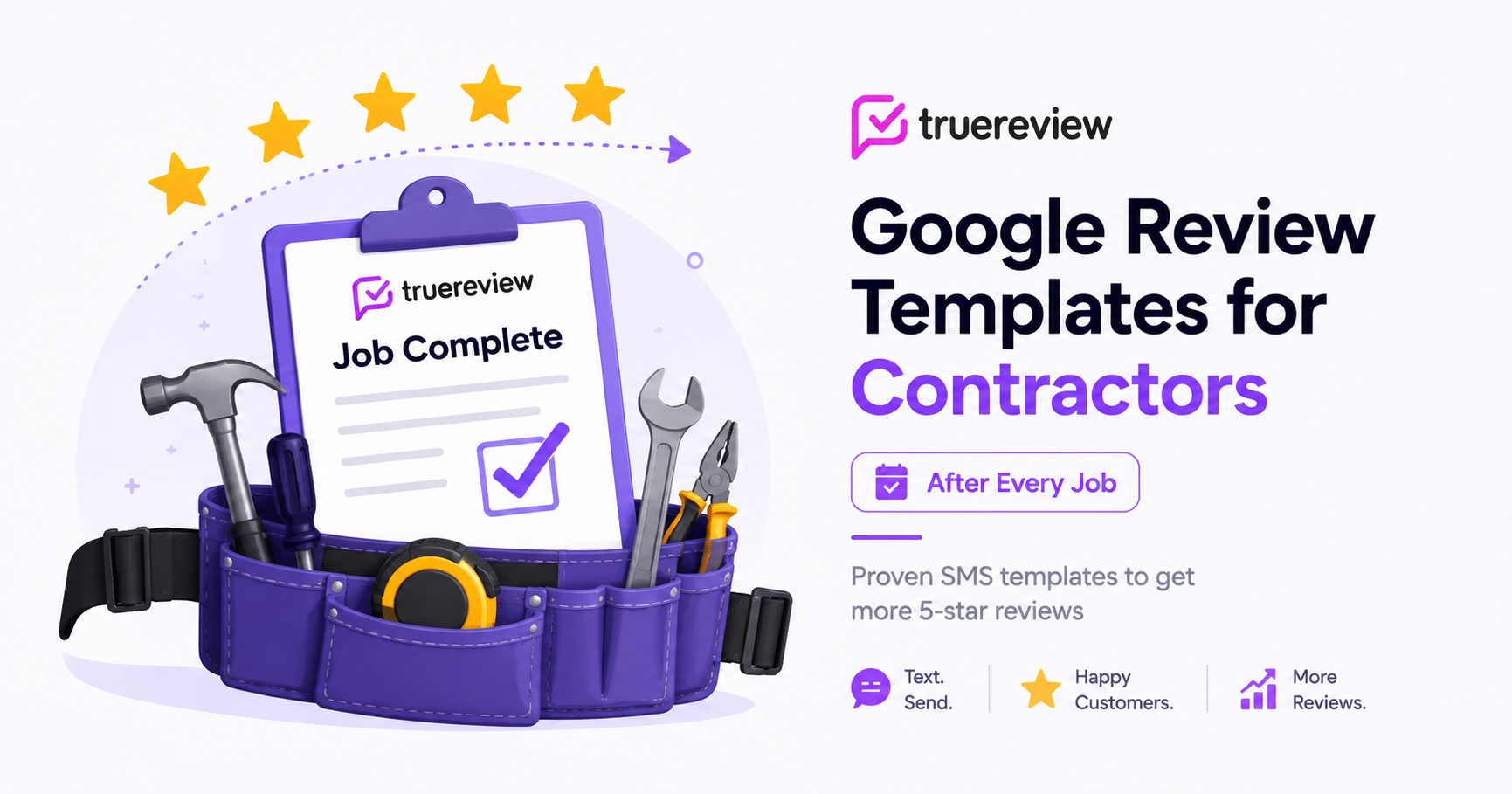
The standard rules apply: short, personal, with a direct review link and one clear ask. Contractor-specific templates that work well:
The post-job standard:
Hi {First Name}, thanks for choosing {Business Name} for your project! If you have a moment, we'd really appreciate a Google review: {Review Link}
The crew-lead personal touch:
Hi {First Name}, this is {Crew Lead Name} from {Business Name}. Thanks for trusting us with the work — it was a pleasure. If you have a minute, a Google review would help us a ton: {Review Link}
The hometown angle (very effective for local contractors):
Hi {First Name}, thanks again for the work today. Word of mouth is honestly how we get most of our jobs in {City} — if you have a minute, a Google review would help: {Review Link}
The reminder (3-5 days later):
Hi {First Name}, just a quick reminder — if you have a minute, we'd really appreciate a Google review: {Review Link}. No pressure if you're busy!
Subject line options:
Email body (post-job):
Hi {First Name},
Thanks again for choosing {Business Name} for your project. It was a pleasure working with you.
If you have a minute, would you mind leaving us a Google review? Word of mouth is how we grow, and reviews from customers like you help other homeowners in {City} find a contractor they can trust.
[Leave a Google Review →]
Thanks so much,{Your Name}{Business Name}
Email body (multi-week project):
Hi {First Name},
Hope you're enjoying your new {kitchen / deck / roof / space}. It was a pleasure working with you on this project.
If everything turned out the way you hoped, would you consider leaving us a Google review? It takes about a minute and helps other homeowners in {City} find us when they're looking for a contractor they can trust.
[Leave a Google Review →]
Best,{Your Name}
The personalization that matters is the project type ("your new kitchen") because it gives the customer a concrete prompt to write about. The personalization that doesn't matter is the date or job number — those don't help and clutter the message.
Most contractors hit the same wall when they try to scale review collection: the field team forgets to ask, or asks inconsistently. The fix isn't training (it helps but doesn't stick); it's automation tied to the operational flow the crew is already doing.
Three patterns that work:
The cleanest setup. When the crew lead marks the job complete in Jobber, Housecall Pro, ServiceTitan, simPRO, or whatever field service software the crew uses, that action triggers the review request automatically — no extra step for the crew.
This requires the field service software to be connected to a review request tool. TrueReview has direct integrations with Jobber, Housecall Pro, ServiceTitan, and simPRO (and via Zapier with most others), so the connection is a one-time setup. After that, every "job complete" action fires off a review request to that customer 1-2 hours later.
The reason this pattern wins: the crew is already marking jobs complete because billing and dispatch depend on it. They don't have to remember a new step. The review request is a side effect of work they're doing anyway.
For contractors whose crews don't use field service software (still common in smaller operations), train crew leads to make a verbal ask at the end of the job: "If you were happy with the work today, we'd really appreciate a Google review — the office is going to text you the link in a bit." Then the office sends the SMS within 1-2 hours.
The verbal ask plus the digital follow-up consistently beats either approach alone. Customers who got the verbal heads-up are 2-3x more likely to act on the SMS when it arrives.
For multi-week renovations where there's a clear PM-to-customer relationship, the PM can send the review request personally as part of the project close-out. This works well for higher-end remodelers because the personal note from the PM the customer worked with feels appropriate to the job size.
The trade-off: it doesn't scale. A PM running 8-12 simultaneous projects will forget. For higher-volume contractors, Pattern 1 is the only sustainable approach.
Most contractors are already using a field service platform. The work to set up automated review requests is mostly about connecting that platform to the review tool — a one-time setup, usually under an hour.
Jobber. Direct integration available. The typical setup triggers a review request when a job is marked "complete" or when a job is "closed and paid." Most contractors prefer the "complete" trigger for timing reasons (paid sometimes lags by days or weeks).
Housecall Pro. Direct integration available. Triggers off job completion or invoice paid. For same-day service work, completion is almost always the right trigger.
ServiceTitan. Direct integration available. ServiceTitan's workflow is more complex than Jobber/Housecall Pro because of how dispatching and invoicing are separated, so the trigger setup deserves a few extra minutes — typically you want it firing off the "job completed" event from the technician's mobile app, not off the invoice.
simPRO. Direct integration available. Job completion is the standard trigger.
Other field service software (FieldEdge, ServiceFusion, BuilderTrend, JobNimbus, etc.). Most of these connect via Zapier. The setup takes a few extra steps but the result is the same: when a job moves into the "complete" status, a review request fires off 1-2 hours later.
Whichever tool you're on, the setup principle is the same: pick the operational signal that means "the customer's work is done," and make that the trigger. Avoid triggering off invoicing or payment, which lag behind the customer's actual experience.
Contractor work is detail-heavy, and even good contractors get the occasional negative review. The way you respond matters more than the review itself — prospective customers reading your Google profile are watching how you handle conflict, not just how often you nail the work.
A few principles that work specifically for contractors:
Respond within 24-48 hours. Faster is better, but don't respond in the heat of the moment. Take a few hours to cool down before writing.
Acknowledge the customer's experience without admitting fault publicly. "We're sorry your experience didn't meet expectations" is fine. "We're sorry we damaged your floor" is a public admission that can affect insurance claims and future legal exposure.
Move the conversation offline. Provide a phone number and ask them to call — most customers won't, but the act of offering reads well to prospects scanning the response.
Reference your warranty and follow-up commitment. Contractors who explicitly note their warranty terms or follow-up policies in negative review responses signal to readers that the business takes accountability seriously.
A safe response template for contractor negative reviews:
Thank you for sharing your feedback, {Name}. We're sorry your experience didn't meet expectations. We stand behind our work with a {warranty period} warranty, and we'd like the opportunity to make this right. Please call our office at {phone number} and ask for {Owner / GM} so we can discuss your concerns directly.
This response acknowledges the issue, signals accountability, references a concrete warranty commitment, and provides a path forward — without admitting any specific fault.
Several contractor-specific channels that work well alongside automated SMS/email:
Yard signs with QR codes. A small "Project by {Business Name}" yard sign with a QR code linking to your Google review page during the project (and for a week or two after) generates passive review requests from neighbors who are watching the work happen. Particularly effective for visible exterior projects — roofs, driveways, decks, landscaping, exterior paint.
Truck wrap CTAs. Add a small "Find us on Google" or QR code element to truck wraps and trailer graphics. Won't generate huge volume, but every drive-by view is essentially free brand impression that occasionally converts to a review or a lead.
Project completion thank-you cards. A printed card handed to the customer at job completion with a QR code linking to your review page. Lower-tech than a text but surprisingly effective — about 15-20% of customers who get a card act on it within a week.
HomeAdvisor and Angi mirroring. If you also collect reviews on HomeAdvisor and Angi (very common for contractors), embed those reviews on your website alongside Google reviews. TrueReview supports widgets for both platforms, plus Google and Facebook, so prospects see your full reputation in one place rather than having to hunt across platforms.
A few practices that show up in contractor review marketing but should be avoided:
Asking customers in the heat of a punch list. If there's still trim to fix or a faucet that's dripping, asking for a review is asking to get a 3-star "would have been 5 stars but...". Wait until the punch list is done.
Incentivizing reviews. Google's policies prohibit it. Promising a discount on the next service in exchange for a review can get your Google Business Profile suspended.
Asking the same customer multiple times. One initial request plus one reminder is the maximum. Beyond that you're a nuisance, and contractors who pester customers tend to generate more 1-star reviews than 5-star ones.
Ignoring negative reviews. A pattern of unresponded-to negative reviews looks worse than the reviews themselves. Even a generic "please call our office" response is dramatically better than silence.
Buying reviews. Google's algorithms catch this, and contractor work is heavily watched because it's a category with a documented history of fraudulent review schemes. The risk-reward math is terrible.
A contractor running a well-built Google review program has all of these in place:
Contractors that get all of this right typically go from 5-10 reviews a year to 30-50+ a month within 90 days. The compounding effect on local search rankings and lead flow shows up in the third or fourth month and keeps building.
Ready to set up automated review collection for your contracting business? Start your free 14-day trial of TrueReview — direct integrations with Jobber, Housecall Pro, ServiceTitan, and simPRO, plus Zapier for everything else, so review requests fire off automatically every time a crew marks a job complete. No setup fees, no contracts.
The after-job trigger approach carries over to nearly every recurring home-service trade — the timing just shifts with the visit rhythm. For seasonal outdoor work, related: our complete guide on lawn care and landscaping companies get more google reviews. For recurring maintenance visits, related: our complete guide on pool service companies get more google reviews.
Cleaning services face the same in-home trust dynamic that makes reviews decisive — if you want the full playbook, read cleaning services get more google reviews. And if you want to see the fully automated version wired into routing software, see also: pest control reviews on autopilot.