BLOG POST
There is no industry where customer trust is harder to earn than auto repair, and there is no industry where Google reviews matter more.
The default assumption most customers walk in with — fairly or not — is that they're about to be upsold, overcharged, or told they need work they don't actually need. That assumption is the single biggest obstacle to getting a new customer through the bay door, and it's exactly what your Google reviews exist to overcome. A shop with 280 reviews at 4.8 stars has, in effect, 280 customers vouching that you're not the stereotype. A shop with 22 reviews at 4.1 stars looks like exactly the place that customer was worried about.
The math is unforgiving: in most metro areas, the top three shops in the local 3-pack capture 60-70% of the search-driven new customer traffic. Everyone else fights over the rest. Climbing into that top three is almost entirely a function of review volume and rating — not website design, not paid ads, not coupons. Just reviews.
This guide is the practical playbook for getting there.
A note: this post focuses purely on review acquisition. For broader auto shop marketing topics — websites, ads, customer retention, repeat business — see our companion post on auto body shop marketing ideas.
Three characteristics of auto repair make reviews unusually decisive:
The trust deficit is structural. Customers don't know what's wrong with their car, can't verify the work was actually done, and can't tell good repairs from bad ones until something fails (or doesn't) months later. They're outsourcing a high-stakes decision to someone whose recommendations they can't independently evaluate. Reviews are how that gap gets bridged — strangers on Google who already paid the bill telling other strangers whether the shop was straight with them.
The decision is local and urgent. When someone's check engine light comes on, they're not researching for weeks. They're typing "auto repair near me" into Google in the parking lot of an AutoZone, and they're calling whichever shop in the local 3-pack has the most reviews and the highest rating. That decision is happening in 30-60 seconds. Your review profile is your sales pitch.
Customer lifetime value is high, and word-of-mouth compounds. A shop that earns trust with one customer often gets that customer's spouse, kids, neighbors, and coworkers over the next 5-10 years. Each great review isn't just one prospect convinced — it's the seed of a referral chain that runs for a decade. The compounding makes the investment in reviews particularly valuable in this category.
The implication for shop owners: a shop sitting at 60 reviews when the competitor down the street has 350 isn't 6x behind. They're losing 5-15 new customers a week who never even looked their way.
Auto repair has surprisingly clean ask-windows because the moment of completion is unambiguous: the customer is paying their bill at the counter or on the phone, and they're either relieved or annoyed. The window for capturing that emotion is short.
The highest-converting moments:
At the counter, when the customer is paying. This is the single best moment. The repair is done, the bill is settled, and the customer's emotion about the experience is at its peak — usually relief that the car is fixed, sometimes positive surprise that the bill came in lower than expected. Combine a verbal ask at the counter with an automated SMS that fires off 1-2 hours after the ticket is closed, and you'll capture roughly 2-3x the reviews of either approach alone.
1-2 hours after vehicle pickup. For customers who don't take possession at the shop (drop-off and pickup arrangements, after-hours pickups, customers who walk to a nearby coffee shop while the work is done), the ideal automated text is sent 1-2 hours after the work order is closed. By then they're driving the car, the brakes feel right, the AC is blowing cold, and they have concrete evidence the shop did its job.
Never on the same visit as a difficult conversation. If you had to deliver bad news — the repair turned out to be more expensive than estimated, a part was on backorder, the diagnosis took longer than expected, the customer was upset about the wait — don't ask that day. Even if you resolved it well, the request lands in a customer who's still got friction in their head about the experience. Wait a week. Better yet, flag those tickets out of the automated review pipeline entirely.
Within a few days of major work, not the same hour. For complex jobs — transmission rebuilds, engine work, major collision repair, full-system diagnostics — wait 24-48 hours before the request goes out. The customer needs time to drive the car, confirm the work held, and form an opinion. Asking too soon means you get a one-line "good service" review; asking after they've put a hundred miles on the car means you get a detailed, trust-building review.
Auto repair isn't one industry. The right ask-window varies a bit by sub-segment.
Independent general repair shops. Same-day or next-morning text after pickup. Most jobs close in a single visit, customer relationships are personal, and the timing rules above apply directly.
Dealership service departments. Same as independent shops, but with one wrinkle — dealership reviews often get tangled up with sales experiences ("I came in for an oil change but left with a pitch for a new car"). Train service advisors to ask only about the service experience, not the dealership overall, and time the request right after pickup before any sales follow-up.
Quick lube and oil change shops. The visit is fast (15-20 minutes) and the emotion is low-intensity. Ask immediately at the counter — verbal + a card with a QR code is more effective than SMS for this segment because the customer probably hasn't given you their phone number.
Tire shops. Customer just dropped a few hundred to a few thousand on tires they'll be staring at for the next 50,000 miles. Ask within 24-48 hours after they've driven on them. The reviews from this window tend to be detailed and specific (ride quality, road noise, the install experience).
Body shops. Wait until the customer has their car back and has had 1-2 days to inspect the work in good lighting. Body work is judged visually, and reviews from same-day pickup tend to be less useful than reviews from the customer who walked around the car in their driveway the next morning.
Transmission and specialty shops. Wait a week. The customer needs to drive the car to confirm the work held. Reviews from this segment, when timed right, are the highest-trust reviews you can get because they're explicitly testifying that the complex repair worked.
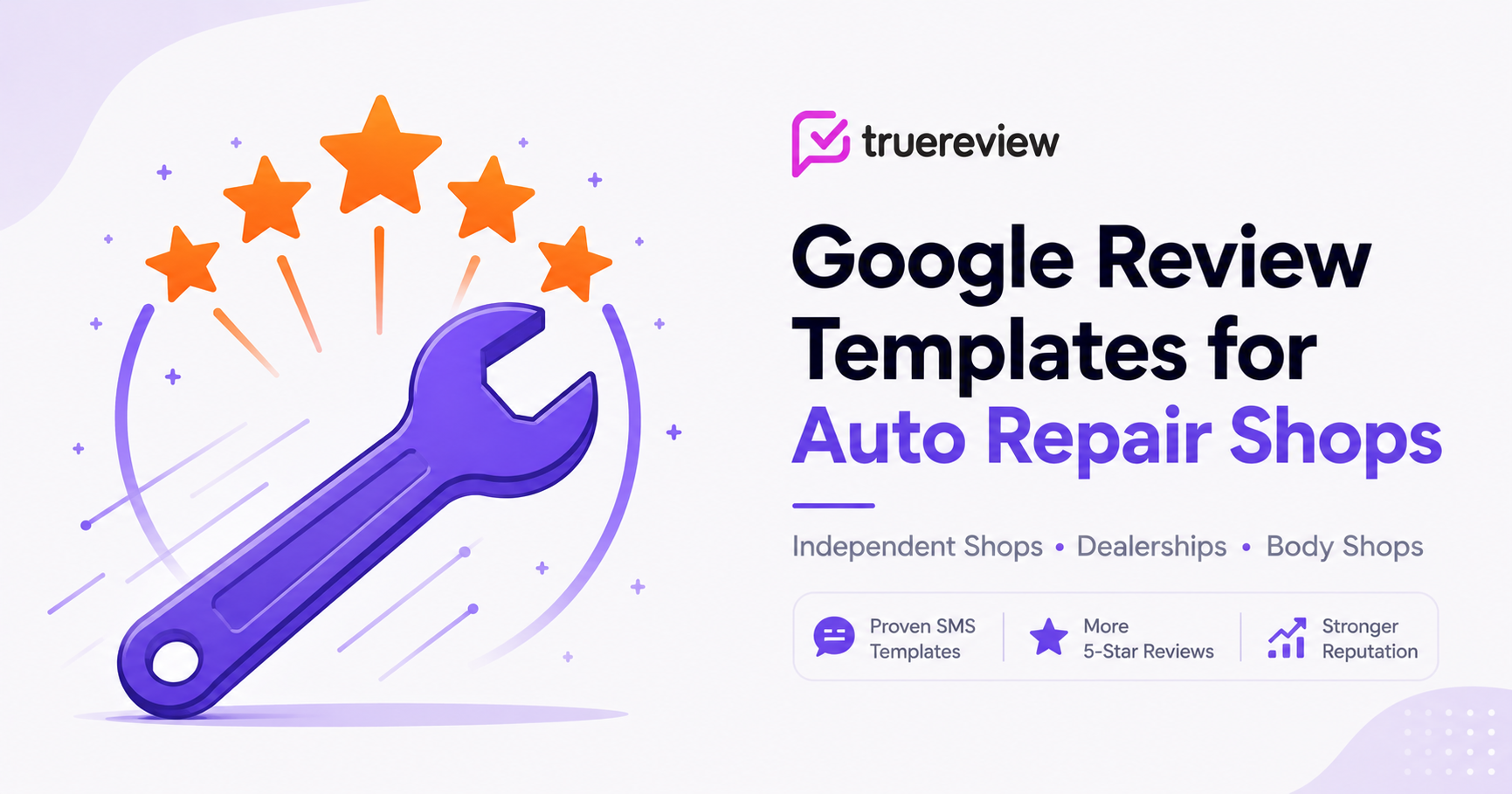
The standard rules apply: short, warm, with a direct review link. A few auto-specific templates:
The post-service standard:
Hi {First Name}, thanks for trusting {Shop Name} with your vehicle today. If you have a moment, we'd really appreciate a Google review: {Review Link}
The personal-touch version (works well for shops with strong service-advisor relationships):
Hi {First Name}, this is {Service Advisor Name} from {Shop Name}. Thanks again for coming in. If you have a minute, a Google review would help us a ton: {Review Link}
The hometown angle:
Hi {First Name}, thanks for choosing {Shop Name}! Word of mouth is honestly how we get most of our work in {City} — if you have a minute, a Google review would help: {Review Link}
The reminder (3-5 days later, only if no response):
Hi {First Name}, just a quick reminder — if you have a minute, we'd really appreciate a Google review of your visit to {Shop Name}: {Review Link}. Thanks again!
Subject line options:
Email body:
Hi {First Name},
Thanks again for choosing {Shop Name}. We know you've got options for auto repair in {City}, and we appreciate you trusting us with your vehicle.
If you have a minute, would you mind leaving us a Google review? Honest feedback from customers like you is how other drivers in {City} find a shop they can trust — and it's a huge help to us as a small business.
[Leave a Google Review →]
Thanks so much,{Service Advisor Name or Owner Name}{Shop Name}
The personalization that matters is using the customer's first name and the shop name. Don't reference the specific repair, the make/model of the vehicle, or the dollar amount — those don't add anything and can read as creepy ("Hey, we know exactly what you brought in and how much you paid").
Most shops underuse verbal asks. The math is striking: a service advisor who consistently asks for a review at the counter generates roughly 3-4x the review rate of a shop relying purely on automated SMS.
The reason is psychological. When the customer is standing across the counter, just settled the bill, and is told face-to-face that a review would mean a lot to the shop, the social pressure to follow through is real. The follow-up SMS that arrives an hour later then catches a customer who's been mentally primed.
A standard verbal ask script that works:
"All set! Hey, before you head out — we live and die by Google reviews in this business. If you were happy with the work today, would you mind leaving us one? I'll text you the link right now so you don't have to look it up. Five seconds, and it really helps the shop."
A few things working in this script:
"We live and die by Google reviews" is honest and gives the customer a real reason. Most customers don't know how much reviews matter to small businesses; telling them flips the request from a chore to a small favor they can do.
"I'll text you the link right now" removes the friction of the customer having to remember and look it up. The link arrives before they leave the parking lot.
"Five seconds" sets a low-effort expectation. Customers will give five seconds; they often won't give five minutes.
The other piece: train every service advisor and counter person on the same script. Inconsistency is the biggest reason verbal asks fail at scale — one advisor asks every customer, another asks none, and the shop's review velocity is hostage to which advisor is at the counter that hour.
A few additional channels that work well for auto repair:
QR codes at the counter. A small acrylic stand on the counter with a QR code linking directly to your Google review page. Customers waiting on paperwork have idle moments — capture them. Shops that add QR codes typically see 25-35% of their reviews start coming through this channel within 60 days.
QR codes on receipts and invoices. Print the QR code at the bottom of every customer receipt with a short prompt: "Loved your visit? Leave us a Google review." Customers who walk out without leaving a review at the counter sometimes pull out the receipt later and act on it.
QR codes in the waiting room. A framed sign in the waiting area with a QR code and a friendly prompt. Customers waiting for an oil change have 15-20 minutes of idle time, and a percentage of them will use it.
Truck-side decals on the shop's service vehicles. A small "Find us on Google" decal on tow trucks, mobile service vans, and shop courtesy cars. Drives passive impressions every time the vehicle is on the road.
Email signature lines. Add "Happy with your service? [Leave us a Google review]" with a link to every email signature — service advisors, shop manager, owner. Generates passive review traffic from every estimate, every appointment confirmation, every routine email.
A few principles tuned to auto repair:
Don't argue the technical details publicly. A response that says "Actually, your differential needed replacing because your fluid was contaminated" reads to other prospects like a defensive shop arguing with a customer. Even if you're right. Don't do it.
Acknowledge the customer's frustration without admitting fault. "We're sorry your experience didn't meet expectations" works. "We're sorry we charged you more than the estimate" is a public admission that affects future disputes.
Reference your warranty or guarantee. Shops that explicitly note their parts-and-labor warranty in negative review responses signal accountability to readers, even if the original reviewer never engages.
Move it offline. Provide a phone number and ask them to call. Most won't, but the offer reads well to prospects.
A safe response template for auto repair negative reviews:
Thank you for the feedback, {Name}. We're sorry your experience didn't meet expectations. We stand behind our work with a {warranty period} parts and labor warranty, and we'd like the opportunity to address your concerns directly. Please call our shop at {phone number} and ask for {Owner / Service Manager}.
For positive reviews, keep it short and warm:
Thanks so much, {Name}! We appreciate you taking the time to leave a review.
Resist the urge to personalize positive responses with details about the visit ("So glad we got the transmission sorted!"). Generic warmth is fine and avoids the small risk of saying anything that could later be used against the shop in a dispute.
Most shops are already using a shop management system — Tekmetric, Mitchell1, ShopKey, AutoVitals, RO Writer, Shopmonkey, Protractor, MaxxTraxx, or similar. Getting review requests to fire automatically when a work order is closed is the single biggest lever for scaling review collection.
The setup is usually one of three patterns:
Direct Zapier connection. Most modern shop management systems either have a Zapier integration or expose webhooks that Zapier can trigger off. When a work order is marked "closed" or "complete," Zapier passes the customer's first name, phone, and email to your review request tool, which then sends an automated SMS or email 1-2 hours later. TrueReview connects to most shop management software through Zapier (and via direct API for custom setups).
CSV import (the manual fallback). For shops on older shop management software without modern integration support, a daily or weekly CSV export of completed work orders can be uploaded to a review tool that sends requests in a batch. Less elegant than full automation, but it works.
Direct integration where available. Some shop management systems have direct integrations with review tools. Worth asking your shop management software vendor what's supported before assuming Zapier is the only path.
The trigger you want is work order closed — not invoice paid (which can lag for fleet customers), and not appointment scheduled (which is too early). When the customer's car leaves the lot and the ticket is closed, that's the signal.
A few practices that show up in auto shop review marketing but should be avoided:
Incentivizing reviews. Free oil change for a 5-star review is a Google policy violation that can get your Business Profile suspended. Don't do it, and don't let new staff start doing it informally.
Asking the same customer multiple times for the same visit. One initial request plus one reminder is the maximum. Beyond that, customers feel hounded and the reviews you do get often turn negative.
Filtering by ticket size. Asking for reviews only from customers who spent over $X — even informally — biases your reviews and can actually hurt the long-tail credibility of your profile. Ask everyone (except the difficult-conversation customers flagged out earlier).
Buying reviews. Auto repair is one of the categories Google watches most closely for review fraud. The detection algorithms are good, the penalty is severe (profile suspension), and the financial math is terrible.
Letting one bad review go unanswered for weeks. A pattern of unresponded negative reviews looks worse than the reviews themselves. Even a generic response within 24-48 hours is dramatically better than silence.
Asking customers to "fix" or remove bad reviews. Pressuring customers backfires publicly when they post a follow-up describing the pressure. If a review is genuinely false, dispute it through Google's process; if it's just unflattering, respond professionally and move on.
A shop running a well-built Google review program has all of these in place:
Shops that get all of this right typically go from 5-15 reviews a year to 30-60+ a month within 90 days, and crack the local 3-pack within 6-12 months in most metros. Shops that don't tend to keep buying paid clicks at $5-15 a piece while their better-reviewed competitors get the search traffic for free.
The verbal-ask-plus-automated-follow-up system works across service businesses, though the timing and emotional register shift by industry. For appointment-based personal care, related: our complete guide on how salons and barbershops turn every appointment into a google review.
Pet-care businesses run on the same trust-and-repeat-visit dynamic — if you want the full playbook, read pet groomers and boarding facilities get more google reviews. And for a visible-result trade where reviews carry real weight, if you want the full playbook, read tattoo and piercing studios get more google reviews.
Ready to systematize review collection at your shop? Start your free 14-day trial of TrueReview — Zapier connections to most shop management software, SMS and email templates designed for auto repair, automated follow-ups, and a dashboard that brings Google, Facebook, and other reviews into one place. No setup fees, no contracts.