BLOG POST
Researching GoHighLevel reviews is unusually difficult, for a structural reason worth stating up front: the affiliate programme pays recurring commission on every signup. That has produced an enormous volume of content that reads like a review and functions like an advertisement.
We are not neutral either. We make TrueReview, which competes with one module of GoHighLevel. We do not earn anything if you sign up for it or if you do not. What we have tried to do here is report what the review platforms show rather than what we would like them to show.
Start here, because it affects everything downstream.
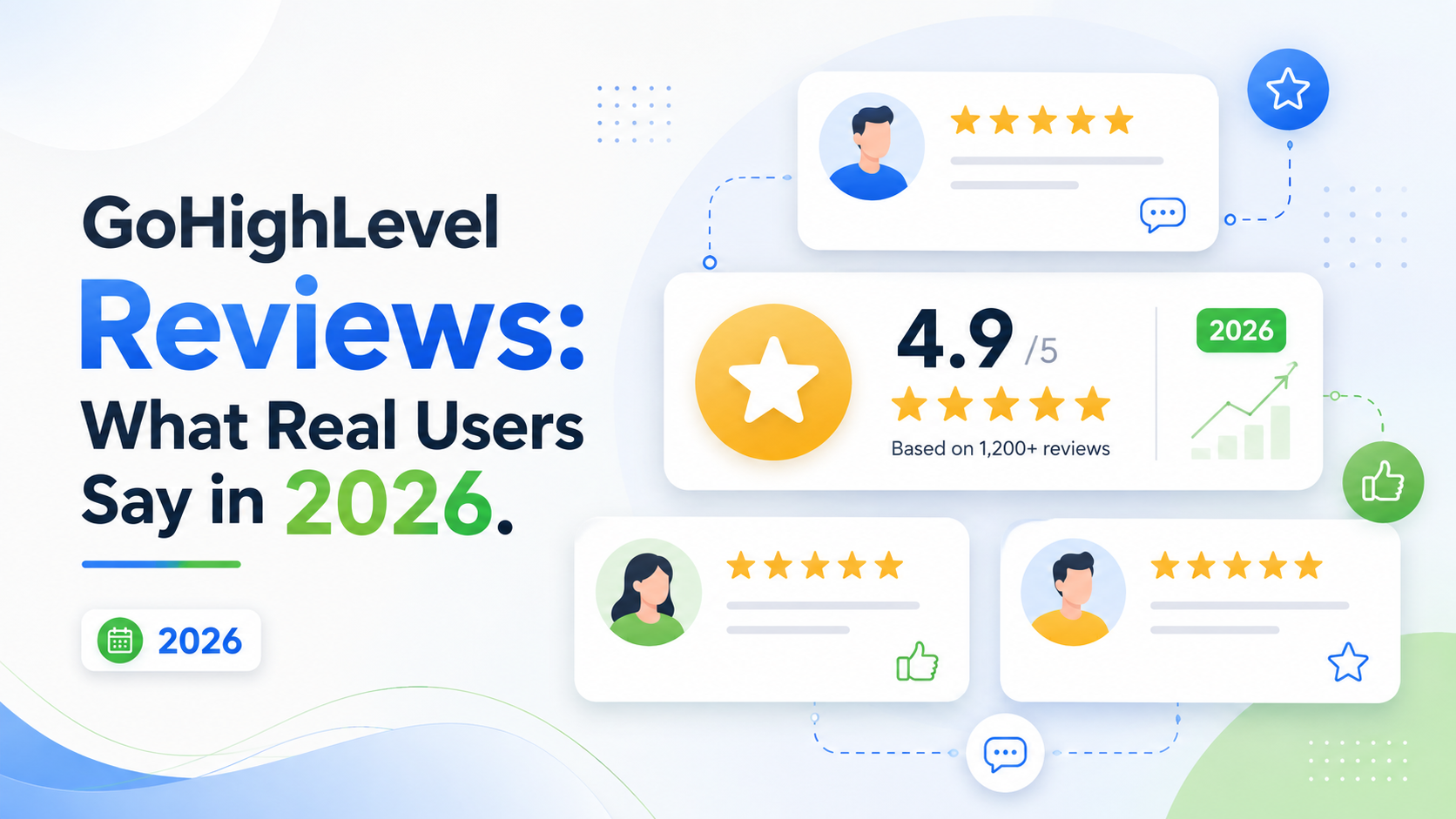
Several widely-cited articles claim GoHighLevel has been reviewed “5,200+” times across G2, Capterra and Trustpilot, and specifically that Capterra carries “over 1,200 reviews.” Checking the platforms directly in July 2026, G2's HighLevel page offers filtering across 641 reviews, and Capterra's page describes 89 verified user reviews. Trustpilot is the outlier with a very large volume — reported in the region of 14,000.
Those are not small discrepancies. Whatever the explanation, the practical advice is the same: go to the platforms yourself rather than trusting an aggregate figure in a listicle, and be sceptical of any article whose headline stat you cannot verify in thirty seconds.
Across G2, Capterra and Trustpilot, GoHighLevel's scores cluster in the low-to-mid four range, with Trustpilot noticeably higher than the others.
That Trustpilot gap is worth understanding rather than averaging away. A large share of Trustpilot reviews for software companies are collected immediately after a support interaction, which measures “did that agent help me” rather than “is this the right platform for my business.” It skews warm. Capterra, with verified-purchaser reviews and a much smaller sample, tends to be the tougher crowd, and its ease-of-use and support sub-scores typically sit below its overall score.
If you want one number, the G2 and Capterra picture is the more decision-relevant one.
Four themes come up over and over.
Tool consolidation and cost savings. The loudest praise by a distance. Reviewers repeatedly describe replacing several subscriptions with one and cutting monthly software spend meaningfully — commonly cited in the $200 to $500 a month range. For agencies replacing a CRM, an email platform, a funnel builder and a scheduler, that saving is immediate and real.
White-label SaaS mode. Agencies single this out as genuinely differentiated. The ability to rebrand the platform, set your own plan tiers and resell it as your own software has no close equivalent at the price. This is the feature that turns GoHighLevel from a cost centre into a revenue line, and reviewers who use it are the most enthusiastic cohort on any platform.
Sub-account architecture for agencies. Reviewers running client work consistently mention that isolated sub-accounts keep everything organised, and that unlimited sub-accounts from the $297 tier removes a ceiling most competitors enforce.
Community and learning resources. An unusually large ecosystem of tutorials, Facebook groups and third-party consultants. Reviewers note you can usually find someone who has solved your problem already.
The learning curve. The single most common criticism across G2 and Capterra, by a wide margin. Reviewers describe an overwhelming number of features, many they did not need, and difficulty locating the ones they did. This is not a complaint about a bad interface so much as the unavoidable cost of a platform that serves dentists, gyms, roofers and agencies from the same codebase.
Support inconsistency. The second most common theme. Reviewers report getting different answers from different agents to the same question, and responses that do not match previous conversations. The practical consequence people describe is having to escalate or re-ask until they reach someone who knows the answer.
Performance and stability. Reviewers mention automations slowing under load, builder pages taking a long time to load, and intermittent glitches. More pointedly, several describe outages arriving without notice or communication — the complaint is less about downtime itself than about being left to work out whether the problem is the platform or their own configuration.
Usage fees on top. SMS, email, phone numbers and AI features are billed separately from the plan. Worth being precise here, because reviews often are not: GoHighLevel does not mark up telephony — LC Phone matches Twilio's rates, and US and Canada messaging carries a 10% discount off list. The legitimate complaint is predictability, not gouging. We have worked the real arithmetic through here.
Becoming your client's software provider. A thoughtful criticism from agency reviewers: once you resell a sub-account, you own the support burden. Setup, workflow building and training all land on you rather than on HighLevel.
A structural point that explains most of the variance in GoHighLevel's ratings.
Any platform built to serve every industry equally will have modules that are adequate rather than excellent. The scheduling is functional but basic next to a dedicated scheduler. The reputation module covers Google and Facebook but not the vertical directories many industries depend on. The email builder is fine but not ActiveCampaign.
So a five-star review from an agency using eight modules and a two-star review from a dentist who wanted two are both accurate. They are measuring different things. When you read a review, the useful question is not “how many stars” but “is this reviewer's business shaped like mine.”

We make TrueReview, a review request tool that competes with GoHighLevel's reputation module. We are not an affiliate and earn nothing from your decision either way. If you use the CRM, funnels and automation, GoHighLevel is not something we replace.
Three practical filters when you go and read them yourself.
Check the reviewer's company size and role. G2 and Capterra both expose this. An agency owner's review and a solo practitioner's review predict completely different experiences.
Look for incentivised labels. Capterra marks reviews where the user received a nominal incentive. That does not make them dishonest, but it is worth knowing.
Weight recency heavily. The platform has changed substantially, particularly around AI features. A review from two years ago describes a different product.
GoHighLevel's reviews describe a product that delivers genuine value to the buyer it was designed for and frustrates the one it was not. The praise concentrates on consolidation savings and white-label resale. The criticism concentrates on complexity, support and cost predictability — and none of it suggests the product does not work.
The most useful thing you can do with any of it is decide which reviewer you are. Our pros and cons breakdown sets out who gets real value and who overpays, and the alternatives guide sorts the options by which module you were actually there for.
If your read on the reviews is that the platform is more than you need, that is worth testing before committing. Start a free 14-day trial of TrueReview — automated review requests by SMS and email, monitoring across Google and dozens of other sites, and flat pricing with sends included.