BLOG POST
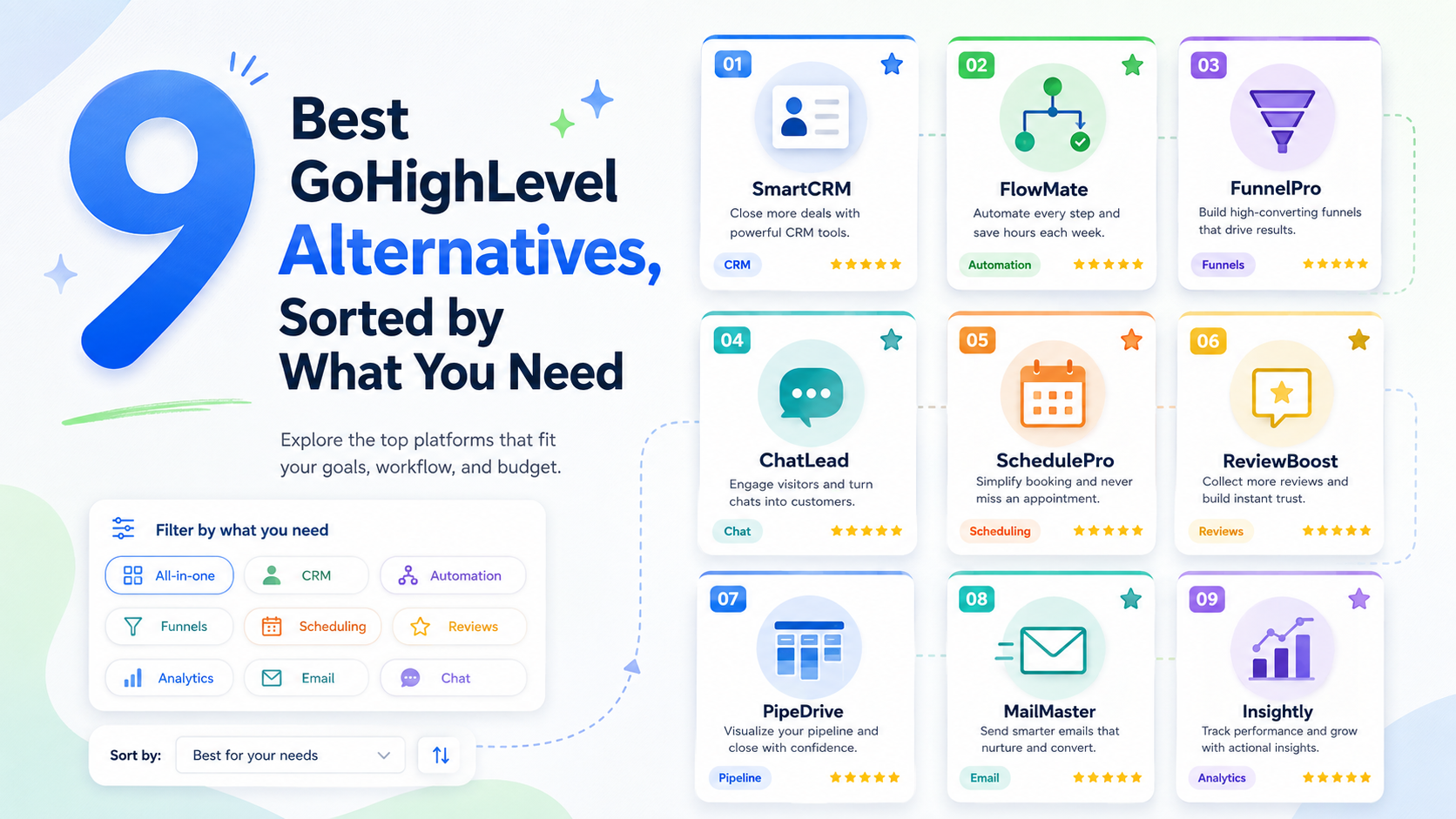
Most GoHighLevel alternatives lists are ranked, which is the wrong shape for this question. GoHighLevel bundles a CRM, a funnel builder, email and SMS, calendars, courses, reputation management and white-label SaaS resale into one subscription. Nothing else does all of that at the price. So a straight ranking always ends up recommending something that replaces a fraction of what you had.
The useful question is narrower: which part were you actually using? Sort by that and the answer becomes obvious. Below are nine alternatives grouped by the job they replace, with an honest note on who each one suits.
A disclosure before we start: we make TrueReview, which appears in the third group. We have put it where it genuinely belongs rather than at the top, and it is not the right pick for most of the situations on this page.
Four reasons come up repeatedly in user reviews and in conversations with people mid-switch.
Complexity. The single most common criticism across G2 and Capterra is the learning curve. The platform does a great deal, and the interface reflects that. Owners who wanted two features find themselves navigating twenty.
Paying for unused capacity. A single-location business on the $97 Starter plan is buying an agency tool. If you are not using sub-accounts, funnels, courses or SaaS mode, you are paying for architecture you will never touch.
Usage costs on top. SMS, email, phone numbers and A2P registration are metered through a wallet that auto-recharges. Not expensive for most, but hard to forecast. We worked through the real numbers here.
Support and stability. Reviewers frequently mention inconsistent support answers and occasional outages without much communication.
None of those are reasons to leave if the platform is doing its job. They are reasons to check whether it is.
Best for: Growing companies that need a genuinely deep CRM with real reporting, and have the budget.
HubSpot is the most complete CRM on this list and the most expensive way to get there. The free tier is legitimately usable, Starter is inexpensive, and then there is a cliff: the Professional tier is where multi-step workflow automation begins, and at the time of writing it carries a mandatory onboarding fee and an annual commitment. Contact-based pricing means the bill grows with your database whether or not you are emailing those people.
Where it beats GoHighLevel: reporting depth, integration ecosystem, data model, polish, and support quality.
Where it does not: there is no white-label, no sub-account resale, no built-in phone system of the same kind, and no path to selling it as your own software. For agencies, that is disqualifying. We have written a fuller GoHighLevel vs HubSpot comparison.
Best for: Small service businesses that want CRM, automation, invoicing and payments in one place.
Keap (formerly Infusionsoft) has been doing small-business automation since 2001, and the maturity shows in the sales and billing side — quotes, invoices, recurring billing and payment reminders tied directly to contact records. That combination is genuinely hard to assemble elsewhere.
Watch for: pricing is contact-based and starts high relative to what you get, there is typically a mandatory onboarding fee, and the interface carries two decades of accumulated features. No white-label or resale path.
Best for: Agencies that want to resell marketing services rather than software.
Vendasta is the closest structural match to GoHighLevel's agency model — white-label dashboards, multi-client management, and a marketplace of services you can resell. The difference in philosophy matters: GoHighLevel gives you tools your clients use, Vendasta gives you products you sell. If you want to be a reseller more than a builder, it is the better fit.
Best for: Cost-conscious teams that want breadth and will tolerate a less polished experience.
Zoho One is the only bundle on this list that rivals GoHighLevel for sheer surface area, at a low per-user cost. The trade is coherence: it feels like many separate applications sharing a login, because that is what it is. Strong for businesses with an operations person who enjoys configuration; frustrating for those who do not.
A lot of people signed up for GoHighLevel because someone showed them the funnel builder. If that is the whole story, these are better at that one job.
Best for: Direct-response marketers whose revenue depends on funnel conversion rates.
The category original, and still the strongest on templates, proven conversion frameworks and community resources. Entry pricing sits around the same level as GoHighLevel's Starter plan, so this is a lateral move on cost, not a saving. You are trading breadth for depth in one area.
Best for: Course creators and membership businesses.
Kartra bundles funnels with integrated video hosting, membership sites, student analytics and deeper behavioural automation than ClickFunnels. Starts a little higher and scales up considerably. Worth it if you sell digital products; overkill if you sell roofing.
Best for: Bootstrapped solo operators.
The budget option, with a genuinely free tier and paid plans well under $50/month. It covers the core funnel, email and course functionality that most people actually use, at a fraction of the price. Less polished, smaller template library, thinner ecosystem — but the value is undeniable at the low end.
Best for: Businesses where email automation is the main event.
If 80% of what you did in GoHighLevel was email sequences and segmentation, ActiveCampaign does that better. The visual automation builder and deliverability infrastructure are stronger. Pricing is contact-based and rises as your list grows. No funnels-first workflow, no phone system, no agency resale mechanism.
This group deserves separating out, because the advice is completely different.
A meaningful share of GoHighLevel signups are local businesses — contractors, clinics, agents, salons — who wanted automated review requests. GoHighLevel has a reputation module and it works, so they signed up, and then paid for a platform to use one tab of it.
If that describes you, replacing GoHighLevel with another all-in-one repeats the original mistake. The alternatives above are all bigger than your problem.
Best for: Local businesses and multi-location operators whose growth depends on reviews.
Purpose-built review tools do one job: get more reviews, monitor them, respond faster. The practical differences against GoHighLevel's module are specific rather than abstract:
Where it does not compete: there is no CRM, no funnel builder, no courses, no white-label SaaS resale. If you need any of those, one of the platforms above is the right answer and a review tool is not.
TrueReview plans run $49, $99 and $299 a month, with discounts for annual billing, and there is a 14-day free trial. Compare that honestly against what you are paying now and against how much of GoHighLevel you actually use — if you are using half the platform, staying put is the cheaper answer.

Open GoHighLevel and list the tabs you used this month. If it is three or more, you need a platform — stay, or move to one of the options in Group 1. If it is one, you have been buying a platform to solve a single-feature problem.
Count the modules you actually use. Not the ones you meant to set up. The ones with data in them.
Separate platform cost from usage cost. Compare like with like. A flat plan that includes sends is not directly comparable to a plan fee plus a metered wallet until you model your own volume.
Check the migration cost honestly. Funnels and workflows cannot be exported from GoHighLevel — they have to be rebuilt. If you have twenty workflows running, that is real work. Our guide to cancelling GoHighLevel covers what to export before you lose access.
Trial before you commit. Every option here has a free trial or free tier. Run your actual use case through it for two weeks rather than reading another comparison table.
GoHighLevel is excellent value for the business it was designed for: an agency that uses the CRM, the funnels, the automation and the white-label resale. If that is you, most of the alternatives on this page are downgrades and the honest recommendation is to stay.
It is poor value for a single-location business using two features. In that case the right move is not to find a smaller all-in-one — it is to buy the specific tool that solves your specific problem. For a lot of local businesses, that problem is reviews, and it is worth reading our breakdown of the reputation module before deciding either way.
If reviews were the reason you signed up in the first place, test the narrow tool before committing to another broad one. Start a free 14-day trial of TrueReview — automated SMS and email review requests with built-in follow-up, native widgets for dozens of review sites, multi-location dashboards, and flat pricing with requests included.