BLOG POST
Most guides on competitor review analysis are written for enterprise brands with a hundred locations and a software budget to match. They talk about dashboards, share-of-voice charts and API pulls. If you run one shop, one clinic, or a handful of service vans, that framing is not much help.
But the underlying idea is one of the best-kept secrets in local marketing: your competitors' customers have already written down, in public, exactly what they love, what they hate, and what they wish were different. That is unfiltered market research, and it costs you nothing but an afternoon of reading.
This guide is the local-business version. No scraping, no special software required, no touching anyone else's customers - just a repeatable way to read what is already public and turn it into sharper positioning, fewer service gaps, and better-timed review requests of your own.
Formal market research - surveys, focus groups, mystery shoppers - is slow and expensive. Competitor reviews are the opposite. They are voluntary, specific, and dated, written by real buyers in your exact market at the moment the experience was fresh. A one-star review about a plumber who no-showed twice tells you more about local demand for reliable scheduling than any generic industry report.
The reason this works is simple: customers describe problems and delights in their own words, not yours. That language is gold for marketing, and the complaints are a free roadmap of where the local standard is falling short. When you read enough of them, patterns emerge that you could never guess from your own four walls.
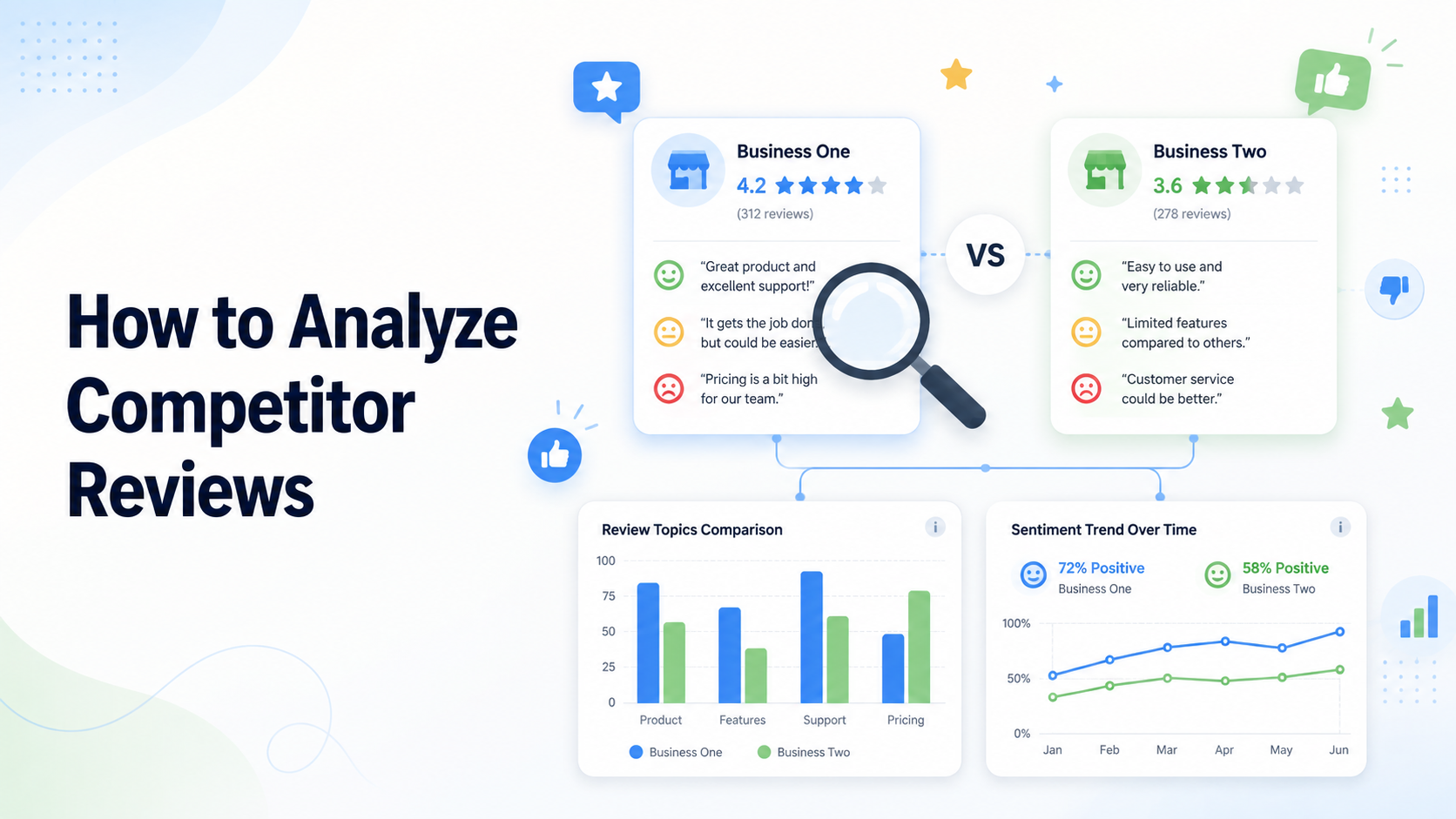
You are not looking for a single smoking-gun review. You are looking for repetition - the same complaint from five different customers, the same phrase of praise across a dozen write-ups. Repetition is signal; a lone outlier is usually noise. Here is the whole method at a glance.
The instinct is to study the market leader. Resist it. The business with 2,000 reviews and a regional footprint is rarely your true competitor - the customer choosing between you and them is choosing on different criteria. You want the businesses a real prospect would actually compare you against: same service radius, same rough price band, same customer type.
A practical shortlist is three or four names. For a local service business, find them the way a customer would: search your core service plus your town or neighborhood, look at the Google Map pack and the profiles that appear, and note who keeps showing up. Add any competitor a customer has mentioned to you by name. That is your panel.
Cast a slightly wider net on platforms, too. Google is the obvious one, but depending on your industry the richest complaints may live on Facebook, industry-specific sites, or booking platforms. Read where your customers actually leave feedback, and keep a note of which platform each theme came from - the tone often differs by platform.
One-star and two-star reviews are where the money is. A service gap is any recurring failure that customers care enough to write about - and if a competitor keeps tripping over the same problem, you can quietly build your operation to avoid it, then say so in your marketing.
Read a competitor's negative reviews in one sitting and tally the themes rather than the individual stories. You are looking for the complaint that appears again and again: "never called back," "showed up late," "quote changed at the end," "felt rushed," "couldn't get anyone on the phone." Any theme that repeats across several customers and several months is a genuine gap, not a one-off bad day.
The pattern in local service reviews is remarkably consistent. The complaints cluster around a handful of operational basics:
Once you can name the recurring gap, you have two moves. Fix it in your own operation so you genuinely deliver better, and then make the promise explicit in your messaging - "same-day callback, guaranteed" lands far harder when you know the local pain is unreturned calls. You are not naming the competitor or disparaging anyone; you are simply meeting a need the market has already told you is unmet.
If one-star reviews tell you what to fix, five-star reviews tell you what to say. Happy customers describe the value they got in language that is more persuasive than anything a copywriter would invent, because it is the language other buyers already use in their own heads.
Read the glowing reviews and highlight the specific phrases people reach for. Notice whether they praise speed, price, friendliness, cleanliness, expertise, or the way a staff member handled a tricky situation. Notice the emotional words - "finally," "relief," "trusted," "no pressure." Those are the buying triggers in your market, and they belong in your headlines, your request messages, and your responses.
Two things are worth separating out. First, the recurring theme: if half of a competitor's five-star reviews mention how thoroughly the technician explained the work, explanation is clearly a valued differentiator locally. Second, the exact wording: capture verbatim phrases so your marketing echoes the customer's own voice rather than industry jargon. A homepage that says "no-pressure, plain-English quotes" beats "customer-centric solutions."
This is the same voice-of-customer discipline big brands pay agencies for, applied to a data set that is sitting in the open. Pair it with the praise in your own reviews and you have a positioning statement grounded in evidence, not guesswork.
Price shows up in reviews more than most owners expect, and it is rarely a simple "too expensive." The useful nuance is in how the objection is framed. Customers who felt blindsided by a final bill are complaining about transparency, not price. Customers who say a job "wasn't worth it" are complaining about perceived value. Those are very different problems, and they call for different responses.
As you read, sort every money-related comment into a few buckets: surprise (the cost wasn't what they expected), opacity (they couldn't get a clear quote up front), value (they paid and felt it wasn't worth it), and comparison (they found the same thing cheaper elsewhere). A competitor drowning in "surprise" complaints is handing you a positioning angle - upfront, itemized quotes - without you having to be the cheapest option in town.
Note, too, where five-star reviews defend a higher price: "worth every penny," "you get what you pay for." That tells you the market will tolerate a premium when the value is communicated well - so you can set rates and craft quotes with confidence instead of racing to the bottom.
Competitor analysis is only worth the afternoon if it changes what you do. The most direct payoff is your own review pipeline. If competitors' complaints cluster around a specific stage - say, the days right after a job when nobody follows up - that is exactly the moment to reach out to your own customers while the experience is fresh and positive.
Timing matters. The strongest reviews come when you ask shortly after a successful outcome, over a channel the customer actually checks. For most local businesses that means a short, friendly request by text or email within a day or two of the work being done, with a gentle follow-up if there is no response. The competitor gaps tell you which moment carries the most goodwill in your specific trade.
Two honest guardrails here. Send the same neutral request to every customer, not just the ones you expect to be happy - selectively asking only your fans ("review gating") runs against Google's policies and the FTC's rule on consumer reviews. The goal is a steady, representative stream of feedback, which over time does more for your rating than any one glowing review.
The themes you harvested also improve your customer feedback management more broadly: they tell you what to ask about, what to fix first, and how to phrase the follow-up so it invites the specifics that make a review useful to the next buyer.
To keep the exercise from becoming a vague scroll, score it. You do not need software - a spreadsheet with a row per competitor and a column per theme is plenty. The point is to convert dozens of anecdotes into a handful of ranked priorities you can act on. Track these five dimensions.
Rank the rows by frequency and by how easily you can act, and you will end up with a short, honest priority list: two or three service fixes, a couple of positioning phrases to test, and a clearer view of where your pricing story needs to be tighter. Repeat the exercise a couple of times a year and you have a lightweight, ongoing read on your local market. If you would rather not track review patterns by hand, tools like TrueReview's Review Insights and online reputation monitoring can surface themes across your own incoming reviews so you spend the time acting rather than tallying.
Analyzing public reviews is fair game. Crossing a few clear lines is not, and getting this wrong can damage your reputation far more than any insight is worth. Keep the whole exercise on the right side of these limits.
The simple test: everything you do should be reading and honest analysis of information that is already public, used to make your own business better. Nothing you do should touch a competitor's customers or their reviews. Stay on that side of the line and the practice is not just legal - it is good business.

The same theme-spotting you do on competitors works even better on your own feedback. TrueReview's Review Insights groups incoming reviews by sentiment and topic so service gaps and praise themes surface on their own - and Review Mentions keeps your team looped in when something needs a reply.
If you are also weighing dedicated competitor-analysis software as part of a broader reputation tool, it is worth comparing options on features and fit - our TrueReview vs ReviewTrackers comparison lays out how the two approaches differ so you can pick what suits a local operation.