BLOG POST
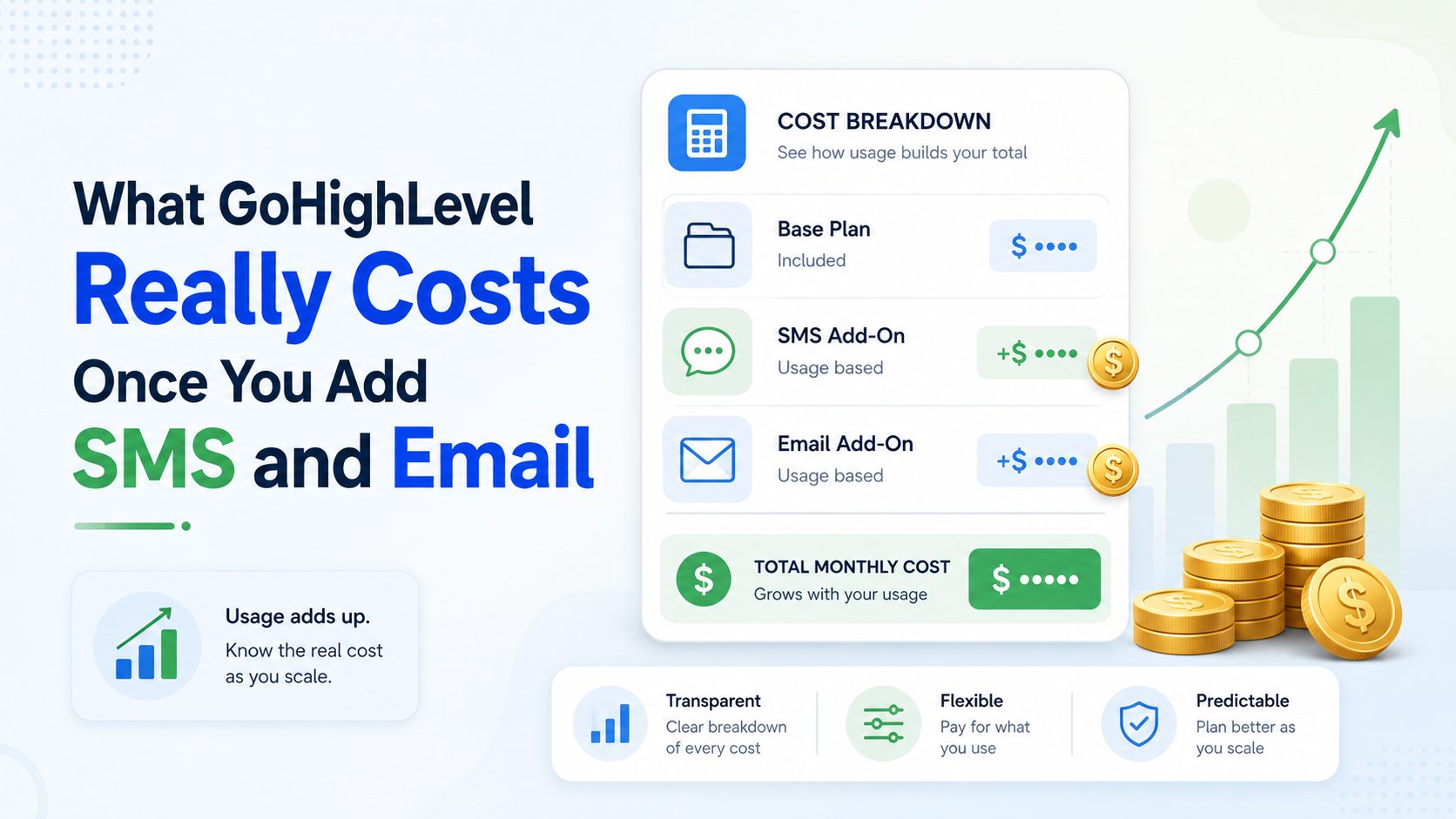
GoHighLevel's pricing page shows three numbers: $97, $297 and $497 a month. Those numbers are accurate and they are not the whole bill. Communication usage — the SMS and email that make automation actually do anything — is billed separately through an agency wallet.
This is not hidden. It is all documented in HighLevel's own billing guides. It is just not on the comparison screenshots, so people budget the plan fee and get surprised by the rest. Here is what the rest costs and how to model it.
All figures below are GoHighLevel's US and Canada rates as of July 2026. International rates differ, and these change — check the current LC Phone pricing guide before you rely on them.
SMS: $0.00747 per segment. Charged on both outbound and inbound messages at the same rate. This reflects a 10% discount applied to the $0.0083 list rate. GoHighLevel does not mark up telephony — the rates match Twilio's, because LC Phone is built on Twilio.
Carrier fees on top of that, per message. These are surcharges from the recipient's mobile carrier, not from GoHighLevel: AT&T $0.0035, T-Mobile $0.0045, Verizon $0.0045, US Cellular $0.0050, all others $0.0040 for outbound SMS.
A 5% location-level markup on those carrier fees. This applies to A2P registration fees and SMS/MMS carrier fees regardless of whether your agency has rebilling switched on.
Phone numbers: $1.15/month for a local number, $2.15 for toll-free.
A2P 10DLC registration. Required to send SMS in the US. Sole Proprietor: up to $23.475 one-time and up to $2.10 per campaign per month, capped at 3,000 segments a day. Low Volume: up to $23.475 one-time and $1.50–$10.50 per campaign monthly. High Volume: $68.625 one-time and $10.50 per campaign monthly. Submitting a campaign starts both charges regardless of whether it is approved. One piece of good news: since 1 February 2026, resubmissions are free — the previous $15 resubmission fee was removed.
Email: $0.675 per 1,000 sends. Email validation is $2.50 per 1,000 if you enable it. A dedicated sending IP is $59/month and only available on the $297 and $497 plans.
Voice, if you use it. Outbound calls total $0.0166/minute (a $0.0126 call leg plus a $0.004 dialer leg — both legs bill for the full call). Inbound is $0.01165/minute. Calls round up to whole minutes. Recording is $0.0025/min, transcription $0.024/min, and stored recordings bill at $0.0005/min/month indefinitely until you delete them.
Take a home services business with three locations sending review requests after completed jobs. Roughly 800 requests a month split across SMS and email, with a two-step follow-up for non-responders.
Realistic message volume: 800 initial requests plus around 500 follow-ups to people who did not respond first time, so about 1,300 sends. Say 900 by SMS and 400 by email. A review request with a link typically runs to two segments once you include the business name and the URL, so 900 messages is roughly 1,800 segments. Add inbound replies — people text back “done” or “thanks” — at maybe 150 segments, which you also pay for.
SMS sending: 1,950 segments × $0.00747 = $14.57
Carrier fees: 1,950 × ~$0.0042 average = $8.19, plus the 5% location markup = $8.60
Email: 400 sends × $0.000675 = $0.27
Phone numbers: 3 local numbers × $1.15 = $3.45
A2P campaign fees: three sub-accounts, one campaign each, Low Volume — call it $4.50 to $31.50/month depending on where each campaign lands in the range, plus one-time registration of up to about $70 across the three
Monthly usage total: roughly $31 to $58, on top of a $297 Unlimited plan (three locations means three sub-accounts, so Starter's 3-sub-account cap technically fits, but leaves you nothing for your own agency account).
So the honest headline is: usage is not the disaster some articles imply. Thirty to sixty dollars on top of $297 is not a scandal. The real issues are different ones.
1. You cannot forecast it cleanly. Four separate charges per message, rates that vary by recipient carrier, a segment count that changes if someone edits the template, and inbound replies you also pay for. You can estimate it. You cannot put a fixed number in a budget and be confident.
2. The wallet auto-recharges. Usage is paid from an agency wallet that automatically charges your card when the balance drops below a threshold. That is convenient and it also means the spending happens without a decision point. A workflow bug that loops, or a bulk send to a list that was bigger than you thought, spends real money before anyone notices. Set your minimum balance and recharge amount deliberately.
3. Charges accrue for things you are not doing. Call recording storage bills daily, per sub-account, for every recording you have ever kept — not just recent ones. A2P campaign fees recur monthly per active campaign whether you sent anything or not. And you are charged for messages where a delivery attempt was made even if the message never arrived; there are no refunds for undelivered SMS.

The same 800 requests a month across three locations sits inside TrueReview's Premium plan at $299/month monthly or $179/month billed annually — 2,500 requests and five locations included, SMS and email in the price, no wallet and no carrier-fee arithmetic. We make this product, so weigh accordingly: the point is not that it is always cheaper, it is that it is a single predictable number.
Be fair about this. Metered pricing is better than flat pricing in two situations.
Low or lumpy volume. If you send 60 review requests one month and 400 the next, you pay for 60 and then 400. A flat plan charges you for the ceiling every month. A seasonal business — landscaping, pools, tax prep — often comes out ahead on metered.
Agencies that rebill. On the $297 plan you can pass usage through to clients at cost. On the $497 plan you can mark it up and keep the margin. At that point usage stops being a cost and becomes a revenue line, which flat-rate pricing cannot replicate.
The metered model is worst for the business in the middle: consistent monthly volume, no clients to rebill, and no appetite for reconciling a wallet statement.
Rather than trusting anyone's example, run this:
Then compare that total plus your plan fee against a flat-rate alternative at your volume. Do the comparison at both your current volume and at three times your current volume, because the whole point of automating review requests is that volume goes up.
GoHighLevel's usage charges are documented, unmarked-up on telephony, and for most local businesses they add tens of dollars a month rather than hundreds. The fair criticism is not that the platform is expensive — it is that the true cost is unknowable until after you have incurred it, and that the wallet spends without asking.
If you are running the numbers as part of a broader evaluation, our full breakdown of GoHighLevel pricing covers the plan tiers and add-ons, and the worth-it assessment covers who gets real value from the platform and who overpays. If reviews are specifically what you are costing out, the reputation module breakdown is the relevant one.
Rates verified against HighLevel's published pricing and billing documentation in July 2026. Usage pricing changes — confirm current rates before making a decision on them.
If a single predictable number is what you are after, that is the trade a flat plan makes. Start a free 14-day trial of TrueReview — SMS and email review requests with the sends included in the plan, automated multi-step follow-up, and no wallet to reconcile. No setup fees, cancel any time.