BLOG POST
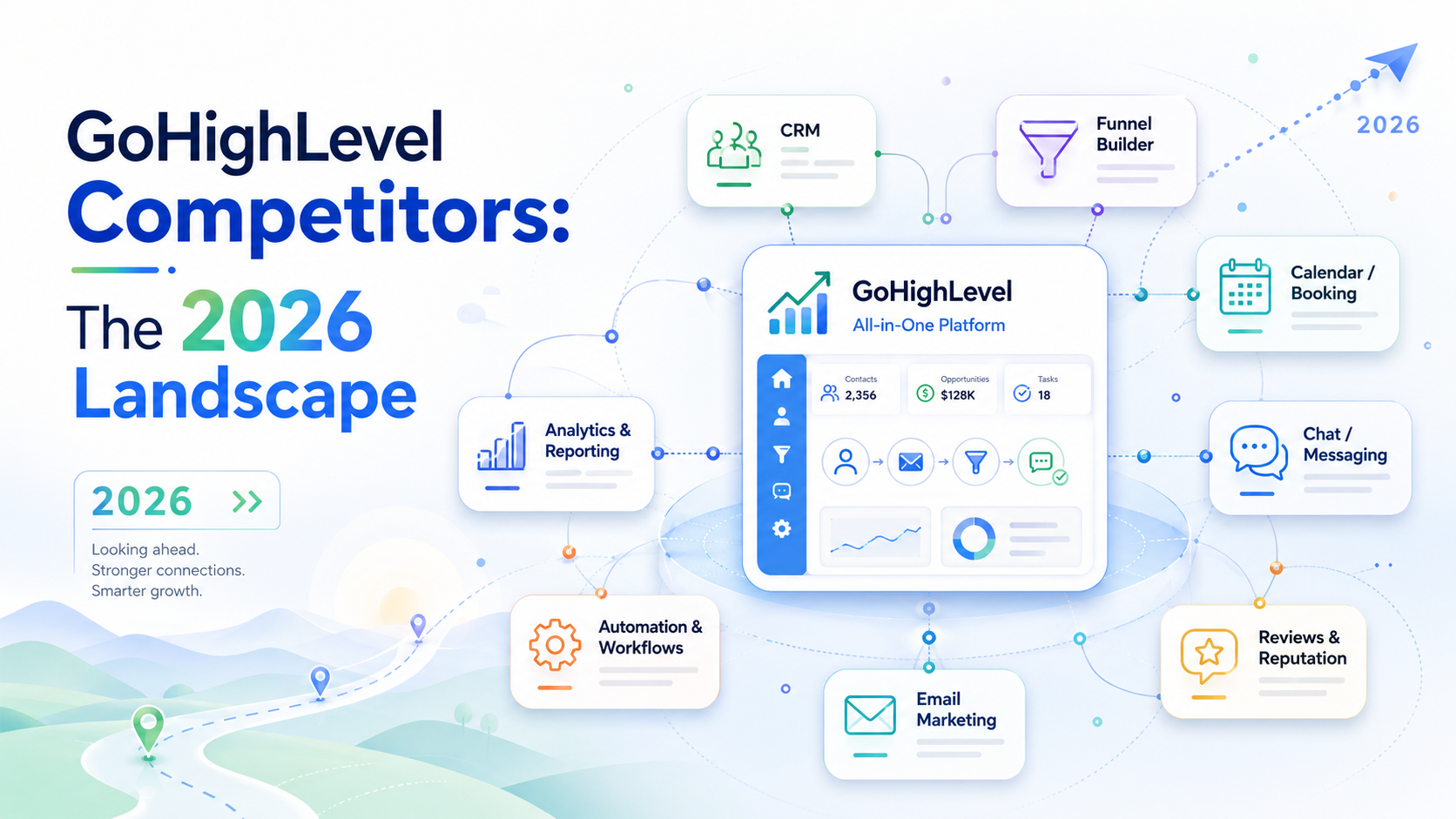
GoHighLevel occupies an unusual position. It is simultaneously a CRM, a funnel builder, an email and SMS platform, a scheduler, a course platform, a reputation tool and a white-label SaaS chassis. That breadth means its competitor set depends entirely on which axis you measure.
This page maps the landscape by category. If you are actively choosing, our GoHighLevel alternatives guide is structured as a recommendation instead.
Disclosure: we make TrueReview, which sits in the fifth category below.
The closest structural competitors. This is the category GoHighLevel effectively defined, and it is small.
Vendasta is the main name. Both offer white-label client dashboards and multi-client management, but the philosophies differ: GoHighLevel gives agencies tools their clients use, while Vendasta gives agencies a marketplace of services to resell. If your model is productised reselling rather than doing the work, Vendasta fits better.
DashClicks plays a similar game with more emphasis on fulfilment services.
What makes this category small is the combination required: multi-tenant architecture, white-labelling, billing infrastructure and a broad enough feature set to be worth reselling. Most software companies build one product well instead.
Competing on data model and reporting depth rather than breadth.
HubSpot is the benchmark. Deeper CRM, far better reporting, an enormous integration ecosystem, and considerably more expensive at scale — particularly once you pass the Starter tier into Professional, where multi-step automation begins alongside onboarding fees and annual commitments. Critically, there is no agency resale path. We have a fuller GoHighLevel vs HubSpot comparison.
Zoho CRM and Zoho One compete on breadth-per-dollar and win on price. The trade is coherence — it feels like many applications sharing a login.
Keap targets small service businesses with strong invoicing, quoting and recurring billing tied to contact records. Contact-based pricing and a legacy interface are the constraints.
Pipedrive, Close and Salesforce come up in comparison searches but sit in a different job: sales pipeline management for teams that sell, not marketing automation for agencies. Salesforce in particular is a different market entirely.
Competing on one module, usually better.
ClickFunnels is the category original and still leads on template quality, conversion frameworks and community. Entry pricing sits close to GoHighLevel's Starter tier, so switching here is a lateral cost move, not a saving.
Kartra adds integrated video hosting, memberships and student analytics — stronger for course and digital product businesses.
Systeme.io is the value play, with a genuine free tier and paid plans well under $50/month covering funnels, email and courses.
The pattern across this category: each does its one job better than GoHighLevel does, and none replaces the CRM, phone system or agency layer.
ActiveCampaign is the serious competitor here — better visual automation builder, better deliverability infrastructure, deeper segmentation. Contact-based pricing that rises with list size. No funnels-first workflow, no phone system, no resale mechanism.
Mailchimp, GetResponse and Brevo appear in comparisons but compete on the email module alone.
Competing on one module that many businesses came for.
This category matters more than its size suggests, because a meaningful share of GoHighLevel signups are local businesses who wanted automated review requests and bought a platform to get them.
Birdeye, Podium and Reputation.com occupy the enterprise end — review management bundled with webchat, messaging, listings and surveys, typically at several hundred to over a thousand dollars a month with annual contracts. They compete with GoHighLevel for multi-location and franchise buyers.
NiceJob, Grade.us, Widewail and TrueReview sit in the focused middle: review request automation, monitoring and widgets, without the broader marketing suite. The competitive argument against GoHighLevel here is specific rather than general — multi-step follow-up sequences that work without being built, native coverage of vertical directories like Angi, Zillow, Avvo and Healthgrades rather than Google and Facebook only, multi-location dashboards, and flat pricing instead of metered sends.
Against the enterprise platforms, the argument runs the other way: less breadth, considerably less cost.
Three lines explain most of the market structure.
The resale line. Almost nothing outside category one lets an agency rebrand and resell the software as its own product. This is GoHighLevel's genuine moat, and it is why agencies rarely leave for HubSpot or ActiveCampaign no matter how much better those are at their specific jobs.
The telephony line. Very few marketing platforms include a built-in phone system. GoHighLevel's LC Phone — and the missed-call text-back and two-way SMS it enables — is a substantial differentiator for local service businesses, and most competitors require you to bolt on Twilio yourself.
The depth line. Every specialist beats GoHighLevel at its own module. That is not a criticism of GoHighLevel so much as an arithmetic fact about horizontal platforms: a product serving dentists, gyms, roofers and agencies from one codebase cannot out-build a product serving only one of them.
Two shifts worth watching.
AI is becoming a pricing layer rather than a feature. GoHighLevel's AI Employee is priced separately at $50 or $97 per month per enabled location, and competitors are converging on similar per-seat or per-location AI pricing. Expect the “included” feature set to shrink as AI capabilities move into add-on tiers across the category.
Vertical specialists are pulling away. ServiceTitan for trades, Clio for legal, Jane for clinics — industry-specific platforms increasingly hold the customer record, which pushes horizontal platforms into being a marketing layer on top rather than the system of record. That changes what GoHighLevel competes with: less “which all-in-one” and more “what sits alongside the vertical platform we already own.”
Identify which axis actually matters to you, then look only at that category. Comparing GoHighLevel to HubSpot when what you needed was a funnel builder produces a confusing answer to the wrong question.
If you want a recommendation rather than a map, our alternatives guide makes actual picks. If you are still deciding whether to leave at all, the pros and cons breakdown is the place to start.