BLOG POST
If you run a local business, sooner or later someone will tell you to "get on Trustpilot." It sounds reasonable. Trustpilot is a big, trusted name, and more reviews are always good, right? But before you sign up, it is worth asking a simpler question: where do your actual customers go when they want to check whether a plumber, dentist, law firm, or restaurant is any good?
For the vast majority of local and service businesses, the answer is Google. Trustpilot is built primarily for ecommerce and consumer-facing brands that sell online, and its open review model is designed around that world. That does not make it a bad platform. It just means it is often the wrong first stop for a business whose customers are searching "near me" and reading the star rating on a Google Business Profile before they ever click through to a website.
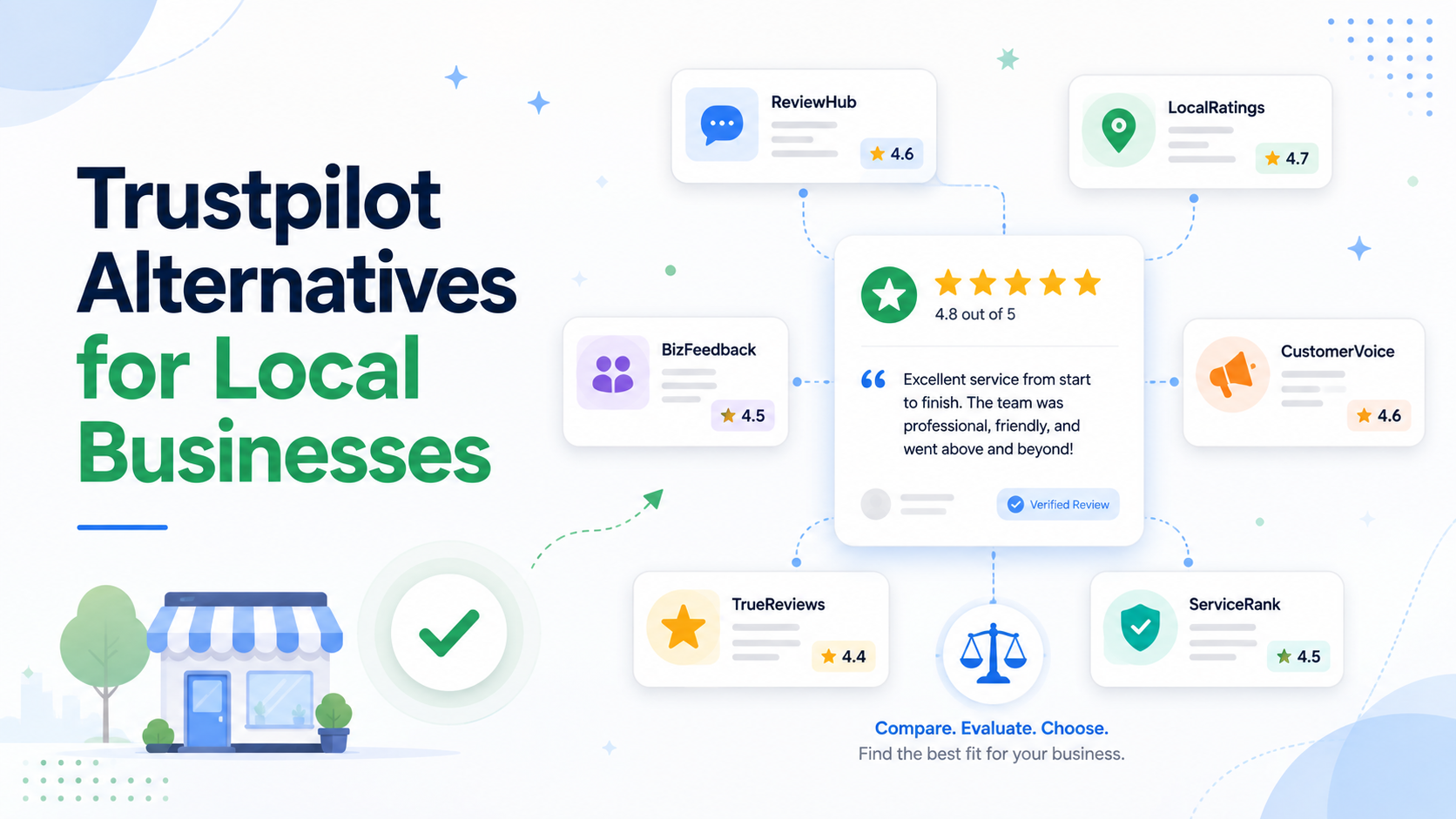
This guide walks through why local businesses tend to look past Trustpilot, what actually matters when you compare options, and eight Trustpilot alternatives worth knowing, presented in a side-by-side table. One of them is our own product, TrueReview, which we have labelled clearly and described factually so you can weigh it like any other.
Trustpilot is an open review platform, meaning anyone can leave a review of a company whether or not the business has an account. That openness works well for online retailers and consumer brands with a national or global customer base. For a business rooted in one town or a handful of locations, the fit is often looser, for a few reasons.
Your customers search Google, not Trustpilot. When someone looks for a local service, they typically see the Google map pack, star ratings, and review counts long before they consider a third-party review site. Reviews on your Google Business Profile influence local search visibility and are the ones most prospects read first. A Trustpilot profile with a handful of reviews rarely moves the needle in the same way.
Pricing skews toward larger brands. Trustpilot offers a free tier, but the business features many companies want, such as review invitations at scale and richer widgets, sit on paid plans that are generally priced with larger ecommerce operations in mind. Independent write-ups put paid plans in the several-hundred-dollars-per-month range and up, so verify current numbers directly with Trustpilot before budgeting.
You may be spreading yourself thin. Every review you route to Trustpilot is a review you did not route to Google, Facebook, or an industry site that matters in your field. For local businesses, concentrating reviews where prospects look usually beats scattering them across a platform they may never visit. If you want a broader view of where reviews carry weight, see our roundup of the best review sites.
None of this means Trustpilot is a poor tool. It is well built for what it is designed to do. The point is simply that "more reviews" is not a goal in itself. What you want is more reviews in the places that shape a prospect's decision and your visibility in local search. For a business that serves customers in person or within a defined area, those places are led by Google, followed by the sites specific to your trade. A Trustpilot alternative, then, is less about finding a rival review site and more about choosing the right way to build reviews where they count.
"Alternative" can mean very different things depending on what you are trying to fix. Some tools are review sites, some are review-generation and reputation platforms, and some are simply widgets that display reviews on your website. Before comparing names, get clear on which of these you need. When you do compare, these are the factors that matter most for a local business.
The tools below span three categories: free platforms you should claim regardless, full review-generation and reputation software, and lightweight widgets. Pricing is approximate and changes often, so treat the figures as a rough guide and confirm current numbers on each vendor's site. To keep things honest, we have flagged our own product, TrueReview, as "(Ours)."
| Tool | Best for | Notable | Pricing (approx.) |
|---|---|---|---|
| Google Business Profile | Every local business | The reviews prospects read first; feeds local search visibility | Free |
| TrueReview (Ours) | Local and multi-location review generation | SMS and email requests, multi-platform monitoring, widgets, unlimited teammates | Tiered plans; 14-day free trial |
| Birdeye | Larger multi-location brands | Broad reputation and customer-experience suite | Custom / quote-based |
| Podium | Businesses wanting messaging plus reviews | Texting-led customer interaction platform | Reportedly from ~$249/mo |
| NiceJob | Small service businesses | Straightforward review requests and website widgets | Reportedly from ~$75/mo |
| Grade.us | Agencies and resellers | White-label review management across sites | Reportedly from ~$110/mo |
| Trustindex | Displaying reviews on a website | Popular Google review widgets and collection tools | Free tier; paid from a few dollars/mo |
| Reviews.io | Businesses that also sell online | Company and product reviews with a Google partnership | Reportedly from ~$89/mo |
Pricing shown is approximate and for orientation only. Verify current pricing, plan limits, and features on each vendor's own website before you buy.
Google Business Profile is not really a competitor to the others; it is the foundation. It is free, it is where local prospects read reviews first, and your rating there influences how you show up in local search. Whatever else you choose, claim and optimize this profile. Many of the paid tools below exist largely to help you earn more reviews on it.
Birdeye and Podium are broad, well-known platforms aimed at businesses that want reputation management bundled with wider customer-experience or messaging features. They can be capable fits for larger operations, though pricing tends to reflect that scope, so weigh the feature breadth against what you will actually use.
NiceJob and Grade.us focus more tightly on getting and showing reviews. NiceJob is popular with small service businesses, while Grade.us is built with agencies and resellers in mind and offers white-label options. Trustindex sits in the widget category: an affordable, often free way to collect and display Google reviews on your site, though it is lighter on automated request campaigns and cross-platform monitoring. Reviews.io is a solid pick if your business also sells products online and wants both company and product reviews.
There is no single best Trustpilot alternative, only the best fit for how your business operates. Use these rough profiles as a starting point, then match against the comparison factors above.
Whichever route you take, the pattern that works for local businesses is consistent: earn reviews where prospects look, respond to them, and display the best ones on your own site. For a deeper look at tools focused on the platform that matters most locally, see our comparison of Google review management software, services, and tools.

TrueReview is our review-generation and reputation software for local and multi-location businesses. It automates review requests by SMS and email, consolidates reviews from Google, Facebook, and many other platforms into one dashboard with alerts, and offers embeddable widgets to show reviews on your site. It sends neutral requests to everyone and manages opt-outs, in line with Google's policy and the FTC's 2024 Rule. See pricing or start a free 14-day trial.