BLOG POST
If you have been researching Medallia, InMoment, AskNicely, or Press Ganey, you have landed in the world of enterprise customer experience (CX) software. These are capable, well-regarded platforms — and for most local and small businesses, they are also far more than you actually need.
This guide explains what these platforms really do, how they differ from the review-generation tools most smaller businesses rely on, roughly what they cost, and how to tell whether your organization is the buyer they were built for. We will keep it straight: no hype, no knocking anyone, and an honest section on when you should not buy one of these at all.
Here is the short version before we get into the detail.
Enterprise CX platforms exist to capture, analyze, and act on customer feedback at scale. Instead of a single review widget or a one-off survey, they run a coordinated feedback program across many touchpoints — post-purchase surveys, contact-center interactions, in-app prompts, email, SMS, and sometimes social and web behavior. The umbrella term you will see most often is voice of the customer (VoC), and the closely related idea of experience management (often shortened to XM).
The common thread across these products is that they turn a large volume of scattered signals into structured insight. That typically includes survey distribution and logic, text and speech analytics that read open-ended comments and call transcripts, sentiment scoring, role-based dashboards, and "closed-loop" workflows that route an unhappy customer to the right person for follow-up. Many of them also fold in employee experience surveys, because staff sentiment and customer sentiment tend to move together.
If you want a broader primer on how organizations centralize and act on this kind of input, our overview of customer feedback management covers the general discipline. Here, the important point is scale: these platforms are engineered for companies that collect feedback in the tens of thousands (or millions) and need to slice it by region, product, team, and journey stage.
A lot of the confusion around these platforms comes from mixing up two things that sound similar but do very different work: Net Promoter Score (NPS) and public online reviews.
NPS is a private, internal metric. You ask customers a single question — "How likely are you to recommend us, on a scale of 0 to 10?" — and calculate a score from the answers. It is a benchmarking tool. It tells you, over time and across segments, whether loyalty is trending up or down, and the open-ended follow-up tells you why. The results usually live inside your dashboards and boardroom decks, not on the public internet. CSAT (customer satisfaction) and CES (customer effort score) work the same way — they are internal experience measurements. Enterprise CX platforms are, at their core, engines for running these survey programs well.
Online reviews are public and discoverable. A Google, Facebook, or industry-specific review is visible to anyone searching for your business, and it directly influences whether a prospect chooses you. Reviews also feed local search visibility in a way that a private NPS score never will. The job here is not benchmarking — it is generating a steady flow of genuine public reviews, monitoring what shows up across platforms, and responding well.
Both matter, and they can reinforce each other: a happy customer identified through a survey is also a good candidate to invite to leave a public review. But if you buy a heavyweight CX platform expecting it to fill your Google profile with reviews, you have bought the wrong category of tool. Conversely, if you buy a review-generation tool expecting deep journey analytics, you will find it thin. It helps to be clear on which problem you are actually trying to solve — and our guide to customer engagement analytics digs further into the measurement side.
Below are four of the most searched-for names in this space. All are established, credible vendors; the differences are mostly about focus, scale, and who they serve best. Treat the details as a starting point and confirm specifics with each vendor, since features and packaging change over time.
Medallia. One of the largest and best-known experience platforms, Medallia is built around capturing "experience signals" across many channels — surveys, digital behavior, contact-center interactions, and more — and applying AI-driven text and speech analytics on top. It is generally aimed at large enterprises with mature CX programs, and it covers both customer and employee experience. Pricing is quote-based and sits firmly at the enterprise end.
InMoment. InMoment markets an "Experience Improvement" (XI) platform that blends survey-based VoC with text analytics and, notably, online review and reputation management (it acquired a well-known reviews product some years back). That makes it a bit of a bridge between traditional CX surveying and public-review monitoring, which can appeal to multi-location brands. Pricing is again custom and quote-based.
AskNicely. AskNicely is more tightly focused on NPS and frontline service feedback, with an emphasis on fast survey delivery, workflows, and coaching frontline teams on the results. It is often positioned for mid-market and service businesses rather than the very largest enterprises, and it tends to be more approachable to get started with — though pricing is still typically quote-based rather than a simple public list.
Press Ganey. Press Ganey is the specialist of the group, concentrated on healthcare. It is widely used for patient experience surveying, including regulatory survey programs (such as CAHPS), along with employee and workforce experience for health systems. If you are outside healthcare it is unlikely to be on your list; inside healthcare, it is a long-established name. Pricing is quote-based and tailored to healthcare organizations.
Worth a mention alongside these four is Qualtrics, another major experience-management platform used heavily for research-grade surveys across customer, employee, product, and brand programs. It shares the same broad profile: powerful, enterprise-focused, and quote-based.
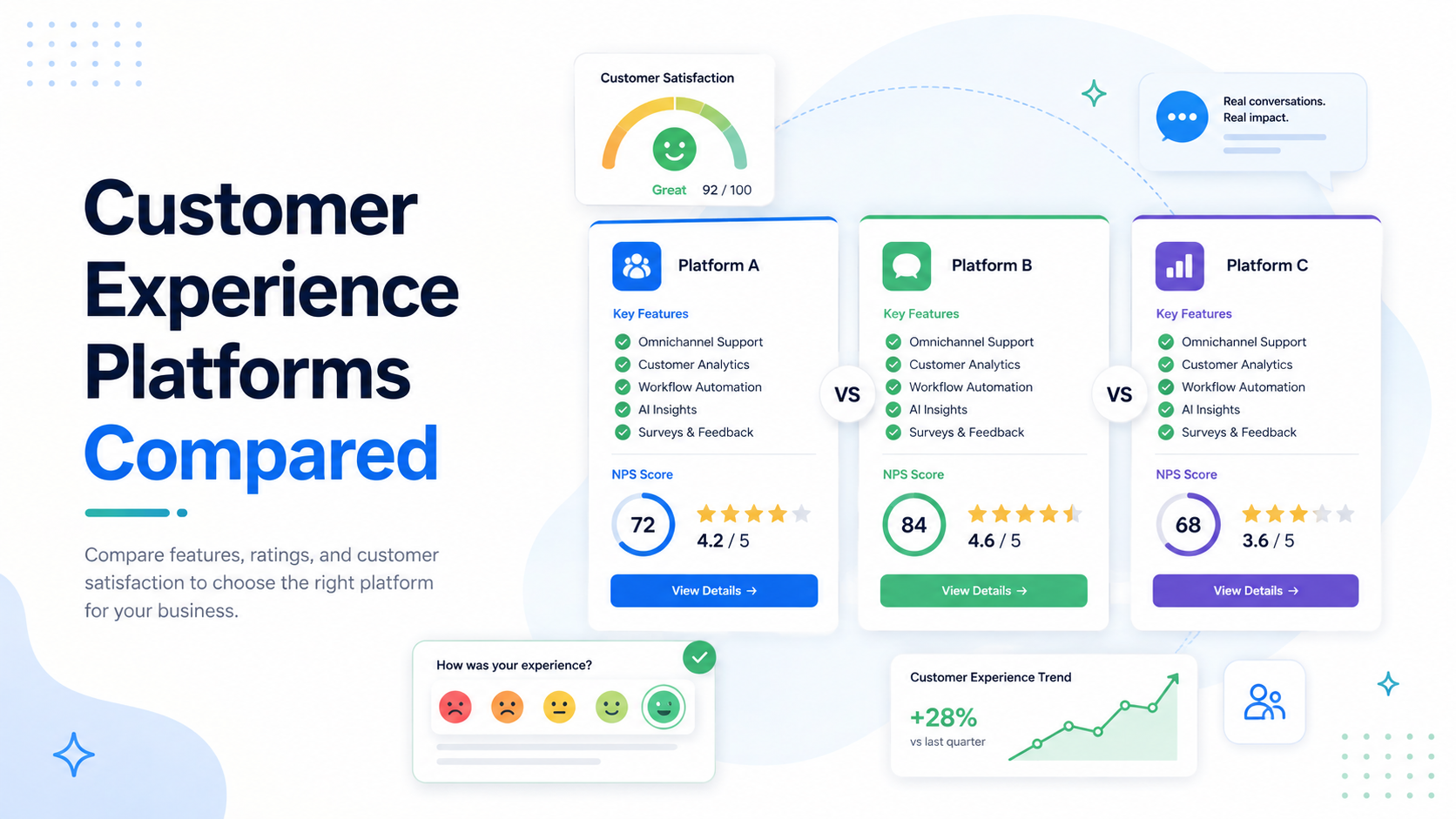
| Platform | Best for | Notable focus | Pricing (approx.) |
|---|---|---|---|
| Medallia | Large enterprises with mature CX programs | Omnichannel experience signals; AI text & speech analytics | Custom / quote-based (enterprise) |
| InMoment | Brands wanting VoC plus review/reputation data | Experience Improvement (XI); reviews + text analytics | Custom / quote-based |
| AskNicely | Mid-market & service teams focused on NPS | Frontline feedback, workflows, and coaching | Quote-based; typically more accessible |
| Press Ganey | Healthcare / patient experience | Patient & workforce surveys; regulatory programs | Custom / quote-based (healthcare) |
Pricing and features change over time. Verify current pricing and capabilities on each vendor's own website before making a decision.
None of these vendors publish a simple pricing page, and that itself tells you something about the market. Enterprise CX software is almost always sold on an annual contract with a custom quote, shaped by the number of survey responses, users, channels, and modules you need. Reported figures vary widely, but it is common to see these programs land in the five- to six-figure range per year, and larger deployments can run higher still.
The subscription is only part of the total cost of ownership. Expect additional line items for implementation and onboarding, integration work to connect the platform to your CRM and data sources, and — in many cases — ongoing professional services or a customer success package to help design and run the program. Time-to-value is measured in weeks or months rather than days, because you are standing up a program, not switching on a widget.
That is not a criticism. For a large organization measuring experience across many locations, channels, and teams, that investment can pay for itself. The point is simply that this pricing model assumes a certain size and level of dedicated staffing. If those assumptions do not match your business, the economics stop making sense — which brings us to the honest part.
If you run a single location, a small multi-location group, a clinic, a dealership, a restaurant, or a local service business, an enterprise CX platform is very likely the wrong purchase. Here are the signs that you are out of scope for these tools:
If several of those describe you, that is not a gap in your operation — it just means you are not the buyer these platforms are built for, and you can get the outcomes you care about with something far simpler.
For most small and local businesses, the practical stack is lighter and cheaper. There are two jobs to cover, and neither requires an enterprise platform.
Reputation and reviews. This is usually the priority: getting more genuine public reviews, monitoring what appears across Google, Facebook, and industry sites, and responding promptly. Purpose-built review-generation and reputation management tools handle exactly this — automated review requests, a single dashboard for monitoring, and reply assistance — without the survey-program overhead.
Lightweight feedback. If you also want to gauge sentiment internally, a straightforward survey tool or a simple NPS/CSAT feature is usually enough. You do not need speech analytics and journey mapping to learn that your checkout is slow or your front desk is friendly.
TrueReview sits in that first category. It is review-generation and reputation software for local and multi-location businesses — not an enterprise CX suite — and it deliberately stays focused on the reviews-and-reputation job rather than trying to be a full VoC platform. If getting more reviews and keeping an eye on your reputation is the outcome you are after, that focus is a feature, not a limitation.

TrueReview automates review requests by SMS and email, monitors your reviews across platforms in one dashboard, and helps you respond — built for local and multi-location businesses, not enterprise CX teams. Start a free 14-day trial.