BLOG POST
If you run a dental, optometry, or medical practice, you have probably heard Solutionreach mentioned as a way to cut down no-shows and keep patients in the loop by text. Maybe a colleague uses it, or it came up while you were shopping for appointment-reminder software. Either way, it helps to know what the platform actually is before you sit through a sales demo.
Most people who type "Solutionreach" into a search bar fall into two camps: patients trying to reach their provider, and practices evaluating the software. This article is for the second group. If you are a patient looking to confirm an appointment or update your details, you are better off contacting your provider's office directly, because Solutionreach is a business tool that practices buy, not a patient portal you sign up for on your own.
Below is a straight explainer of what Solutionreach does, who it is built for, roughly what it costs, and where review generation fits into the picture, so you can decide whether it belongs on your shortlist.
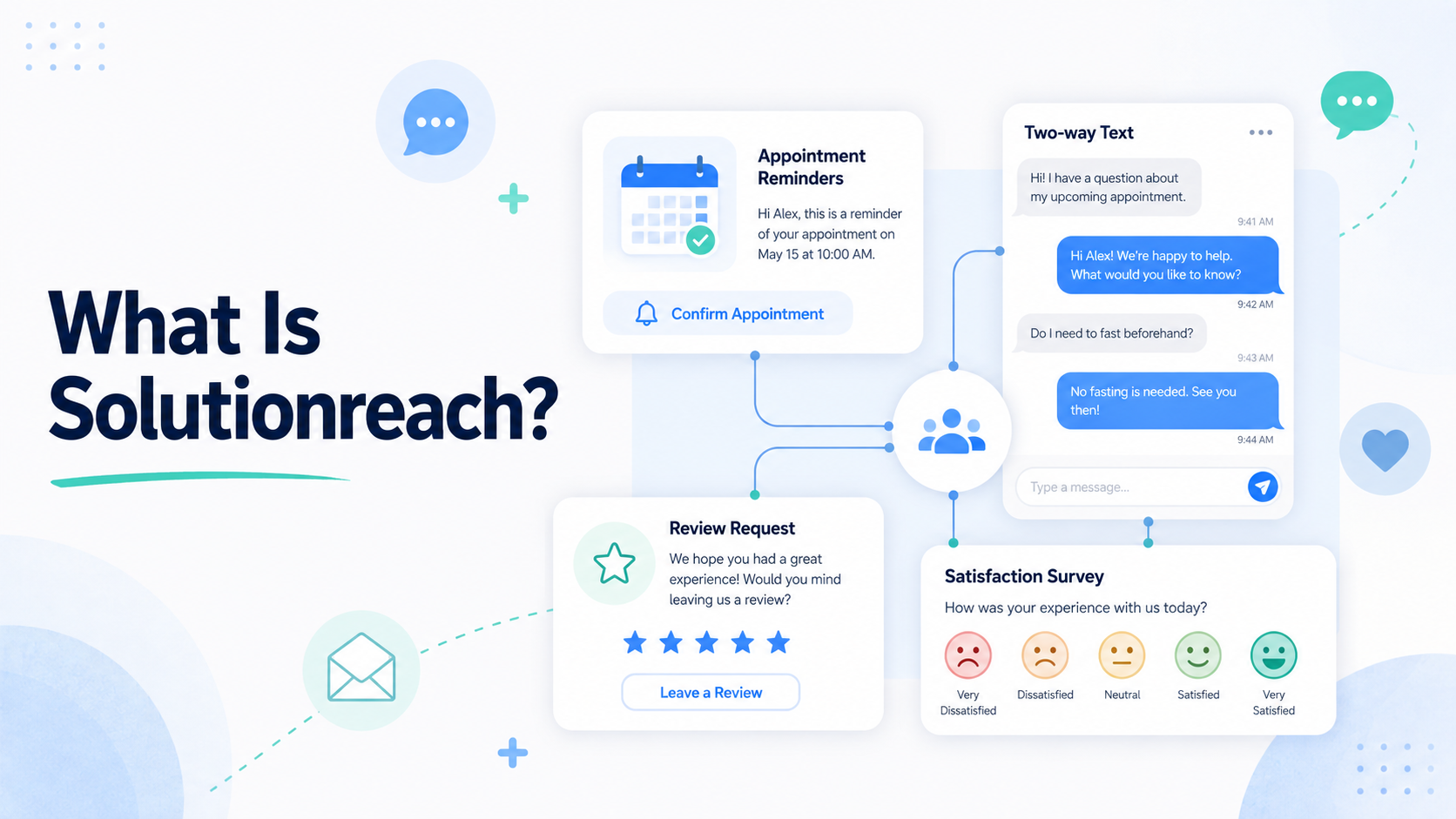
Solutionreach is a patient-relationship management and engagement platform. In plain terms, it sits between your practice management system (PMS) or EHR and your patients, and it automates the routine communication your front desk would otherwise handle by phone: reminding people about upcoming visits, nudging them when they are due for a recall, collecting forms before they arrive, and letting them text the office back.
The company has been in the patient-communication space for around 25 years and is based in Utah. That longevity matters mostly because it means broad integration coverage. Solutionreach reports compatibility with hundreds of practice management and EHR systems, which is often the deciding factor for a practice, because a reminder tool is only useful if it can read your schedule automatically.
It is worth being clear about what category this is. Solutionreach is patient-communication and engagement software, sometimes called patient relationship management. It overlaps with, but is not the same as, dedicated healthcare reputation management software, which focuses specifically on generating and monitoring online reviews. Solutionreach does include reputation features, but reviews are one piece of a much wider communication suite.
The platform is aimed squarely at healthcare practices rather than general local businesses. Its core customers fall into a few buckets:
Inside a practice, the day-to-day users are usually front-office staff and office managers who handle scheduling and patient outreach, plus practice owners who care about the no-show rate and the chair-time it frees up. Patients experience Solutionreach only indirectly, through the texts, emails, and forms your office sends them. For dental teams specifically, our guide for dental practices digs into how patient communication and reviews work together.
Solutionreach bundles a fairly wide set of tools. Exact availability depends on your plan and integrations, so treat the list below as the general shape of the platform rather than a guarantee of what is in any single package.
On the compliance side, Solutionreach positions its texting around HIPAA requirements and publishes its own guidance on secure patient messaging. If patient privacy is central to your decision, confirm the specifics and any business associate agreement directly with their team, because the details depend on how each feature is configured.
Solutionreach does not publish a public rate card. Pricing is quote-based and depends on your practice size, the number of providers, which modules you turn on, and how complex your PMS integration is. Because of that, any figure you see online should be treated as a rough guide rather than a quote.
Based on third-party reports and customer accounts, monthly costs commonly land somewhere from a few hundred dollars a month for smaller single-location practices up to a few thousand for larger multi-location groups. Many reports also mention an annual contract and a one-time implementation or setup fee that scales with integration complexity. None of this is official, so the only reliable number is the one Solutionreach quotes you after a demo.

Vendor pricing and features change over time. Before you commit, ask for a written quote and confirm what is and is not included, then compare it against a focused tool's published pricing.
Solutionreach includes reputation and survey features, but many practices find that a dedicated review-generation tool does a more focused job of turning happy patients into public reviews on Google and healthcare directories. The two are not mutually exclusive: it is common to keep an engagement platform for reminders and intake, and run a review platform alongside it for reputation.
This is where TrueReview fits. TrueReview is review-generation and reputation software that automates review requests by SMS and email, then consolidates the reviews you earn across platforms into one dashboard. Rather than being a full patient-communication suite, it focuses on the reputation side, so it slots in next to whatever reminder or scheduling tool you already use.
On privacy, TrueReview takes a careful stance. It is HIPAA-aware and offers a BAA-lite path for practices that need one, rather than making blanket compliance claims. A practical note if you plan to lean on email requests: the SendGrid email service is not HIPAA-eligible, so review invitations should avoid including protected health information regardless of the channel you use. Keep requests generic ("thanks for visiting, how did we do?") and you sidestep the issue entirely.
Keep the reminder tool you like and layer focused, compliant review generation on top. Start a free 14-day trial and see how it fits your workflow.
Solutionreach is one of several patient-engagement platforms, and the right fit depends on your PMS, your budget, and how much you value reviews versus broader communication. A few names that commonly come up in the same evaluation:
Whatever you compare, verify current pricing and features on each vendor's own site before deciding, since packages and terms change over time.