BLOG POST
Managing reputation for a single medical practice is hard enough. Managing it across 12 locations, or 50, or 200, is a different problem entirely.
Multi-location healthcare organizations — dental support organizations (DSOs), urgent care chains, MSO-affiliated medical groups, multi-site physical therapy and chiropractic practices, MedSpa groups, and hospital systems — face reputation challenges that single-practice playbooks don't address. Every location is its own Google Business Profile, with its own review base, its own GBP listing details, and its own community-level reputation. A group with 30 locations has 30 Google profiles, potentially 30 different star ratings, and 30 ways for the brand to look inconsistent to a patient researching their options.
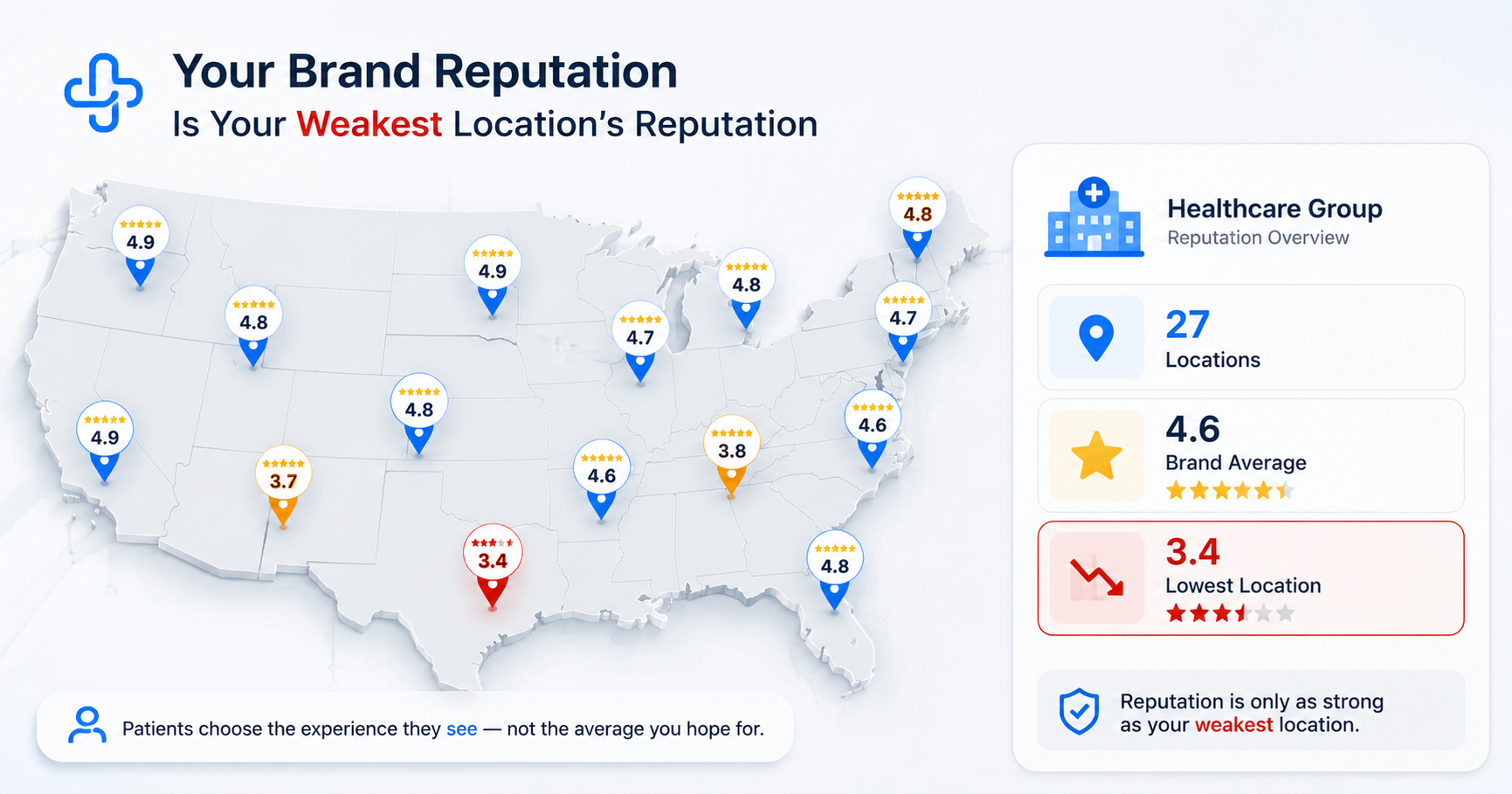
The hard truth: your group's reputation isn't an average — it's a floor. A patient researching your brand finds the closest location to them. If that one location has 47 reviews at 4.9 stars, they book. If it has 12 reviews at 3.6 stars, they call a competitor, regardless of how well your flagship location is rated. The weakest location drags the brand.
This guide is the 2026 playbook for managing healthcare reputation at scale — the platforms, the policies, the operational systems, and the HIPAA considerations that determine whether a multi-location group's reputation strategy works or quietly bleeds patient volume.
If you're running a single practice, our HIPAA-compliant guide for medical practices covers the single-practice playbook. For the broader local-business reputation foundation, see our pillar guide on Google reviews for business.
A few structural realities that make this category harder than single-practice reputation work.
Patients shop by location, not by brand. When someone searches "urgent care near me" or "dentist [neighborhood]," Google shows them the nearest individual location — not a parent brand. 81% of all patient-facing healthcare reviews are posted on Google, and every one of them is tied to a specific location's Google Business Profile, not your corporate identity. Your patient-acquisition fight happens at the GBP level, location by location.
Each location has its own reputation arc. A new location starts with zero reviews and has to build to credibility. An acquired location inherits whatever reputation existed before the acquisition — sometimes good, sometimes a 3.2-star nightmare. A flagship location may have hundreds of reviews while a satellite has eight. None of this averages out cleanly.
The category is consolidating fast. DSOs now control roughly a third of US dental practices and are growing at double-digit rates. Urgent care has consolidated significantly under chains like CityMD, MedExpress, and Carbon Health. MSOs in primary care, dermatology, ophthalmology, and women's health are aggregating practices at record pace. Every acquisition adds another GBP, another review base, and another reputation surface to manage.
HIPAA compliance has to be consistent across every location. A single location violating HIPAA in a review response — say, by acknowledging that a complainer was a patient — exposes the entire parent organization. One California PT clinic recently faced a $35,000 HIPAA penalty for responding to a negative review by detailing the patient's treatment protocol and attendance. At scale, the risk of any single staff member at any single location making this mistake compounds with every location added.
The patient stakes are higher than other multi-location verticals. A bad review of a restaurant chain costs you a meal. A bad review of a urgent care or dental practice gets layered into a patient's decision about who to trust with their body. Healthcare reviews carry weight that retail and restaurant reviews don't.
The takeaway: you need a reputation system designed for scale and for healthcare specifically. Tools built for single-practice marketing fall apart at 12 locations. Generic multi-location reputation tools miss HIPAA requirements. The right system handles both.
The strategy splits into six interlocking pillars. Most multi-location organizations have 2 or 3 of these in place and quietly bleed on the rest.
Each location needs its own GBP — but all of them need to be managed from one place by one team, with consistent standards.
What this looks like in practice:
A common failure mode: each location's office manager handles GBP themselves with no oversight, and three years in, half the locations have inconsistent hours, missing photos, wrong categories, and no recent posts. The brand looks fragmented to patients comparing locations.
This is where most multi-location healthcare groups fall furthest behind. They have a system, but it's a manual, location-specific, inconsistent one — staff at each location remembering to ask for reviews, with no central coordination.
What works at scale:
A platform purpose-built for multi-location operations like TrueReview's manage-multiple-businesses feature centralizes this — one login, one dashboard, location-routed review requests, and per-location reporting. The same review automation that takes a single-practice from 15 reviews to 100+ in a year takes a 30-location group from 450 reviews to 3,000+ over the same period.
The biggest legal risk in multi-location reputation management is inconsistent review response practices. A staff member at one location might respond to a review with "Thanks for choosing us for your root canal!" — and that response just publicly confirmed that the reviewer was a patient and what procedure they had. Both confirmations violate HIPAA.
The non-negotiable HIPAA rules for review responses:
What to put in place at scale:
You cannot manage what you don't measure. Multi-location reputation management lives or dies on whether you have real visibility into how every location is performing relative to the brand average and to each other.
The metrics that matter at the location level:
The metrics that matter at the brand level:
The locations dragging your brand down need targeted intervention — not the same generic "ask for more reviews" plan you give everyone. Maybe they need a staff training refresh. Maybe they have a single provider whose negative reviews are dragging the location's average. Maybe they have a chronic operational issue (long waits, billing problems) that no amount of review-request automation will fix.
Google is the primary battle, but multi-location healthcare groups also need consistent listings on the broader directory ecosystem. Inconsistent listings hurt local SEO and confuse patients.
The platforms that matter beyond Google for healthcare:
For each, every location needs accurate, consistent NAP (Name, Address, Phone) information. The Birdeye data shows 71% of consumers report having a negative experience because of incorrect local business information found online — a fragmented multi-location healthcare group is exactly the kind of organization where these inconsistencies pile up unnoticed.
The system at scale: use a listings management tool (or include it as part of your reputation platform) to push consistent NAP data to all directories from one source of truth. Yext, Birdeye, and similar tools handle this for enterprises; TrueReview's review widget and embedded review features handle the front-end display of those reviews back on your location-specific website pages.
At single-practice scale, a viral negative review is a manageable problem. At multi-location scale, it's a brand-level crisis that can spread across review sites, social media, and local news in hours.
What you need before the crisis hits:
Most multi-location groups discover they need this only after they don't have it. The day a single negative experience becomes a regional news story is not the day to start writing protocols.
A meta-decision every multi-location organization makes (sometimes intentionally, often by default): does reputation management live at corporate or at the location level?
Centralized model: A corporate team owns GBP, review monitoring, and response writing across all locations. Locations may flag issues but don't directly manage the public-facing reputation.
Federated model: Each location's manager owns day-to-day reputation, with corporate setting policy and providing tools.
Hybrid model (most common at scale): Corporate owns GBP management, listings, monitoring, and crisis response. Locations handle individual review responses using approved templates, with corporate review for anything escalated.
There's no universally right answer. What matters is being deliberate — not letting the model emerge from whoever happens to be most willing to take it on at each location.
If you're starting from a fragmented current state (which is most groups), here's the sequence:
Month 1: Audit & Centralize
Month 2: Systems & Policy
Month 3: Execution & Tuning
By day 90, every location should be on the same system, with consistent collection workflows, HIPAA-compliant response practices, and visible performance data. The locations that need targeted intervention should be identified, with clear ownership of the work to improve them.
Five things to remember:
Multi-location healthcare reputation management in 2026 isn't about doing reputation work harder — it's about doing it systematically at scale, with healthcare-specific guardrails, and with operational visibility that lets you intervene where it matters most.
Ready to centralize your reputation system across every location? Start a free 14-day trial of TrueReview — manage every location from one dashboard, automate location-routed review requests via SMS and email, deploy HIPAA-compliant AI response suggestions, and get per-location performance reporting across your entire network.