BLOG POST
If you run a medical or dental practice, "patient communication software" is one of those categories that sounds simple until you start shopping. Every vendor promises fewer no-shows, happier patients, and a fuller schedule. Under the hood, though, these products are built around very different starting points, and the one that fits a solo dental office is rarely the one a 40-provider health system needs.
The confusion is understandable. NexHealth, Luma Health, Weave, Solutionreach, RevenueWell, Relatient, Artera, and Tebra all describe themselves with overlapping language: engagement, communication, access, retention. But some of these platforms lead with scheduling, some lead with messaging, and a few are really about reputation and reviews. Knowing which "lens" a tool was designed through tells you more than any feature checklist.
This guide breaks the market into three practical families, compares ten well-known platforms in one table, walks through EHR and practice-management integrations, sets realistic pricing expectations, and explains where a dedicated review tool fits alongside (not instead of) a full communication platform. Verify current features and pricing on each vendor's site before you buy, since they change often.
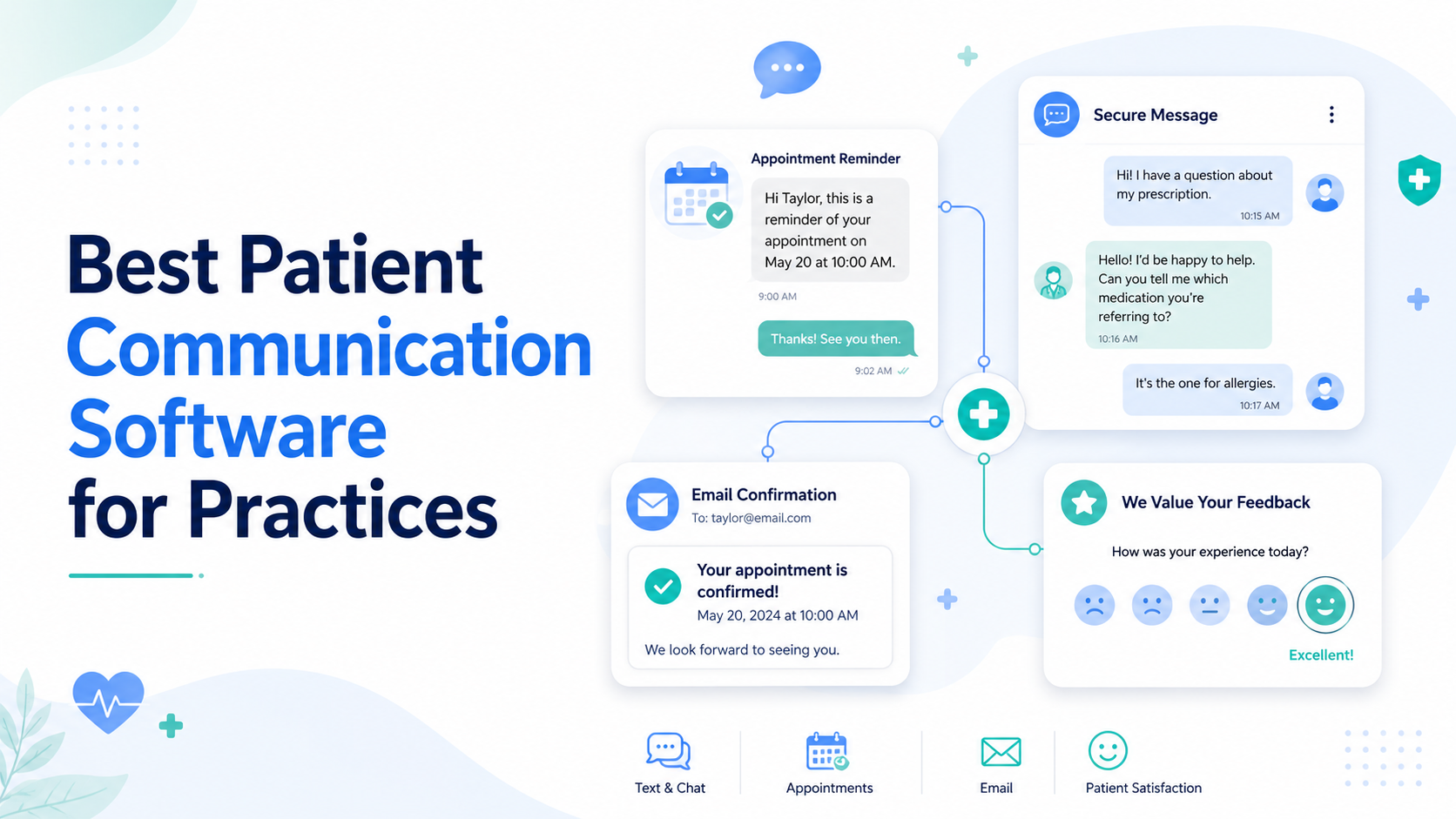
At its broadest, patient communication software is any system that automates the messages a practice sends and receives outside of a live phone call: appointment reminders, confirmations, recall and recare notices, intake forms, billing nudges, post-visit follow-ups, and review requests. The goal is almost always the same — reduce no-shows, cut front-desk phone time, and keep the schedule full — but the path to that goal differs by product.
Many of these tools are also described as "patient engagement platforms," which is a slightly broader term that can include self-scheduling, digital intake, patient portals, telehealth links, and campaign marketing. In practice, the two labels are used interchangeably, and the buying decision comes down to which capabilities you actually need and which system your clinical records already live in.
The most important filter is deceptively boring: does the tool sync cleanly, in real time, with your EHR or practice-management system? A messaging platform that cannot read your appointment book has to be updated manually, which quietly defeats the automation you paid for. We come back to integrations below, because they make or break the whole experience.
It also helps to be clear about who the software is really for. A tool that dazzles in a health-system demo can be heavy and overbuilt for a two-provider dental office, while a lightweight all-in-one that suits a small clinic may lack the reporting and access controls a multi-location group needs. There is no single "best" product in this category — only the best fit for your size, specialty, staffing, and the systems you already run.
Almost every platform in this category leans toward one of three centers of gravity. A tool can do all three things to some degree, but its origins usually show in what it does best and where it charges the most.
Why does this matter? Because you will pay for the platform's center of gravity whether you use it or not. Buying an enterprise scheduling platform to send appointment texts is overkill; buying a texting tool and hoping it will meaningfully grow your Google rating usually disappoints. Match the tool's strength to your bottleneck, then confirm it covers the "good enough" version of the other two jobs.
Before you sit through a single demo, work through the questions below. They will narrow a crowded field to a short list far faster than feature grids will.
The table below groups ten widely used platforms by their center of gravity. Treat "best for" as a starting point, not a verdict — several of these tools serve adjacent markets well. Pricing is approximate and mostly quote-based in this category, so confirm current numbers directly with each vendor.
| Platform | Group | Best for | Notable | Pricing (approx.) |
|---|---|---|---|---|
| NexHealth | Scheduling-led | Dental & medical practices wanting online booking | Real-time booking, reminders, forms, payments, broad EHR sync | Quote-based; reportedly from a few hundred/mo |
| Luma Health | Scheduling-led | Larger groups & health systems | Self-scheduling, waitlist, intake, AI messaging; deep Epic/Oracle Health ties | Custom/quote |
| Relatient | Scheduling-led | Large medical groups & specialty networks | Dash platform: self-scheduling, reminders, intake, patient payments | Custom/quote |
| Tebra | Scheduling-led | Independent practices wanting EHR + engagement in one | Combines EHR/PM with scheduling, reminders, reputation, websites | Modular/quote |
| Weave | Messaging-led | Small dental, optometry, vet & medical offices | Combines VoIP phones with texting, reminders, reviews, payments | Quote-based; reportedly from ~$249/mo |
| Solutionreach | Messaging-led | Mid-size practices focused on recall & retention | Reminders, two-way texting, surveys, newsletters, reviews | Quote-based; reportedly mid-hundreds/mo |
| RevenueWell | Messaging-led | Dental practices focused on marketing & recare | Campaigns, reminders, online forms, reviews, AI phone tools | Quote-based |
| Artera | Messaging-led | Enterprise health systems unifying outreach | Formerly WELL Health; consolidates messages across many systems | Enterprise/quote |
| Podium | Review-led | Local practices wanting reviews plus texting | Review generation, webchat, messaging, payments; not healthcare-only | Quote-based; reportedly from ~$249/mo |
| TrueReview (Ours) | Review-led | Practices that want more & better reviews without gating | SMS/email review requests, multi-platform monitoring, AI replies, HIPAA-aware with a BAA-lite path | Tiered; 14-day free trial |
Pricing is approximate and changes often — verify current pricing and features on each vendor's website before purchasing.
A few honest caveats. NexHealth, Luma Health, Relatient, and Artera all publish little public pricing and sell primarily through demos, so any figure you see quoted secondhand is a rough guide at best. Podium and Weave serve wide swaths of local business beyond healthcare, which is a strength for texting and reviews but means their clinical-workflow depth varies by specialty. And every one of these vendors iterates quickly, so the feature you need most is worth confirming live in a demo.
Integration is where patient communication software either quietly saves hours a week or quietly creates them. The right question is not "do you integrate?" but "do you write back to my system in real time, and has that connection been in production for practices like mine?"
Patterns worth knowing as you shortlist vendors:
Whatever you choose, ask for a reference customer on your exact EHR and version. Integrations are certified per system, and "supported" does not always mean "battle-tested for your setup."
Pricing in this category is mostly quote-based and rarely published in full, which makes apples-to-apples comparison hard. Still, some broad patterns hold. Small-practice, messaging-first tools such as Weave, Solutionreach, and RevenueWell commonly land somewhere in the low-to-mid hundreds of dollars per month per location, often with onboarding fees and annual contracts. Enterprise scheduling and communication platforms such as Luma Health, Relatient, and Artera are custom-quoted and can run substantially higher, scaling with providers, locations, and message volume.
Watch for the line items that inflate a quote: setup and onboarding fees, per-provider or per-location pricing, text and email overage charges, phone-hardware costs for VoIP-based tools, and "premium" modules (reviews, campaigns, AI features) sold as add-ons. A platform that looks cheaper on the headline can end up costing more once your real usage is priced in. When in doubt, ask each vendor to quote your specific number of locations, providers, and monthly message volume, and compare total annual cost rather than the sticker price.
Contract terms matter as much as the monthly figure. Many platforms in this category ask for an annual commitment, and a few build in automatic renewals, so read the term length and cancellation window before signing. If you are early in your evaluation, favor vendors that let you pilot the workflow — whether through a hands-on trial or a short initial term — so you can confirm the tool earns its keep with your patients before you lock in for a year.
Dedicated review tools sit at the more affordable end of this spectrum, because they do one job rather than ten. TrueReview, for example, uses simple tiered plans (Starter, Small Business, and Premium) with a 14-day free trial that includes up to 250 requests, so you can test the review workflow before committing. You can see current tiers on the TrueReview pricing page.
Here is the honest part. TrueReview is not a scheduling platform, a VoIP phone system, or an EHR. It will not book appointments, run your patient portal, or manage clinical intake. If empty slots or phone overload are your primary problem, one of the scheduling-led or messaging-led platforms above is the right starting point.
What a full communication platform typically treats as a side feature — asking patients for reviews and managing your online reputation — is the entire focus of a dedicated review tool. That focus tends to show. Many all-in-one platforms bundle a basic "send a review link" function, but they rarely offer the compliance guardrails, cross-platform monitoring, and response tooling that a reputation-first product does.
TrueReview automates review requests by SMS and email, personalized or in bulk, with customizable delays and follow-up drip campaigns. It sends neutral requests to every patient rather than screening for happy ones first (no review gating), which keeps you consistent with Google's policies and the FTC's rule on consumer reviews. It consolidates reviews from across the web — Google, Facebook, Healthgrades, Zocdoc, WebMD, and more — into one dashboard with alerts, generates AI-suggested replies, and includes Review Radar™, which detects reviews that appear to violate Google's review policies. It is HIPAA-aware and offers a BAA-lite path for practices that need one; if you use email-based requests, note that the underlying email provider (SendGrid) is not HIPAA-eligible, so patient-identifying details should stay out of email content.
In practice, many healthcare organizations run a communication or scheduling platform for the calendar and inbox, and pair it with a dedicated review tool to grow and protect their public reputation. The two are complementary, not competing. For a deeper look at the reputation side, see our guide to healthcare reputation management, and if you are weighing specific platforms, our comparisons of TrueReview vs Tebra and TrueReview vs Relatient go deeper on where each fits.

Already have a scheduler or texting tool? TrueReview handles the review-and-reputation job those platforms treat as an afterthought — compliant requests, cross-platform monitoring, and AI-assisted replies, HIPAA-aware with a BAA-lite path. Start a free 14-day trial.