BLOG POST
Google quietly renamed Google My Business to Google Business Profile in late 2021, and most articles online still haven't caught up. The old name is everywhere — in software interfaces, blog posts, agency pitches, even some of Google's own training materials — but the actual product has continued to evolve under the new name, with meaningful changes to how profiles are managed, how rankings are calculated, and what signals matter most.
This guide is the 2026 reference: what Google Business Profile is now, what's changed since the GMB days, the seven fields that actually move local pack rankings, how verification works today, and the operational habits that compound into top-three local pack placement over time. The fundamentals are still recognizable from the GMB era, but the weights have shifted, the policy enforcement has tightened, and the businesses that treat their profile as a static listing are losing ground every quarter to the ones treating it as an active marketing surface.
Google Business Profile is the free product that controls how your business appears in Google Search, Google Maps, and the local 3-pack. It's the same underlying product that used to be called Google My Business, with three structural changes worth understanding.
The dedicated app is gone. The old Google My Business mobile app was retired in 2022. All profile management now happens either through the management interface inside Google Search (when you're signed in and search for your own business) or through Google Maps. There's no separate app to download.
The desktop dashboard moved. The old business.google.com dashboard still exists for multi-location managers, but most single-location businesses now manage their profile directly from Search — you log into Google, search for your business name, and the management options appear inline in the search result. Faster, but harder for new users to find.
The ranking signals have rebalanced. Google's local algorithm still revolves around the three traditional pillars — relevance, distance, and prominence — but within those, the relative weight of reviews, profile completeness, and consistent activity has increased meaningfully. A perfectly filled out profile with zero recent activity ranks worse in 2026 than a slightly less complete profile with consistent review velocity, regular posts, and active Q&A.
The Google Business Profile is the single highest-leverage marketing asset most local businesses have, and the gap between businesses that treat it that way and those that don't has widened substantially over the past three years.
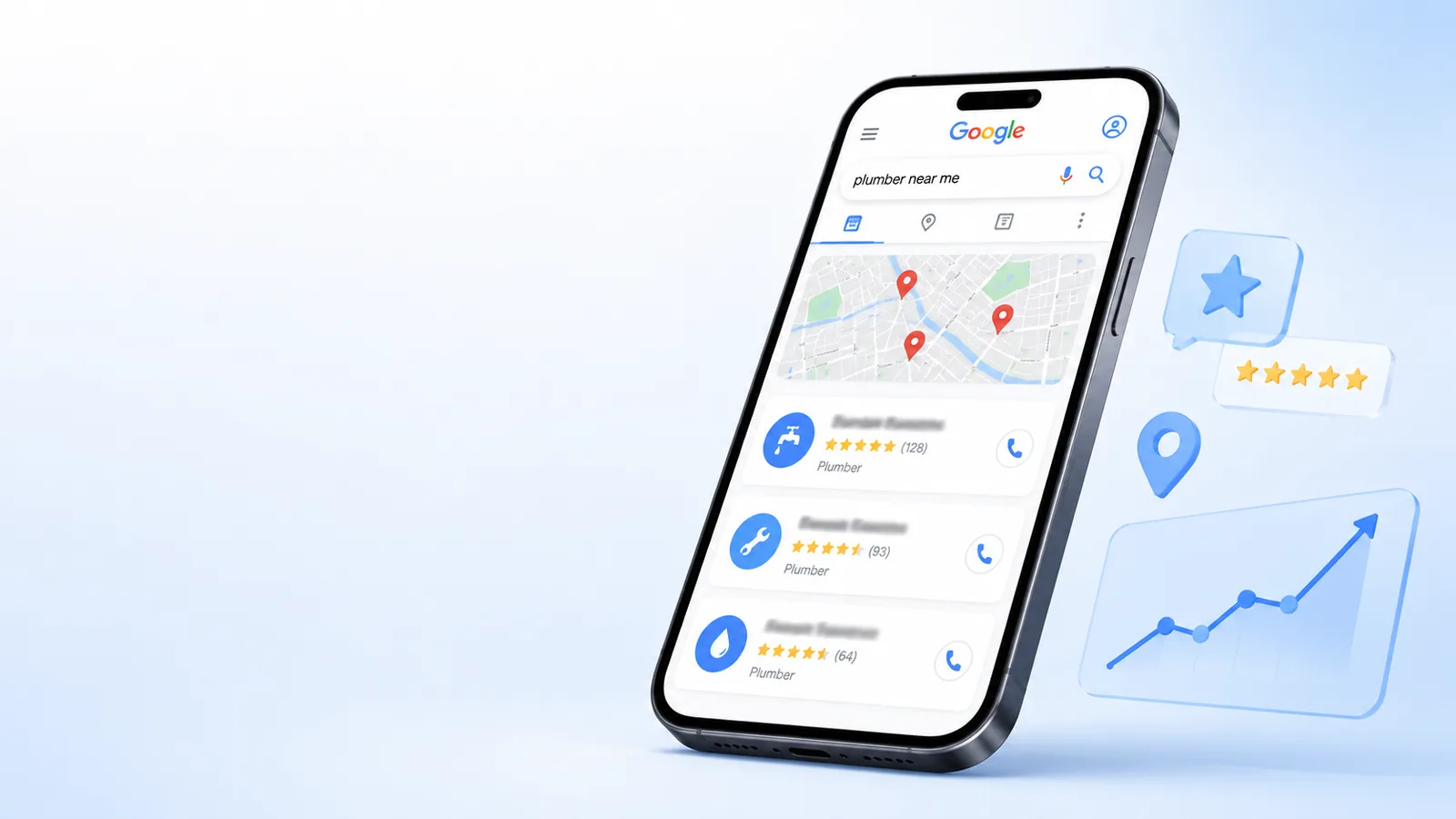
Google has compressed more high-intent traffic into the local pack. When someone searches for "plumber near me" or "dentist in Austin" with a local intent signal, the first thing Google shows is the local 3-pack — three businesses with their reviews, photos, and a map. Most users don't scroll past it. The conventional organic blue links that used to dominate are now buried below the pack on mobile and de-emphasized on desktop.
AI overviews increasingly pull from GBP data. When someone asks an AI assistant for a recommendation, the AI doesn't visit your website to evaluate you — it queries the structured business data Google already has, which comes overwhelmingly from your profile. A weak profile is invisible to AI search the same way it's invisible to local pack search.
Prospects have moved beyond just reading reviews. They look at profile photos, hours, posts, Q&A responses, and response patterns to form a comprehensive impression in under a minute. A complete, active, well-maintained profile signals operational seriousness; a thin, neglected one signals the opposite.
Out of the dozens of fields a Google Business Profile contains, seven materially affect local pack rankings. The rest are useful for conversion but don't directly influence whether you appear in the pack. Focus optimization energy here first.
1. Primary category. The single most important field on your profile. Google uses your primary category to decide which searches you're eligible to appear for. "Dentist" and "Cosmetic Dentist" rank for different queries, even though they overlap. Choose the most specific primary category that accurately describes your core service.
2. Secondary categories. You can add up to nine additional categories. Use them — but only for services you actually provide. Stuffing irrelevant categories ("Restaurant" when you're a coffee shop with pastries) gets profiles flagged and demoted.
3. Business name. Use your real, legal business name. Adding keywords ("Acme Plumbing — Best 24/7 Emergency Plumber") is a policy violation that gets profiles suspended. Google's enforcement on this has gotten substantially more aggressive in 2025-2026.
4. Address and service area. Storefront businesses display their address; service-area businesses (plumbers, electricians, mobile services) hide their address and show a service area instead. Misconfiguring this — claiming a storefront address when you operate from home — is one of the top causes of suspension.
5. Reviews — count, recency, and response rate. Reviews are the single largest variable signal in the algorithm. Volume matters, but recency matters more than total count after the first hundred or so reviews. A business with 200 reviews from the past 12 months outranks one with 800 reviews mostly from 2019.
6. Profile completeness. Every field you fill out — hours, website, attributes, services, products, photos — is a signal of an active business. Profiles below roughly 80% completeness rank worse than equivalent profiles at 100%.
7. Engagement signals. Posts, Q&A responses, photo uploads, and review responses all signal that the business is actively maintained. The cumulative volume over the trailing 90 days matters more than any single big update.
Verification is how Google confirms you're authorized to manage a given business. Until you're verified, your profile is essentially invisible. There are now five verification paths, and which one is offered depends on your business category, location, and history.
Video verification. Now the most common path for new profiles. Google asks you to record a video showing your business location, signage, equipment, and proof you're authorized to manage it. Typically takes 5-7 days for review. The video doesn't need to be polished — clear and complete is what matters.
Postcard verification. The legacy default, still available for some categories. Google mails a postcard with a verification code to your business address; you enter the code in your profile. Takes 5-14 days, sometimes longer in international markets. Less common for new profiles in 2026 because Google has moved most categories to video verification.
Phone or text verification. Available for some businesses, especially when the phone number on the profile is verified and the business has been previously claimed. Faster — typically same-day.
Email verification. Available in narrow cases, mostly for businesses where the domain on the email matches the business website. Same-day when available.
Instant verification. For businesses that have already verified the same domain in Google Search Console, instant verification skips the standard process entirely. The fastest path when it's available, but most small businesses won't qualify because they haven't done Search Console verification.
Verification fails most often because the business name or address on the profile doesn't match what's on the verification artifact (postcard delivery address, video signage, etc.). Get these aligned before submitting.
Choosing the right primary category is the highest-leverage optimization decision on the entire profile, and most businesses get it wrong.
The general rule: pick the most specific category that accurately matches what most of your customers come to you for. "Italian Restaurant" beats "Restaurant." "Personal Injury Attorney" beats "Attorney." "Cosmetic Dentist" beats "Dentist" — but only if cosmetic work is genuinely your primary focus. Lying about your primary category to chase higher-volume keywords backfires when actual customers leave negative reviews about services you don't actually emphasize.
For secondary categories, the rule is different: add every category that legitimately describes something you do. A medical spa that does Botox, fillers, laser hair removal, and chemical peels should have all four categories selected. Each one expands the set of search queries the profile is eligible to appear for.
Two common mistakes:
The biggest behavioral shift between GMB-era optimization and GBP optimization in 2026 is how much engagement signals matter. A profile that gets new photos, posts, and Q&A activity regularly ranks materially better than one that's filled out perfectly but sits static.
Businesses with active photo programs receive substantially more profile views, direction requests, and click-throughs. The mechanics:
Google Business Profile posts are essentially mini-announcements that appear in your profile for seven days. They drive limited direct traffic but they're a strong activity signal. The minimum cadence to maintain the signal is roughly one post per week. Categories to rotate through:
The Q&A section is publicly viewable and anyone can ask or answer questions. Two underused tactics:
Reviews are the largest variable signal in the local algorithm. Three dimensions matter, in this order:
Recency. A steady flow of new reviews matters more than total volume after the first hundred or so. Profiles with no reviews in the past 90 days are downweighted regardless of their lifetime count. A consistent program that produces 10-20 new reviews per month outperforms a one-time push that gets 200 reviews and then goes silent.
Response rate. Profiles that respond to most reviews (positive, neutral, and negative) rank better than profiles that don't. Response time matters too — within 24-48 hours of the review posting is the target.
Volume. All else equal, more reviews beats fewer. But "all else equal" is a critical qualifier — 800 mostly-old reviews lose to 200 mostly-recent ones.
The compliance layer that most agencies and review platforms ignore: Google's review policy explicitly prohibits review gating (filtering out unhappy customers before asking for a review), incentivized reviews (offering anything of value in exchange for a review), and fake reviews. The 2024 FTC Rule on Consumer Reviews and Testimonials adds federal penalties on top of Google's platform-level enforcement. A review program that quietly violates these rules can produce a wave of suspended profiles and removed reviews when Google's detection catches up — which it increasingly does.
For the full framework on compliant review collection, see our guide to review management and our guide to asking for reviews. For handling reviews that violate Google's policy, see our guide to removing bad Google reviews.

TrueReview sends compliant SMS and email review requests after every customer interaction, with Review Radar scanning incoming reviews for Google policy violations and guiding you through reporting. Multi-platform support across Google, Facebook, Trustpilot, plus vertical-specific platforms like Zillow, Realtor.com, Mangomint, Boulevard, and Vagaro. Start a free 14-day trial.
Google's enforcement of profile policies has gotten substantially more aggressive in 2025-2026. The most common reasons profiles get suspended:
Keyword-stuffed business names. "Acme Plumbing — Best 24/7 Emergency Plumber in Austin" gets suspended. Use the real legal business name only.
Address misconfigurations. Claiming a storefront address when operating from home; claiming a virtual office or coworking space as a real location; using the same address for multiple profiles. All trigger suspension.
Service-area abuse. Service-area businesses that set unrealistic service radiuses to appear in more cities get demoted or suspended.
Multiple profiles for the same business. Duplicates created accidentally or to capture more search terms get merged or suspended. One business, one profile.
Closed or moved without updating. Businesses that close, move, or substantially change services without updating the profile get demoted.
Fake review patterns. Unusual review velocity (a sudden burst of 50 five-star reviews in a week), reviews from accounts with no other review history, or reviews that all use similar language patterns trigger algorithmic review removals and can cascade into profile suspension.
Reinstating a suspended profile is possible but slow — typically 5-14 days for review, with no guarantee of approval. Avoiding suspension by following policy from the start is dramatically easier.
Six things to focus on, in order of leverage:
The fundamentals of Google Business Profile optimization in 2026 are recognizable from the Google My Business era, but the weights have shifted. Categories are the foundation. Reviews — collected steadily, responded to consistently, and grown compliantly — are the compounding signal that pulls profiles into the top three over months. Engagement activity keeps the signal live between review milestones. Businesses that treat their profile as an active marketing surface are pulling ahead of the ones treating it as a one-time setup task.
For complementary reading, see our guide to Google business reviews, our guide to Google Maps marketing, and our review response templates with 30+ examples.
TrueReview sends compliant SMS and email review requests, monitors incoming reviews across Google and 8+ other platforms, and includes Review Radar — our AI that spots Google policy violations and guides you through reporting. HIPAA-aware workflows for healthcare; agency and multi-location support with white-label options. Setup takes about 15 minutes. Start a free 14-day trial.