BLOG POST
Local online marketing is the system that puts your business in front of the prospects who can actually walk through your door, call you, or hire you for a job near where they live. It overlaps with local SEO, digital marketing, and reputation management, but it's specifically focused on the geographic-proximity component — the prospects within a defined radius who are looking for what you do.
The mechanics changed substantially over the past few years. Google retired the Google My Business app and rebranded to Google Business Profile. Reviews became the dominant local ranking signal, materially outpacing on-page SEO for most categories. The FTC's 2024 Rule on Consumer Reviews made several previously-common tactics federally illegal. AI-generated search results started feeding directly from Business Profile data and reviews. Yelp's traffic share continued to shift toward Google for most categories, while specialty platforms (Nextdoor, vertical-specific platforms) grew in their niches.
This guide covers the full local online marketing framework in 2026: the seven channels that matter, the relative leverage of each, where to focus first, and how to operate compliantly across all of them.
Local online marketing is a stack, not a single channel. The components, in order of leverage for most local businesses:
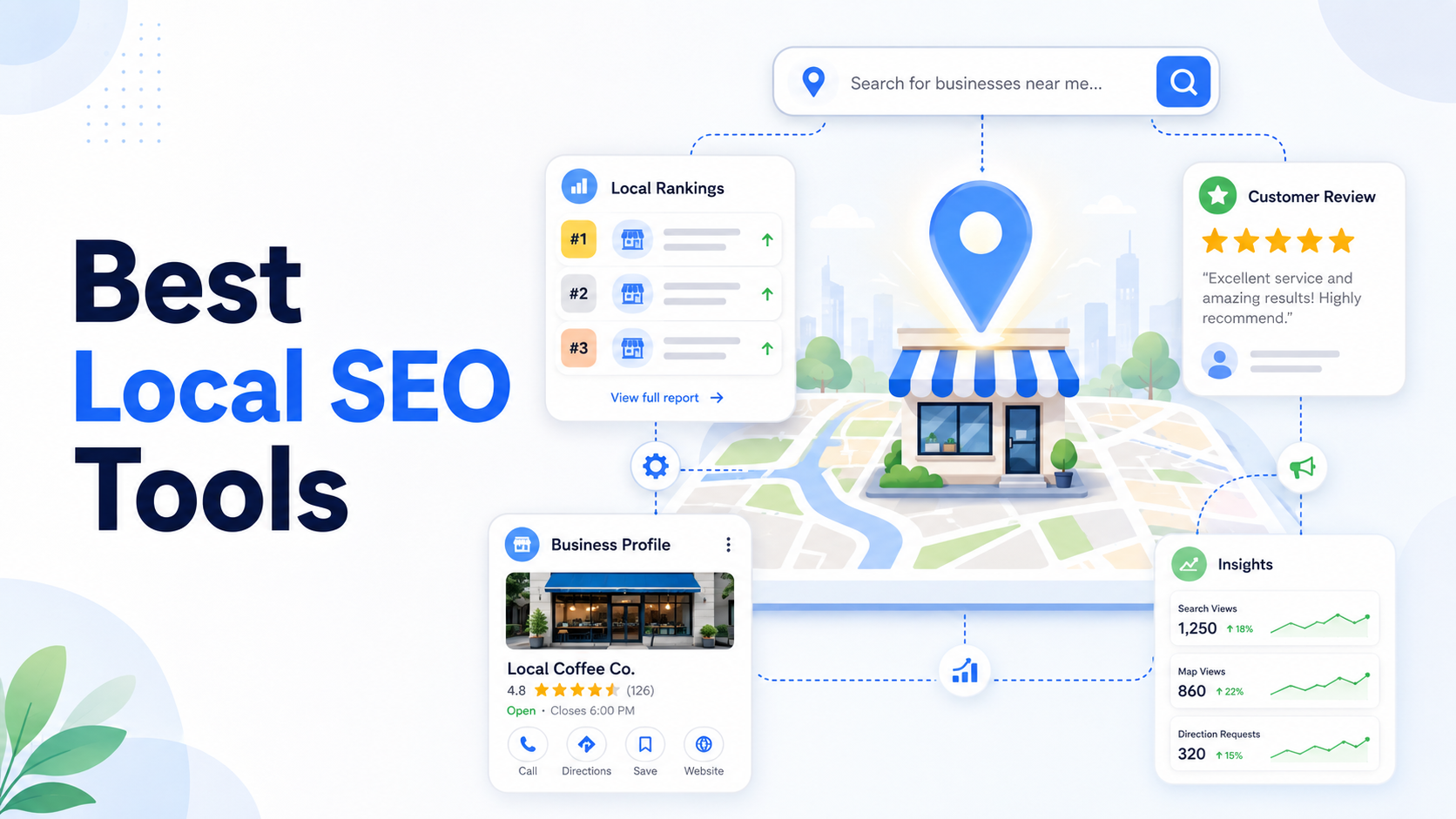
1. Google Business Profile. The foundation. Your free profile listing that controls how you appear in Google Search, Google Maps, and the local 3-pack. For most local businesses, GBP drives more discovery than the website itself does.
2. Reviews. The single highest-leverage signal for local rankings, and the largest trust signal for prospects researching your business. Primary on Google; secondary on Yelp, Facebook, and vertical-specific platforms by category.
3. Local SEO and website optimization. Your website's local relevance and technical fundamentals: NAP consistency across the web, location pages for multi-location businesses, mobile-optimized layout, fast load times, structured data.
4. Paid local advertising. Google Local Service Ads (for eligible categories), Google Ads with local intent targeting, Yelp Ads (for categories where Yelp drives meaningful traffic), Meta (Facebook/Instagram) ads for retargeting and brand awareness, Nextdoor Sponsored Posts for residential-serving businesses.
5. Content and local SEO content strategy. Service-area pages, neighborhood pages for multi-location businesses, locally-relevant blog content, FAQ schema, and the supporting content that signals topical authority for local search.
6. Social media for community engagement. Local Instagram and Facebook presence, neighborhood-relevant content, community involvement, and the brand-awareness layer that supports the other channels rather than driving direct conversions.
7. Email and customer retention. The long-tail layer that nurtures existing customers into repeat business, drives reviews from past customers, and supports the lifetime value math that makes the rest of the program economically viable.
Most local businesses get the order wrong. They invest in website redesigns and social media before claiming their Google Business Profile or building a review program. The order matters because the channels compound from the top down: a strong Business Profile + review program makes paid spend more efficient, makes the website convert better, and gives social media organic content to feature.

Google Business Profile + a compliant review program is the highest-leverage combination for most local businesses. TrueReview automates compliant SMS and email Google review requests after each customer event, integrates with 8+ booking and CRM platforms, and surfaces incoming reviews in a unified dashboard. Start a free 14-day trial.
The free profile listing that controls how your business appears across Google's surfaces — search results, Maps, the local 3-pack, and increasingly the AI-generated overviews that summarize local options. For most local businesses, GBP drives more discovery than the website does.
Every field complete: specific primary category (not generic — "Italian Restaurant" outperforms "Restaurant"), accurate secondary categories, complete hours including special hours for holidays, services list, products list, attributes, business description without keyword stuffing, NAP consistency with everywhere else your business appears. 50+ photos — exterior, interior, team, work samples. Fresh Google Posts weekly. Active Q&A monitoring (the Q&A section is publicly answerable by anyone — if you don't answer, competitors or strangers will).
Most established businesses have an auto-generated Business Profile they haven't claimed. The current process: search for your business on Google or Maps, click "Claim this business" or "Own this business?", verify ownership through Google's available verification methods (video, postcard, phone/email, or instant via Search Console). Full claim-and-verify typically takes 5-14 days. For complete step-by-step coverage, see our guide to claiming your Google Business Profile. Before you build out listings, confirm you can check business name availability.
Google's local 3-pack — the three Business Profile listings that appear above organic results for most local searches — gets a disproportionate share of clicks. Mobile-first design has accelerated this; on phones, the 3-pack often fills the entire above-the-fold area for a category search. AI Overviews introduced in 2024 and expanded in 2025 increasingly synthesize Business Profile data and reviews to generate direct recommendations, which means a strong profile feeds AI-mediated discovery in addition to direct search results.
For the complete profile optimization playbook, see our guide to Google Business Profile.
Reviews are the prominence signal that most directly moves local rankings, and the largest trust signal that drives prospects to choose your business over competitors with similar profiles. The four operational metrics that matter:
Lifetime volume. Aim to pass 100 reviews to break out of "still building" perception. Above 100 is "established"; above 500 is "category leader"; above 1,000 is "dominant."
Monthly velocity. Most successful single-location businesses produce 10-20 new reviews per month. Below 5/month signals inactivity. Above 30/month for a single location starts to look suspicious to algorithms unless your transaction volume justifies it.
Recency. No 90-day gaps. Recent reviews carry more weight than old ones; prospects scrolling reviews also pay close attention to the most recent ones, which form the trust impression.
Response rate. 90%+ within 24-48 hours, on every review — positive, neutral, and negative. Response activity is a real ranking signal and a major trust signal for prospects.
The FTC's 2024 Rule on Consumer Reviews made several previously-common tactics federally illegal with civil penalties in the tens of thousands of dollars per violation. The current compliant playbook:
Ask every customer. No filtering by satisfaction (that's review gating, a Rule violation and Google policy violation). SMS or email triggered after each customer event, two requests maximum (initial ask plus one polite reminder).
No incentives. Discounts, gift cards, contest entries, free items, or any value exchange for a review violates the Rule and platform policies. Ask without offering anything in return.
No rating specification. Don't say "leave us a 5-star review." Don't say "if you had a great experience..." Don't ask only after positive interactions. Just ask for the review.
No fake reviews. No purchased reviews, no AI-generated reviews presented as genuine, no employee or family reviews without disclosure of the relationship.
Different categories have different review platform stacks. For most local businesses, Google is primary and one or two secondary platforms matter. Restaurants and bars: Google + Yelp + (TripAdvisor for tourist markets). Home services: Google + (Angi, HomeAdvisor, BBB depending on region) + Nextdoor for residential-serving categories. Medical and dental: Google + Healthgrades + (Vitals, ZocDoc by specialty) + Facebook. Legal: Google + Avvo + Martindale-Hubbell. Real estate: Zillow + Realtor.com + Google. Salon/spa: Google + Yelp + (Mangomint/Boulevard/Vagaro booking platform reviews).
For platform selection by category, see our guide to the best review sites for local businesses. For the complete review management framework, see our complete guide to review management.
Review gating, incentivized reviews, fake reviews, and rating specification all violate Google's policy and the FTC's 2024 Rule on Consumer Reviews. TrueReview is built compliance-first: no gating, no satisfaction filtering, no rating specification. Review Radar surfaces Google policy violations on incoming reviews and guides reporting. Start a free 14-day trial.
Your website's role in local online marketing is to convert prospects who clicked through from Google Search, the local 3-pack, Maps, or another channel — and to support the local search signals that determine whether you appear in those channels in the first place.
Your business name, address, and phone number should match exactly across your Business Profile, website, Yelp listing, Facebook page, BBB profile, industry directories, and any other citations. Inconsistent NAP suppresses local rankings across all platforms. Audit periodically and standardize. For multi-location businesses, ensure each location uses its specific NAP, not the corporate NAP.
If you operate multiple locations, each location needs its own dedicated page with location-specific content: address with embedded map, hours, services available at that location, photos of that location, customer reviews specific to that location, location-specific staff or team information, and (where relevant) location-specific FAQ. Generic location pages with only an address don't compete with thoughtful location pages from competitors.
If you serve a geographic area rather than operating from one storefront, create service-area pages for each major city, neighborhood, or region you serve. Each page should have unique content addressing that area's specific needs — not just keyword variations of the same template. Generic "we serve [city]" pages with no unique content read as thin and don't rank.
Most local searches happen on mobile. A slow or poorly-formatted mobile site loses prospects before they read your content. Google's Core Web Vitals are real ranking signals: Largest Contentful Paint under 2.5 seconds, Interaction to Next Paint under 200ms, Cumulative Layout Shift under 0.1. Use Google's PageSpeed Insights to measure, and address the specific issues it identifies.
Structured data tells Google what your business is and what content is on each page. LocalBusiness schema with your NAP, hours, geo coordinates, and category helps Google understand your local relevance. Service or Product schema for service or product pages. Review schema (with caveats — only mark up genuine reviews displayed on the page, not aggregated review stars from external platforms).
HTTPS (SSL certificate), no broken links, no 404 errors on indexed pages, sitemap submitted to Google Search Console, robots.txt configured correctly, no thin or duplicate pages indexed. These are baseline expectations in 2026 — not optimization opportunities. Sites that get them wrong fall behind even with great content and reviews.
The paid layer accelerates discovery for businesses willing to invest beyond organic. The current options, ranked by typical ROI for local businesses:
Top-of-search-results placement with a "Google Guaranteed" or "Google Screened" badge, available for ~70 service categories: home services (HVAC, plumbing, electrical, roofing, painting), legal (most practice areas), healthcare (some categories), real estate, financial planning, and others. LSAs charge per qualified lead rather than per click, which makes them efficient for high-intent categories. Background checks, license verification, and the Google Guaranteed badge add prospect trust. For full coverage, see our guide to Google Local Service Ads.
Traditional search ads with local intent targeting. Effective for categories where LSAs don't exist or your business isn't eligible, and for keyword targeting beyond LSAs' category coverage. Use geographic targeting (radius around your business, specific cities, or service areas), bid adjustments for high-converting locations, and location extensions to display your address on ad units. Performance Max campaigns can be effective for retail and category-broad businesses but require strong feed data.
Worth testing for categories where Yelp drives meaningful traffic: restaurants, bars, salons, spas, dentists, auto repair, home services in dense metros. Less effective elsewhere. Start with a small test budget ($150-300/month for 60 days), track conversions directly, and scale based on data, not Yelp's sales pitch. For depth, see our complete Yelp playbook.
Most useful for brand awareness, retargeting website visitors, and audience-specific targeting (parents of school-age children, homeowners in a specific income bracket, etc.). Less effective for direct-response local lead generation than LSAs or Google Ads for most categories — the audience isn't in the same high-intent mode as someone Googling "[service] near me."
Worth testing for residential-serving categories: home services, family services, neighborhood retail. CPMs typically $5-$25 per thousand impressions. The neighbor-verification model produces engaged audiences for the right categories. For depth, see our Nextdoor reviews guide.
For most local businesses just starting paid: Google LSAs (if eligible) get tested first, because the lead-based pricing and Guaranteed badge produce the strongest combination of efficiency and trust signal. Google Ads gets tested second for the keyword coverage LSAs miss. Yelp Ads and Nextdoor are category-dependent — test only if your category has documented traction on those platforms. Meta is supporting infrastructure, not primary lead gen.
Content's role in local online marketing is to demonstrate topical authority for your category and geographic area — helping Google understand what you do, where you do it, and why prospects searching for variations of those terms should see you.
The foundation. One dedicated page per service you offer, plus one per major service area you serve. Each page should answer the questions a prospect would have about that specific service in that specific area: what's included, what it costs (or how pricing works), how long it takes, what to expect, common variations, and the FAQ a prospect would naturally ask.
Content that demonstrates local expertise without being thin local SEO bait. Articles about local issues that affect your category (e.g., "How [climate] affects [your service] in [region]"), local customer case studies, local industry news commentary, and answers to the questions your customers actually ask. Avoid the "10 best [category] in [city]" listicle pattern unless you can genuinely produce expert-curated lists — thin versions of these get demoted.
The questions prospects ask before they call you. Add an FAQ section to your service pages, your location pages, and your homepage where relevant. Mark up FAQ content with FAQ schema where appropriate (Google has restricted FAQ rich-result eligibility to government and health sites in some markets, but the schema still helps with understanding even when rich results don't display).
Google's algorithm rewards content from sources demonstrating Experience, Expertise, Authoritativeness, and Trust. For local businesses, the signals that matter: author attribution on content (real people with real credentials), an "About" page with team bios and credentials, citations to authoritative sources (not just internal links), and consistent demonstration that you actually do what you write about. Generic, ghostwritten, or AI-generated content without expert input underperforms in 2026's algorithm.
Social media's role in local online marketing is brand awareness, community connection, and supporting the other channels — not driving direct conversions. The realistic framing:
Brand recognition with prospects who later search for you on Google. Community goodwill that produces referrals and reviews. A content source for prospect research (people researching your business often check your social presence). Visibility for local events, hiring, and community involvement.
Direct lead generation, ranking improvements (social signals are not direct Google ranking factors), or conversions at scale. The conversion math on organic social for most local businesses doesn't work the way it does for e-commerce or consumer brands.
For most local businesses, 2-4 posts per week on the platforms your customers actually use is sufficient. Quality over quantity. Local-relevant content (community events, behind-the-scenes work, customer features with permission, local partnerships, seasonal content tied to your service) outperforms generic industry content. Engagement with local accounts in your community (mentioning local landmarks, partnering with neighborhood businesses) builds the local network signal that supports the other channels.
For residential-serving businesses, Nextdoor is the social platform most often underweighted relative to its actual conversion impact — the neighbor-verification model produces engagement that Facebook and Instagram don't, for the categories that match.
The long-tail layer. Email's role in local online marketing is keeping past customers engaged, driving repeat business, generating reviews from past customers (compliantly), and supporting the lifetime-value math that makes the rest of the program economically viable.
Welcome series for new customers. Transactional emails (appointment confirmations, service receipts, post-service follow-ups). Newsletter or content emails (monthly is sufficient for most local businesses; weekly is excessive unless you have genuinely weekly news). Reactivation campaigns for customers who haven't returned in 6-12 months. Review request emails as part of the post-service follow-up flow.
CAN-SPAM Act for US-based businesses requires opt-out mechanisms in commercial emails, accurate sender identification, and no deceptive subject lines. GDPR applies if you have any EU-based customers (collect explicit consent, honor data requests). Healthcare businesses need HIPAA-compliant email practices for any messages referencing patient information.
Post-service review request emails (or SMS) are the highest-conversion path to new reviews for most businesses — compliant automated follow-up after each customer event produces 15-30% review conversion rates when designed well. Email and SMS together (with the customer's preferred channel) outperform either alone. For the review program specifically, see our guide to getting more Google reviews.
Most businesses get the order wrong. The right sequence:
The mistake most businesses make is starting in the middle — investing in a website redesign or social media presence before claiming Google Business Profile or building a review program. The channels compound from the top down, and skipping the foundation means everything above it underperforms.
Patterns that show up across businesses underperforming in their local market:
Treating "GMB" as still current. Google rebranded Google My Business to Google Business Profile in late 2021 and retired the standalone app and dashboard by 2024. If you're still searching for GMB tutorials, you're reading outdated content.
Skipping the review program entirely. Reviews are the highest-leverage local ranking signal. Businesses without an active review program leave the largest leverage point unclaimed and lose to competitors who claimed it.
Buying or generating fake reviews. Federal-level FTC violation under the 2024 Rule with civil penalties in the tens of thousands per violation. Platform-level violations trigger profile suspension, Yelp Consumer Alerts, and reputational damage that compounds. For depth, see our guide to buying reviews and the compliance reality.
Review gating. Filtering customers by satisfaction before sending them to public review platforms violates Google's policy, Yelp's policy, Nextdoor's community guidelines, and the FTC 2024 Rule. Ask every customer or don't ask at all.
Offering incentives for reviews. Discounts, gift cards, contest entries, or any value exchange for reviews violates platform policies and the FTC Rule. The incentive doesn't need to be conditional on positive reviews to create exposure.
Keyword-stuffed business names. "Joe's Plumbing Best 24/7 Emergency Service Miami" violates Google's policy and risks profile suspension. Use your actual legal or DBA name only.
Inconsistent NAP across platforms. Different business name, address, or phone on different citations suppresses local rankings across all of them.
Generic location or service pages. Thin pages with city names swapped in but otherwise identical content get demoted by Google's helpful content systems. Each location or service page needs unique, thoughtful content.
Treating social media as primary marketing. For most local businesses, social is supporting infrastructure, not a primary discovery or conversion channel. Over-investing in social while underinvesting in Google Business Profile and reviews is a common misallocation.
Set-and-forget profiles. Once-claimed Business Profiles that never get updated with fresh Posts, new photos, or current hours fall behind competitors who treat profiles as living assets.
Ignoring response activity. Below 70% response rate signals disengagement. Universal response (every review, within 24-48 hours) is a real ranking signal AND a major trust signal for prospects reading review threads.
Buying paid ads before fixing organic. A weak Business Profile running Google Ads pays for clicks that don't convert at the rate they would with a strong profile. Fix the foundation first, then layer paid on top.
Deeper coverage by topic:
Google Business Profile: our complete guide to Google Business Profile and our guide to claiming your Google Business Profile.
Reviews specifically: our complete guide to review management, our guide to Google business reviews, our guide to getting more Google reviews, and our complete guide to online reviews for businesses.
Google Maps: our complete guide to Google Maps marketing.
Platform selection: our guide to the best review sites for local businesses.
Yelp: our complete Yelp playbook and our guide to buying Yelp reviews and the compliance reality.
Nextdoor: our Nextdoor reviews guide.
Paid local: our guide to Google Local Service Ads.
Asking and responding: our guide to asking for reviews and our review response templates guide.
One often-overlooked component of the local search ecosystem is Google's Local Guides program — volunteer contributors who write a disproportionate share of the reviews you see in Maps. Understanding how they operate helps you engage with them appropriately.
Six things to operationalize, in order of leverage:
Local online marketing in 2026 rewards businesses that treat it as a stack rather than a single channel, lead with Google Business Profile + reviews rather than website redesigns or social media, and operate compliantly under the FTC's 2024 Rule. The businesses winning in their local markets aren't necessarily the ones with the biggest marketing budgets — they're the ones who got the order right.
TrueReview automates compliant SMS and email Google review requests with one initial ask and one polite reminder. Integrates with Mangomint, Boulevard, Vagaro, Zillow, Realtor.com, and 8+ other booking and CRM platforms. AI-assisted response generation with human-review workflow. Review Radar surfaces Google policy violations. HIPAA-aware workflows for healthcare. Agency and multi-location support with white-label options. Start a free 14-day trial — setup takes about 15 minutes.