BLOG POST
Most "advertising techniques for business" articles try to teach you everything at once: SEO, social media, paid ads, email, content marketing, partnerships, and a dozen other channels stacked into a single listicle. The result is a 1,500-word document that covers the entire marketing universe and tells you nothing useful about any of it.
This guide takes a different approach. The premise: most local businesses are not Apple. You don't have a 12-person marketing team, a $500K annual budget, or the luxury of running 9 channels simultaneously to figure out which one works. You have limited time and limited money, and the question that actually matters is which channels deserve your effort first, and what specifically works in each one as of 2026.
The honest answer is that the channel mix that works for local service businesses, restaurants, healthcare practices, and home services in 2026 is narrower than the listicles suggest. Five channels do most of the work: Google Business Profile and local SEO, Google Search ads, Meta paid social, email automation, and a strong review program that compounds all four. Everything else — TikTok, influencer partnerships, traditional PR, content marketing — can work, but they're optimizations layered on top of the foundation, not replacements for it.
Customer acquisition channels fall into two categories: demand capture (reaching people who are already looking for what you offer) and demand generation (creating awareness with people who weren't looking yet). For most local businesses, demand capture is dramatically more efficient and should be exhausted before serious investment in demand generation.
Demand capture means showing up when someone searches "plumber near me" or "dentist in [neighborhood]" or "best Italian restaurant downtown." These prospects have intent. They will hire someone today, tomorrow, or this week. Your job is to be the option they pick. The channels that capture demand are Google Business Profile, Google Search ads, and (for emergency-style services) Local Services Ads.
Demand generation means putting your business in front of people who aren't actively shopping — via social media ads, content marketing, billboards, sponsored events. These prospects might become customers someday. The channels that generate demand are Meta paid ads, TikTok, influencer partnerships, content marketing, and traditional advertising.
Demand capture is more efficient because the prospect's intent is already established. Demand generation is more expensive per acquisition because you're also paying to create the intent. Most local businesses can profitably run a customer acquisition program on demand capture alone — you don't need TikTok or YouTube ads to grow a plumbing business. You need to dominate the local Google results, run high-intent Search ads, and ask every happy customer for a review.
The two-channel rule for most local businesses: start with Google Business Profile (free) and one paid channel (Google Search ads OR Meta paid social, depending on your business model). Master those before adding others.
Quick reference for which channels matter most, what they're best for, and where they fit:
The pattern: most local businesses should master the five foundation channels first, layer in 1-2 amplifiers once the foundation is producing reliable customer flow, and ignore the rest unless they specifically fit your business model.
If you do nothing else from this guide, do this. Google Business Profile is the single highest-leverage customer acquisition channel for local businesses, and it's free.
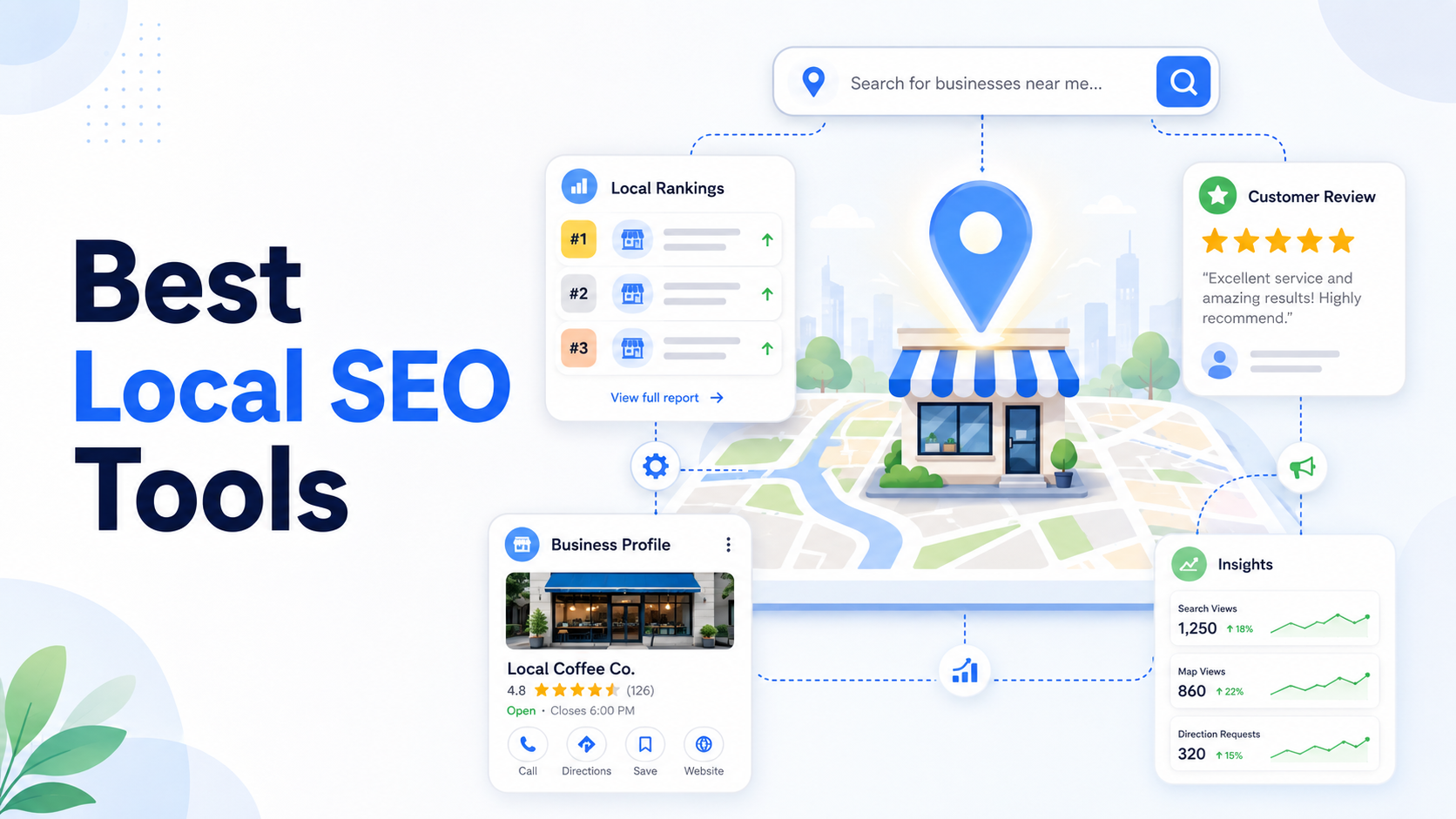
The mechanics: when someone searches "[service] near me" or "[service] in [city]" or any localized variation, Google returns a "local 3-pack" (the three businesses shown on a map at the top of search results) followed by organic results. The three businesses in the local 3-pack capture roughly 70% of clicks on that search. Getting into the local 3-pack is the most valuable thing you can do for organic customer acquisition.
What actually moves you up in local rankings:
Profile completeness and accuracy. Correct business category (the single biggest relevance lever), exact NAP details, hours, services, attributes, photos, description. Most local businesses leave 30-40% of the profile blank, which leaves rankings on the table.
Review velocity and quality. Recent, frequent, detailed reviews signal to Google that your business is active and trustworthy. The single most reliable predictor of local ranking improvement over 90 days is review acquisition volume.
NAP consistency across the web. Your business name, address, and phone number should be identical across Google, Yelp, Facebook, BBB, industry directories, and citation aggregators. Inconsistencies suppress rankings across all platforms simultaneously.
Backlinks to your website. Local Chamber of Commerce, industry association, supplier websites, local news features. Backlinks from authoritative local sources are real ranking signals.
Engagement signals. Customers clicking "Directions" or "Call" or "Website" from your profile. Photos uploaded by customers. Questions answered in the Q&A section. These all signal active engagement.
For complete coverage of profile optimization, see our complete guide to Google Business Profile, and for the broader local marketing framework see our local online marketing framework.

Strong, recent review velocity lifts your local Google rankings, your Google Search ad click-through rates (review stars in ad copy), your Meta ad conversion rates (social proof in creative), your landing page conversion rates (review widgets), and your email campaign open rates (sender reputation). One review program improves the ROI of every paid channel. TrueReview automates compliant Google review requests via SMS and email after each customer event. Start a free trial.
Google Search ads are the highest-intent paid channel for local businesses. The prospect has typed a query indicating active intent ("emergency plumber Miami," "best dentist for veneers," "wedding photographer in Brooklyn"), and your ad appears at the top of results. You pay only when they click.
What works in 2026:
Tight geographic targeting. Restrict ads to your actual service area. A plumber in San Diego paying for clicks from LA users is burning money. Set radius targeting or use precise location lists.
Keyword tiers, not keyword piles. Don't bid on everything that mentions your industry. Focus on three keyword tiers: (1) explicit local intent ("plumber San Diego," "dentist downtown"), (2) problem-oriented queries ("water heater not working"), (3) brand defensive ("[your business name]"). Each tier needs its own ad group, its own ad copy, and often its own landing page.
Match types and negative keywords. Use phrase or exact match for high-intent terms; broad match wastes spend on irrelevant queries. Build a negative keyword list to exclude things like "free," "DIY," "how to," and competitor brand names you don't want to bid against.
Ad assets (formerly extensions). Site links, callouts, call extensions, location extensions, structured snippets, review extensions. Use all of them — ads with full assets get higher click-through rates and lower cost per click.
Quality Score management. Google rewards relevant ads with lower CPCs. Tight keyword-to-ad-to-landing-page alignment improves Quality Score, which lowers your effective cost per click sometimes by 30-50%.
Conversion tracking. Set up conversion tracking for actual customer outcomes (form fills, calls, appointments booked) — not just clicks. Without conversion data, you cannot optimize the campaign and are essentially guessing.
Local Services Ads (LSAs) where eligible. For home services, legal, healthcare, and several other categories, Google offers Local Services Ads — pay-per-lead instead of pay-per-click, with the Google Guaranteed or Google Screened badge. When available for your category, LSAs typically outperform standard Search ads on cost per acquired customer. See our complete guide to Google Local Services Ads.
For deeper coverage of how the local algorithm decides who shows up, see our complete guide to Google Maps marketing.
Meta (Facebook and Instagram) is the second largest paid acquisition channel for most local businesses, and the most important for visually-driven categories: restaurants, salons, medical spas, retail, fitness, food, beauty.
The key distinction from Google: Meta is primarily demand generation, not demand capture. People scrolling Instagram aren't typing "best Italian restaurant near me" — they're being shown content that catches their attention. Your job is to interrupt their feed with creative compelling enough to make them stop and convert.
What works in 2026:
Creative is 80% of performance. The difference between a profitable Meta campaign and an unprofitable one is almost always the creative. Test multiple variations of imagery, video, and copy. Static images underperform short-form video in most categories. User-generated content (real customers, real photos) typically outperforms produced content.
Reels and Stories outperform feed ads. Meta's algorithm strongly favors short-form vertical video. Static feed ads still work for some categories (real estate, B2B) but the engagement and reach on Reels is significantly higher.
Advantage+ campaigns simplify targeting. Meta's Advantage+ Shopping and Advantage+ Audience features typically outperform manually defined audiences for local businesses. Resist the urge to over-segment your audience — the algorithm is better at finding converters than you are.
Local awareness and lead gen are the two primary objectives. For brick-and-mortar businesses driving foot traffic, use the Local Awareness or Store Traffic objective. For services capturing leads, use Lead Gen forms (which keep the prospect in Meta rather than sending them to a landing page).
Retargeting separately from prospecting. Run separate campaigns for cold prospecting (people who don't know you yet) and warm retargeting (people who visited your website, watched 50%+ of a video, or engaged with your profile). The creative, copy, and bid strategy should be different for each.
Conversion tracking via Conversions API (CAPI). iOS 14.5+ broke browser pixel tracking. The Conversions API sends server-side conversion data to Meta, allowing the algorithm to optimize properly. Without CAPI, Meta is increasingly flying blind on your conversion data.
For visually-driven businesses, Meta is often the highest-volume customer acquisition channel after Google Business Profile. For pure service businesses (legal, accounting, B2B services), Google Search ads typically deliver better ROI than Meta.
Email and SMS are often dismissed in advertising-technique listicles because they're not new or exciting. They're also the highest-ROI customer acquisition and retention channels for almost every local business, year after year, decade after decade.
The reason: you're communicating with people who already know you. Existing customers convert at 5-10x the rate of cold traffic, and email/SMS automation lets you reach them on autopilot.
What to automate:
Welcome sequence. A multi-touch sequence to new customers introducing your full service offering, key team members, and the experience they should expect. Most local businesses skip this and miss easy revenue from customers who don't know about your other services.
Post-service review request. Send 24-72 hours after each customer event asking for a Google review. This is the single highest-leverage automation you can run — it directly powers the review velocity that lifts every other channel.
Reactivation sequence. Automated emails to customers who haven't returned in X days/months. Specific to your business cycle: a salon might reach out at 6 weeks, a dentist at 6 months, a roofer at 5 years. Reactivation campaigns typically deliver 5-15% reactivation rates with modest creative effort.
Birthday and anniversary touches. Personalized outreach tied to the customer's milestones. Lower volume but very high engagement rates.
Referral program activation. Automated emails inviting existing happy customers into your referral program, with the offer and tracking mechanism. Most local businesses leave this entirely manual or skip it.
Educational and value sequences. Periodic emails that aren't sales pitches — tips, seasonal advice, behind-the-scenes content. Keeps you top of mind with customers who haven't been back recently.
Email is cheap. SMS has higher open rates (95%+ vs. 20-30% for email) but should be used sparingly to avoid feeling intrusive. Most local businesses underinvest in both channels by 10x relative to their actual ROI potential.
A continuous review program isn't a separate marketing channel — it's the multiplier that improves the ROI of every other channel listed in this guide. Strong review velocity:
Lifts Google local rankings. Review quantity, recency, and quality are direct ranking signals. Businesses that acquire 3-5 fresh reviews per month consistently outrank competitors with stale review profiles.
Increases Google Search ad CTR. Ads with review stars (4-5 stars displayed in the ad) get 17-25% higher click-through rates on average, lowering your effective cost per click.
Improves Meta and TikTok ad conversion. Featuring customer reviews in ad creative is one of the most reliable conversion lifts — social proof outperforms most other creative angles.
Increases landing page conversion. Review widgets and testimonials on landing pages typically lift conversion rates 15-30%. The reviews are doing the selling that your copy can't do as credibly.
Improves email sender reputation. Active customer engagement signals to email providers that you're a legitimate sender, which improves deliverability across your other email campaigns.
The mechanics of a working review program:
Automated request timing. Send the request 24-72 hours after each customer event, when the experience is fresh but they've had time to settle. Manual asks rarely scale; automation does.
SMS plus email, not one or the other. SMS gets higher open rates (95%+); email is more detailed and works for older demographics. Use both for maximum coverage.
Direct customer to Google primarily. Google reviews drive local ranking; other platforms are secondary. Some businesses also benefit from Yelp, Facebook, or industry-specific platforms (Healthgrades, Zillow, Realtor.com, etc.) as secondary asks.
No gating, no incentives. The FTC's 2024 Rule made review gating (asking only happy customers for reviews) and incentivized reviews (offering anything of value in exchange for a review) explicitly illegal with civil penalties up to $51,744 per violation. Ask every customer, ask the same way, offer nothing.
Respond to every review, positive and negative. Response rate is a ranking signal and signals professionalism to future prospects reading your profile.
For complete coverage, see our complete guide to getting Google reviews and our complete guide to review management. If you want the full playbook, read check business name availability.
Manually asking every customer for a review doesn't scale past a handful of customers per week. TrueReview automates compliant Google review requests via SMS and email after each customer event, integrates with Mangomint, Boulevard, Vagaro, Zillow, Realtor.com, and 8+ other booking and CRM platforms, surfaces incoming reviews in real time, and includes AI-assisted response generation. Start a free trial — setup takes about 15 minutes.
Once the five foundation channels are producing reliable customer flow, certain amplifiers can produce additional gains. None of these should come before the foundation is solid.
Short-form vertical video has reshaped how consumers discover local businesses, particularly in restaurants, food, beauty, fashion, fitness, and lifestyle. A restaurant that goes viral on TikTok can fill its reservations for months; a salon that publishes consistent before/afters on Instagram Reels and TikTok can build a waiting list.
The catch: this requires real, ongoing creative investment. You can't run a TikTok program with the same "set it and forget it" approach as Google ads. You need someone — on staff, contractor, or owner — willing to film and publish 2-4+ videos per week consistently for at least 3-6 months before the algorithm starts working for you.
What works: native vertical video, authentic feel (over-produced content underperforms), consistent posting cadence, leaning into trends and audio, behind-the-scenes content, transformation reveals, educational content specific to your category. What doesn't work: ports of your Instagram feed, static text-on-image posts, infrequent posting.
For most local businesses, TikTok is worth experimenting with after the foundation channels are working. For visually-driven businesses with native video capability, it can become a major acquisition source.
Local micro-influencers (5,000-50,000 engaged followers in your geography) often deliver real ROI for restaurants, beauty, fashion, fitness, and lifestyle businesses. Macro-influencers and celebrity partnerships rarely produce returns for local businesses — the audience is too broad and the cost is too high.
What works:
Local relevance over follower count. A food blogger with 15,000 followers in your city is worth more than a national lifestyle influencer with 500,000 followers spread across the country. Local relevance trumps reach.
Genuine product/service experience. Influencers who actually use your product and create authentic content perform 5-10x better than influencers reading from a brief.
Multiple touchpoints, not single posts. One sponsored post rarely produces measurable results. A multi-month relationship with multiple touchpoints does.
FTC disclosure required. The FTC requires clear disclosure of any material relationship between the influencer and the brand. "#ad" or "Paid partnership with [brand]" should be visible. Non-disclosed sponsored content is now actively enforced by the FTC under the 2024 Rule.
What doesn't work: paying a national influencer with no local audience, expecting measurable results from a single one-off post, or using fake reviews and undisclosed paid content (both federal violations).
Content marketing — publishing helpful, evergreen content on your website that ranks in Google and attracts qualified traffic — is high-leverage when it works, but works only for certain business models and only on a long timeline.
When content marketing works: high-consideration purchases where prospects research extensively before buying (real estate, legal services, financial advisory, high-ticket B2B). For these, content that answers prospect questions can produce qualified leads for years from a single piece of writing.
When content marketing rarely works: low-consideration purchases (restaurants, fast service businesses) where prospects don't research extensively. A pizza shop publishing blog posts about pizza is unlikely to acquire customers through that channel; demand capture (search and reviews) will outperform it by 10-20x.
The realistic timeline: 6-12 months of consistent publishing before content begins ranking and driving traffic. 12-18 months before it becomes a primary acquisition channel. Most local businesses publish for 2-3 months, see no immediate results, and quit — missing the compound returns that come later.
If you commit to content marketing: publish 1-2 high-quality, in-depth pieces per month that genuinely help your prospects solve real problems. Focus on long-tail, intent-rich keywords specific to your category. Build internal links between related pieces. Plan for 12 months of consistency before evaluating ROI.
Referral programs are often the highest-converting customer acquisition channel when run well, and the most overlooked channel in advertising listicles. A referred customer typically converts at 3-5x the rate of cold traffic, has higher lifetime value, and is more likely to refer additional customers themselves.
What separates working referral programs from ones that exist on paper:
Formalized incentive structure. A clear, valuable reward for both the referrer and the new customer. Vague "we appreciate referrals" rarely produces measurable activity; a specific "$25 credit for you, 20% off for them" produces consistent volume.
Easy tracking and attribution. The referrer needs an easy way to share (link, code, email forward), and you need to track which customers came from which referrers. Manual tracking breaks; automated tracking scales.
Activation timing. Invite happy customers into the referral program at the moment of satisfaction — right after a great experience or after they've left a positive review. Not via a generic "by the way" email three months later.
Follow-through with the referrer. When a referred customer becomes a paying customer, the referrer needs to know — with their reward credited promptly. This is what produces repeat referrals.
Partnership programs are referral programs at the business level — partnerships with adjacent businesses that share your target customer (e.g., a dentist partnering with an orthodontist, a real estate agent partnering with a mortgage broker). Same mechanics, different participant pool, often produces meaningful volume with relatively little ongoing effort.
Every channel above sends traffic somewhere. If that destination is a slow, poorly designed, or unconvincing website, you're paying to drive traffic that doesn't convert. The website is the conversion layer beneath all advertising.
What matters for local business websites in 2026:
Page speed. Sites that load in <2 seconds convert dramatically better than sites that load in 4+ seconds. Mobile speed matters more than desktop for most local businesses (60-80% of traffic). Use Google PageSpeed Insights to measure and improve.
Mobile-first design. The majority of local searches happen on mobile. Your site needs to work beautifully on a phone — readable text without zooming, easy-tap buttons, no horizontal scrolling, fast-loading images.
Clear conversion paths. Phone number visible on every page (tap-to-call enabled). "Book Appointment" or "Get Quote" CTA prominent. Contact form accessible. Don't make the prospect dig to figure out how to become a customer.
Trust signals above the fold. Review ratings, certifications, professional affiliations, "as seen in" mentions, years in business — the credibility cues that signal you're a legitimate operation worth contacting.
Location-specific content. For multi-location businesses, dedicated location pages with unique content (not duplicate content with the address swapped). For single-location businesses, mention the neighborhood, surrounding areas, and local landmarks throughout the site.
Schema markup. Structured data that helps Google understand your business (LocalBusiness schema, Service schema, Review schema). Often invisible to humans but valuable for search visibility.
A 30% improvement in website conversion rate is equivalent to a 30% reduction in customer acquisition cost across every paid channel. It's often the highest-ROI investment in the entire marketing stack.
If you're starting from zero or restructuring your customer acquisition program, the sequence that works for most local businesses:
Days 1-30: Foundation. Claim and fully optimize Google Business Profile. Audit and fix NAP citations across the top 20 directories. Set up a continuous review program with automated SMS+email requests. Audit website for speed, mobile experience, and clear conversion paths.
Days 31-90: First paid channel. Launch Google Search ads (for service businesses with clear local search intent) OR Meta paid social (for visually-driven businesses). Pick one based on your category — don't run both yet. Set up conversion tracking properly. Iterate on creative and copy weekly. Target a positive ROAS within 60-90 days.
Days 91-180: Email and SMS automation. Build the post-service review request automation, welcome sequence, reactivation sequence, and birthday/anniversary touches. These compound over time and start paying off immediately for existing customers.
Days 181-365: Second paid channel. Add the second foundation paid channel (Meta or Google, whichever you didn't start with). Layer in basic referral program with formalized incentives and tracking. Evaluate whether you're ready for amplifier channels.
Year 2 and beyond: Add amplifiers selectively. TikTok if your business is visually-driven and you have native video capability. Content marketing if you're a high-consideration purchase business. Influencer partnerships if you're in restaurants, beauty, fashion, or lifestyle. Resist the urge to add channels just because they're trendy — each new channel pulls focus from your existing channels.
The discipline is doing fewer things well rather than many things mediocre. Most local businesses fail at advertising not because they pick the wrong channels but because they spread their attention across too many channels and execute none of them deeply.
Patterns that consistently fail for local businesses:
Running too many channels too thinly. Six channels at 1/6 the effort each will outperform 1 channel at full effort almost never. Pick two, run them deeply, expand later.
Skipping conversion tracking. Without conversion data, every channel is a guess. Set up proper tracking before spending serious money.
Optimizing for clicks instead of customers. Click-through rate, impressions, and engagement are leading indicators. Actual customers acquired and revenue produced are the metrics that matter. Stop reporting on the leading indicators if they don't predict the lagging ones.
Underinvesting in the website. Improving your website conversion rate is often higher-ROI than adding a new channel. Audit your conversion path before scaling spend.
Ignoring reviews and other compounding assets. Reviews, email lists, and referral networks compound. Paid ads don't — they require ongoing spend forever. Invest in the assets that pay you back over years.
Treating advertising as separate from operations. The best advertising is consistently great customer experience that produces word of mouth, reviews, and referrals. If your operational quality is mediocre, no amount of paid acquisition will produce a sustainable business.
Chasing the channel of the moment. TikTok in 2023, Threads in 2024, BlueSky in 2025, the next platform in 2026. Be skeptical of advice that says you need to be everywhere. Most local businesses can't afford to be everywhere, and the channels that have worked for 10 years (Google, Meta, email) are still working.
Failing to measure properly. The most common pattern: "we're running Google ads, we don't know if they're working." Set up conversion tracking, set up call tracking, set up form-fill attribution. Measure the actual ROI of every channel. Cut the ones that don't work; double down on the ones that do.
Deeper coverage by topic:
The local marketing framework: our complete local online marketing framework covers NAP citation strategy, local SEO, and the localization-specific layer beneath this guide.
Google Business Profile optimization: our complete guide to Google Business Profile.
Google Maps marketing and the local algorithm: our complete guide to Google Maps marketing.
Local Services Ads: our complete guide to Google Local Services Ads.
The review program that powers it all: our complete guide to getting Google reviews and our complete guide to review management.
Review platforms and where to invest: our guide to the best review sites for local businesses.
Whatever advertising channels you choose, a continuous review program is the multiplier that improves the ROI of all of them. TrueReview automates compliant Google review requests via SMS and email after each customer event, surfaces incoming reviews in real time across Google, Facebook, Yelp, and 25+ other platforms, includes AI-assisted response generation, and integrates with Mangomint, Boulevard, Vagaro, Zillow, Realtor.com, and 8+ other booking and CRM platforms. Start a free trial — setup takes about 15 minutes.