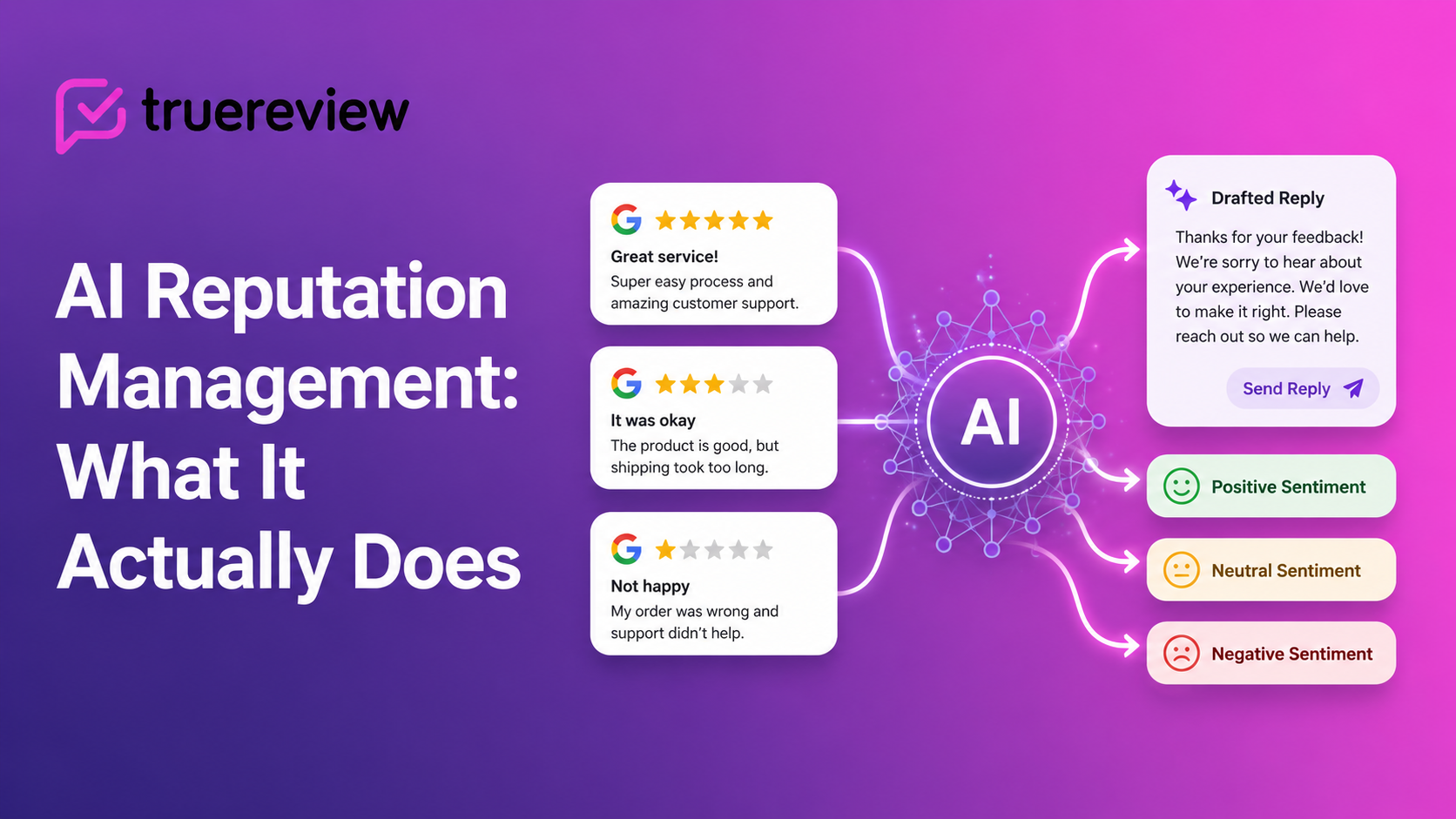
AI reputation management means using AI to monitor, analyze, and draft responses to reviews — not to remove or fabricate them.
AI genuinely helps with the high-volume, repetitive parts of reputation work: monitoring reviews across platforms, analyzing sentiment and themes, and drafting first-pass responses you edit and approve. What AI can't do is remove negative reviews, guarantee outcomes, or replace human judgment — and any tool promising automated review removal or AI-generated reviews is selling something that violates platform policy and the FTC's 2024 Rule. The right approach uses AI to save time while keeping a human in the loop and staying compliant.
"AI reputation management" is having a moment in marketing copy — and like most AI marketing, it's a mix of genuinely useful capability and overpromised magic. Some vendors imply AI can make bad reviews disappear or generate a glowing reputation on autopilot. It can't, and the ones promising that are describing things that are against platform rules and federal law.
This guide is the clear-eyed version: what the term actually means, where AI genuinely earns its place in a reputation workflow, where it falls short, how it intersects with Google's policies and the FTC, and what to look for if you're evaluating tools.
What "AI reputation management" actually means
Strip away the marketing and AI reputation management refers to using artificial intelligence — mostly large language models and sentiment analysis — to assist with the operational work of managing online reviews and brand perception. In practice that breaks into a few concrete capabilities:
- Monitoring: automatically detecting and aggregating new reviews and mentions across Google, Facebook, and other platforms in near-real time.
- Sentiment analysis: classifying reviews as positive, neutral, or negative, and surfacing the emotional tenor at scale.
- Theme extraction: identifying recurring topics across hundreds of reviews — "wait times," "billing," "a specific staff member" — that a human would take hours to tally.
- Response drafting: generating first-draft replies to reviews that a human edits and approves before publishing.
Notice what's not on that list: removing reviews, generating reviews, or "fixing" a reputation without underlying operational change. Those aren't AI capabilities — they're either impossible or against the rules, regardless of how much AI is involved.
Where AI genuinely helps
The honest case for AI in reputation management is real and worth taking seriously. It shines wherever the work is high-volume, repetitive, and pattern-based.
- Monitoring at scale. A business with reviews trickling in across five platforms can't realistically check each one daily. AI-powered monitoring surfaces every new review in one place within minutes — which is what makes a fast response window achievable.
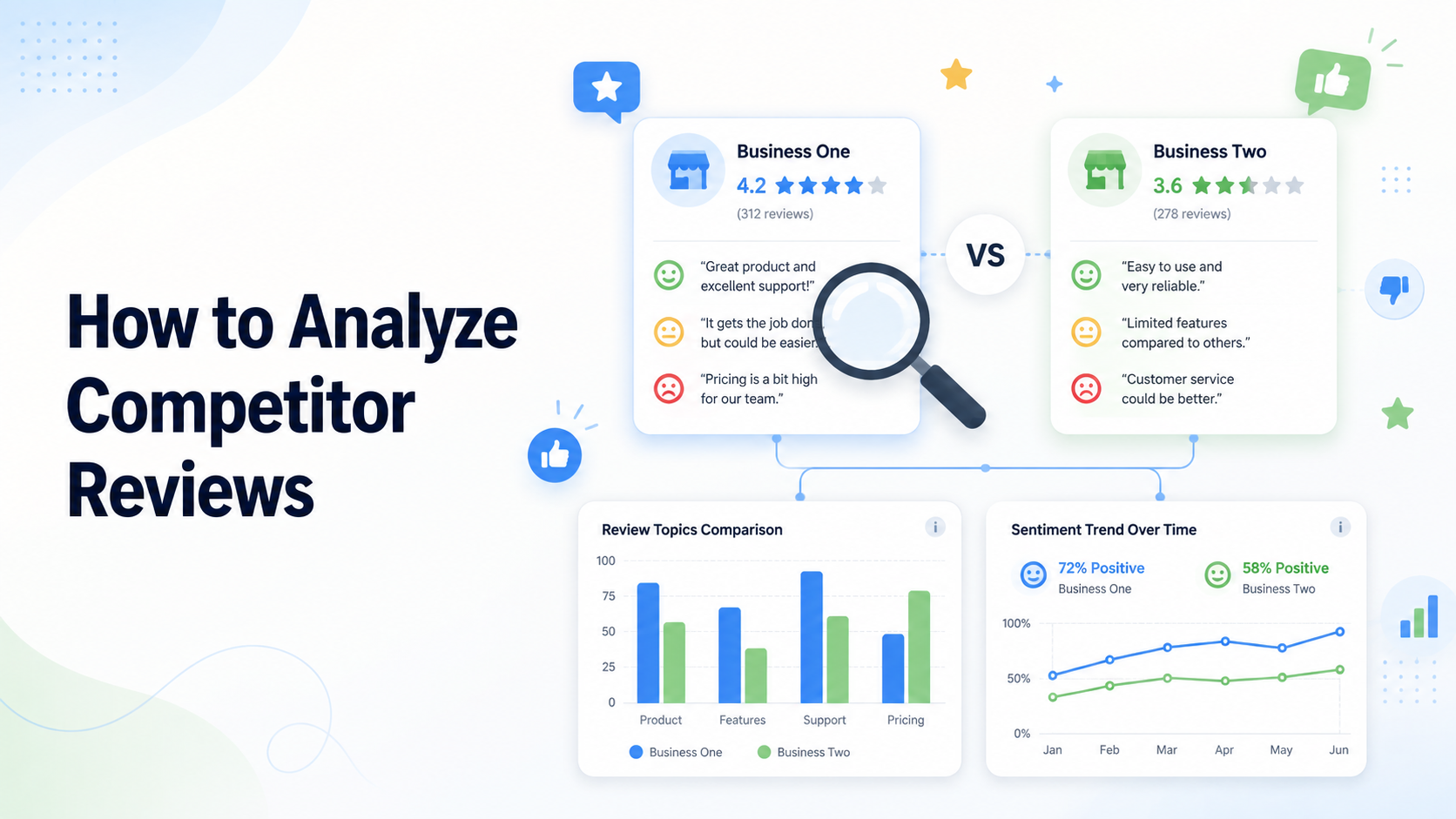
- Sentiment and theme analysis. Reading 300 reviews to figure out what customers consistently praise or complain about is a day's work for a person. AI does it in seconds and updates continuously, turning your review corpus into genuine operational intelligence.
- Response drafting. Starting from a blank box for every reply is the main reason businesses fall behind on responses. AI drafts a specific, on-brand first version from the actual review — the human then edits and approves. You keep the personal touch and reclaim most of the time.
- Prioritization. AI can flag the reviews that need a human's attention first — an angry 1-star from a long-time customer, or a review that may violate platform policy — so limited time goes where it matters.
The throughline: AI is a force multiplier for the parts of reputation work that are about volume and speed. It doesn't replace the human; it removes the drudgery that stops the human from being consistent. For how this fits a full workflow, see our complete guide to review management.

AI assistance with a human always in the loop
TrueReview uses automation responsibly: it monitors reviews across Google and 8+ platforms, surfaces sentiment and themes, and drafts responses you approve before they post. No automated removal, no fabricated reviews — just the repetitive work handled for you. Start a free 14-day trial.
Where AI falls short
Equally important is being clear about what AI can't do — both because overreliance produces bad outcomes and because some vendors actively market the impossible.
- It can't remove negative reviews. No AI can delete a review you don't like. Reviews come down only when they violate a platform's policy and are reported and removed by the platform — or when the reviewer removes them. Any tool claiming "AI automatic review removal" is misrepresenting how this works. We wrote a whole piece on this: why "AI that automatically removes Google reviews" is always a lie.
- It can't replace human judgment. A sensitive negative review — a grieving family, a billing dispute, a complaint with legal implications — needs human empathy and discretion. AI drafts can miss context, tone, and compliance nuance. The human edit isn't optional.
- It can't generate genuine reviews. AI can write text that looks like a review, but using it to post fake reviews is fraud under the FTC's 2024 Rule and against every platform's policy. Genuine reviews come from real customers, full stop.
- It can't fix an underlying problem. If customers are unhappy for real reasons, no amount of AI-polished responses changes the substance. Reputation tools surface problems; they don't solve operational ones.
- It can hallucinate. Unsupervised AI responses can invent details, promise things you can't deliver, or disclose information they shouldn't — a real risk in regulated fields. This is exactly why a human approves before publishing.
AI and Google's policies
This is where the marketing claims collide with the rules. A few hard lines worth understanding:
Google prohibits fake and incentivized reviews. Using AI to generate reviews, or to power any scheme that fabricates or solicits dishonest reviews, violates Google's review policies and risks profile suspension.
The FTC's 2024 Rule makes it federal. The FTC's Rule on the Use of Consumer Reviews and Testimonials (16 CFR Part 465, effective October 2024) added federal penalties — civil penalties reaching into the tens of thousands of dollars per violation — for buying or selling fake reviews, AI-generated fake reviews presented as genuine, and suppressing negative reviews. AI doesn't get a pass; an AI-generated fake review is still a fake review.
"Automated removal" implies things no compliant tool can do. Reviews are removed by the platform after a policy violation is reported — not by a third-party tool acting on your behalf. The compliant version of "AI helps with bad reviews" is software that spots reviews appearing to violate Google's policies and guides you through reporting them. The reporting is something you do, with guidance. That's the line between a helpful tool and a policy violation.
This is exactly the model behind TrueReview's Review Radar™: it scans incoming reviews and flags ones that appear to violate Google's policies, then walks you through the reporting process. It surfaces potential violations and guides you — it never claims to remove reviews itself or act on your behalf.
How TrueReview uses automation responsibly
Our own approach is a useful illustration of the responsible pattern, because we built the product around these constraints rather than against them:
- Monitoring across Google and 8+ platforms in a unified dashboard, with near-real-time alerts — so nothing slips past the response window.
- Sentiment and theme analysis so you can see what's trending across your reviews without reading every one.
- AI-assisted response drafting calibrated to your industry and brand voice — with a human-review step required before anything publishes.
- Review Radar™, which flags reviews that appear to violate Google's policies and guides you through reporting them — without ever claiming to remove them for you.
- Compliant collection — automated requests sent to every customer, no gating, no incentives, consistent with Google policy and the FTC Rule.
The consistent principle: automate the repetitive work, keep a human on every judgment call, and never cross into removal or fabrication. For the automation side of collection specifically, see our guide to setting up an automated review request drip campaign.
A selection checklist
If you're evaluating an "AI reputation management" tool, these questions separate the responsible ones from the ones selling magic:
1
Does it promise to remove reviews?
If a tool claims it can automatically remove or "guarantee" removal of negative reviews, walk away. That's not how review removal works, and the claim signals a vendor willing to misrepresent the rules.
2
Is there a human-in-the-loop step?
Responsible tools draft responses for a human to approve, not auto-publish unsupervised AI text. Look for an explicit review-and-approve workflow.
3
How does it handle review collection?
It should send requests to every customer with no gating and no incentives. If the "AI" filters customers by predicted sentiment before asking, that's gating — a policy and FTC violation.
4
Does it support your compliance needs?
For regulated fields, the tool should build in constraints — HIPAA-aware workflows for healthcare, awareness of bar rules for legal — rather than leaving compliance entirely to you.
The bottom line
AI reputation management is genuinely useful for monitoring, analysis, and response drafting — the high-volume work where speed and consistency matter. It is not a way to delete bad reviews, manufacture good ones, or remove the human from the loop. The tools worth using are the ones honest about that line: automate the repetitive parts, keep judgment human, and stay on the right side of Google's policies and the FTC. Anything promising more is promising something it can't legally deliver. See our detailed comparison of the google review software that actually gets replies before you decide.
FAQ
The most common follow-ups on AI reputation management.
Can AI remove bad Google reviews?
+
No. No AI tool can delete a review. Reviews come down only when they violate a platform's policy and are reported and removed by the platform, or when the reviewer removes them. The compliant role AI can play is spotting reviews that appear to violate policy and guiding you through reporting them — the reporting is something you do. Any tool claiming "automatic AI removal" is misrepresenting how the process works.
Is it safe to use AI to respond to reviews?
+
Yes, when a human reviews and approves each draft before it publishes. AI is excellent for generating a specific first draft from the actual review, which you then edit for tone, accuracy, and compliance. The pattern to avoid is auto-publishing unsupervised AI responses, which can hallucinate details, over-promise, or disclose things they shouldn't — especially risky in regulated industries.
Does using AI for reviews violate Google or FTC rules?
+
Using AI to assist with monitoring, analysis, and drafting responses is fine. Using AI to generate fake reviews, gate customers by predicted sentiment, or suppress negative reviews violates Google's policies and the FTC's 2024 Rule (16 CFR Part 465), which carries civil penalties into the tens of thousands of dollars per violation. The technology isn't the issue — how it's used is.
What can AI realistically do for my reputation?
+
It can monitor every platform in one place, analyze sentiment and recurring themes across hundreds of reviews, draft first-pass responses you approve, and flag reviews that need urgent attention or appear to violate policy. In short, it makes consistent, fast, data-informed reputation work achievable without a dedicated full-time person — while leaving judgment and final approval to you.
What's the difference between AI review management and review gating?
+
Legitimate AI review management asks every customer for a review and uses AI to monitor and respond. Gating uses a pre-screen — sometimes dressed up as "AI sentiment routing" — to send only happy customers to the public review platform while diverting unhappy ones. Gating violates Google's policy and the FTC's 2024 Rule regardless of whether AI is involved. The compliant approach asks everyone through the same flow.