BLOG POST
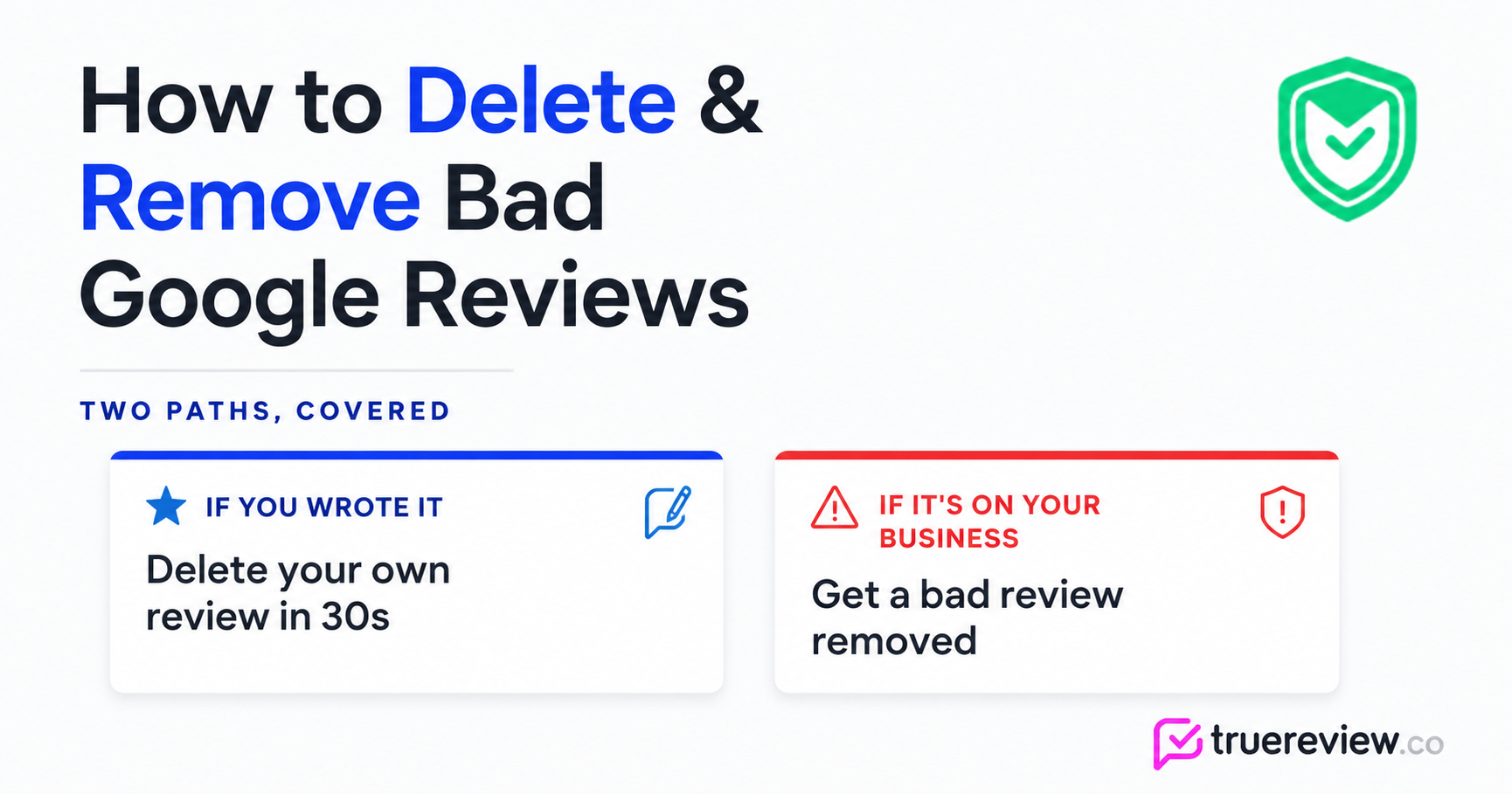
When people search “how to delete a Google review,” they’re usually one of two people. They’re a reviewer who left a review they regret — and want to know how to take it down themselves. Or they’re a business owner with a bad review on their profile — and want to know how to get it removed.
The mechanics are completely different for the two cases. A reviewer can delete their own review in about 30 seconds. A business owner can’t delete a review at all — they can only report it, and only if it violates a specific Google content policy. Flagging doesn't always work the first time. Here's how to win a review appeal when Google says no.
This post covers both. If you’re a reviewer, skip to the first section. If you’re a business owner, skip to the second. Each section is short on purpose — they’re meant to answer the question and route you to the right next step.
If you left a review and want to remove or edit it, you have full control. Google lets reviewers manage their own reviews from any device, any time, with no approval process.
The review disappears from the business’s profile immediately. If you want to edit instead of delete, choose Edit review in the same menu — you can change the star rating, the text, or both. If you're having trouble even finding the reviews you've left, that's a common snag. If you want the full playbook, read our guide on how to see my google reviews. And if you'd rather rewrite your review than remove it, it helps to know what makes a good one. If you want the full playbook, read our guide on how to write a google review for a business.
Same instant effect. The review is gone from the business’s profile and from your contributor history.
Three things to know.
The business won’t be notified. They won’t get an email or any alert that a review was deleted. The review just disappears from their profile.
Their star rating will recalculate automatically. If your review was a one-star on a profile with five reviews, removing it can noticeably change the average. If it was a five-star on a profile with five hundred reviews, the change will be invisible.
The review can’t be recovered. Once you click delete, there’s no undo. If you might want it back, edit instead of delete.
No. Only the reviewer who wrote the review can delete it — and Google can remove it if it violates a content policy. A business owner cannot delete your review even if they ask Google to. A third-party service cannot delete it on your behalf. The control belongs entirely to you.
This is also why some business owners reach out and ask reviewers to update or remove reviews after resolving an issue. They’re asking because it’s the only legitimate way for them to get the review off their profile when it doesn’t violate policy. (They’re not allowed to offer you anything in exchange — that violates Google’s rating manipulation policy and can flag their own profile.)
Here’s the part most articles get wrong: as a business owner, you cannot delete a Google review. There is no button in your Business Profile that removes a review, no admin override, no setting to hide reviews from public view.
Only two parties can take a review off Google: the reviewer who wrote it, and Google’s review team after a policy report. That’s the entire universe of options.
What you can do is report a review that violates Google’s content policies. If Google agrees the review breaks a specific rule, they’ll remove it. If they don’t, the review stays up — and there’s no amount of money, no service, and no workaround that changes that.
Reporting is only part of the picture when the review is genuinely negative rather than policy-violating. Our full guide covers how to remove negative reviews and what your realistic options are when Google won't act.
Google removes a review when it violates one of these content policies. Match your situation to the right policy before you report — picking the wrong category is the single most common reason reports get rejected. Some industries face this more acutely than others — dental practices, for instance, deal with strict privacy rules that shape how they respond. If that's you, see our guide on how to remove Google reviews for dental practices.
What Google won’t remove: a one-star review from a real customer who had a real bad experience. Even if it’s unfair, exaggerated, or based on a misunderstanding — if it describes a genuine interaction with your business, it’s protected as opinion. For what to do with those, see our guide on how to remove bad Google reviews.

Reading through 10 policy categories and matching them to the review on your screen is the hardest part of this process. Review Radar — included in TrueReview's Small Business and Premium plans — scans every incoming review automatically, flags potential violations, and identifies the right category before you submit. You still file the report yourself (the only compliant way), but the policy-matching step happens in the background. For business owners deciding between paying a removal service and doing it themselves, this is the middle path.
Once you’ve identified which policy the review violates, the reporting process is short.
The simplest path is directly from your Business Profile. Sign in to the Google account that manages your profile. Search your business name in Google Search or Maps. In the knowledge panel, click into the Reviews section. Find the review, click the three-dot menu, select Report review, choose the category that matches the policy violation, submit.
For better tracking — including status updates and the ability to appeal if your first report is rejected — use Google’s Reviews Management Tool. It’s the same reporting process, but with a dashboard that tracks every report you submit. For anything beyond a single obvious violation, this is the right path.
Expect a status of “Decision pending” for several days. Most first reports come back as “Report reviewed — no policy violation.” That’s not the end of the road — it’s the start of the appeal stage, where the actual review happens with a human moderator. The full reporting walkthrough, including the supporting-details field most people skip, is in our pillar guide on removing Google reviews from your business.
No, and this is intentional. If business owners could delete reviews they didn’t like, the entire review system would be worthless to customers — which is the entire reason anyone reads reviews in the first place. Only reviewers can delete their own reviews. Only Google can remove policy-violating ones. Owners report; they don’t remove.
This is also why every contract clause some businesses used to bury in their terms of service — “you agree not to post negative reviews” — became illegal under the FTC’s Consumer Review Fairness Act in 2016. Trying to suppress honest negative reviews isn’t just against Google’s policies; it’s federally regulated.
Indirectly, yes. If the reviewer is a real customer with a real complaint and you resolve the underlying issue, a meaningful percentage will update or remove their own review. This is the cleanest possible “removal” — no policy report, no waiting on Google, no risk that an appeal fails.
What you cannot do: offer the customer anything of value in exchange for the removal. Refunds-conditional-on-removal, discounts, free services, anything that ties a benefit to the review change — all of those violate Google’s Rating Manipulation policy and can flag your profile. The line is “let me make this right” (fine) versus “I’ll refund you if you delete the review” (not fine).
For the response that actually works in this situation, see our guide on how to reply to bad reviews.
For most business owners, the realistic outcome of the reporting process is mixed. Some reviews get removed. Some don’t. The ones that don’t are usually real-customer reviews that don’t cross any of the policy lines above — and no amount of escalation will change that.
If you’ve reported a review, appealed, and Google has upheld it, three moves still work.
Respond publicly to neutralize the review. A calm, professional response signals to future readers that you’ve engaged with the issue. Future customers reading your profile pay attention to how you handle disputed reviews — often more than they pay attention to the bad review itself. The response isn’t for the angry reviewer; it’s for the next prospect reading your profile a week from now.
Resolve with the customer if possible. Reach out privately, offer to make the underlying issue right, and ask if they’d consider updating their review after you’ve fixed the problem. Some will. Most won’t. The ones who do are the cleanest possible removals.
Build review velocity to dilute the impact. A single problematic review on a profile with 200 recent positive reviews is statistical noise. A single problematic review on a profile with 25 total reviews is a visible scar. Systematically collecting reviews from real customers is the most reliable long-term defense against reviews you can’t get removed.
For the full response-and-recovery playbook on reviews that stay up, see our guide on how to remove bad Google reviews — and when you actually can’t. Plenty of owners trade tactics on forums when a review won't come down. We rounded up what actually holds up in our guide on how to remove bad Google reviews, according to Reddit. A single unfair one-star rating can drag down an otherwise strong profile. For the tactics that work on those specifically, see our guide on how to get rid of 1-star Google reviews.
Deleting a Google review depends entirely on who you are.
If you wrote the review, you have full control — sign in, find the review, click delete. Under a minute, done.
If a review was left on your business, you don’t have delete access. What you do have is the ability to report reviews that violate Google’s content policies, and the ability to respond to and recover from the ones that don’t. The reporting process works when you match the right policy to the right category and bring evidence. The response process works when you treat future readers — not the angry reviewer — as your audience.
For everything beyond the basics: if you have a review you need to report, our pillar guide on removing Google reviews walks through the full reporting process. If your first report was rejected, our dispute and appeal walkthrough covers the appeal mechanics. If you’re trying to figure out whether paid help is worth it, our breakdown of paying someone to remove Google reviews is the honest answer.
The reviews you act on quickly — within the first 48 hours — are the ones most likely to come down. If catching them in that window sounds like work you don’t want to do manually, Review Radar (in TrueReview’s Small Business and Premium plans) does the policy-matching automatically the moment each review lands. Start a free trial and have monitoring running before your next review hits.