BLOG POST

How to Get Rid of 1-Star Google Reviews (Step-by-Step)

May 20, 2026

A 1-star Google review is the worst kind of review to receive. Not because it's necessarily the most damaging on its merits — sometimes a 1-star is a single sentence of frustration that any prospect can read past — but because of what it does to your math.

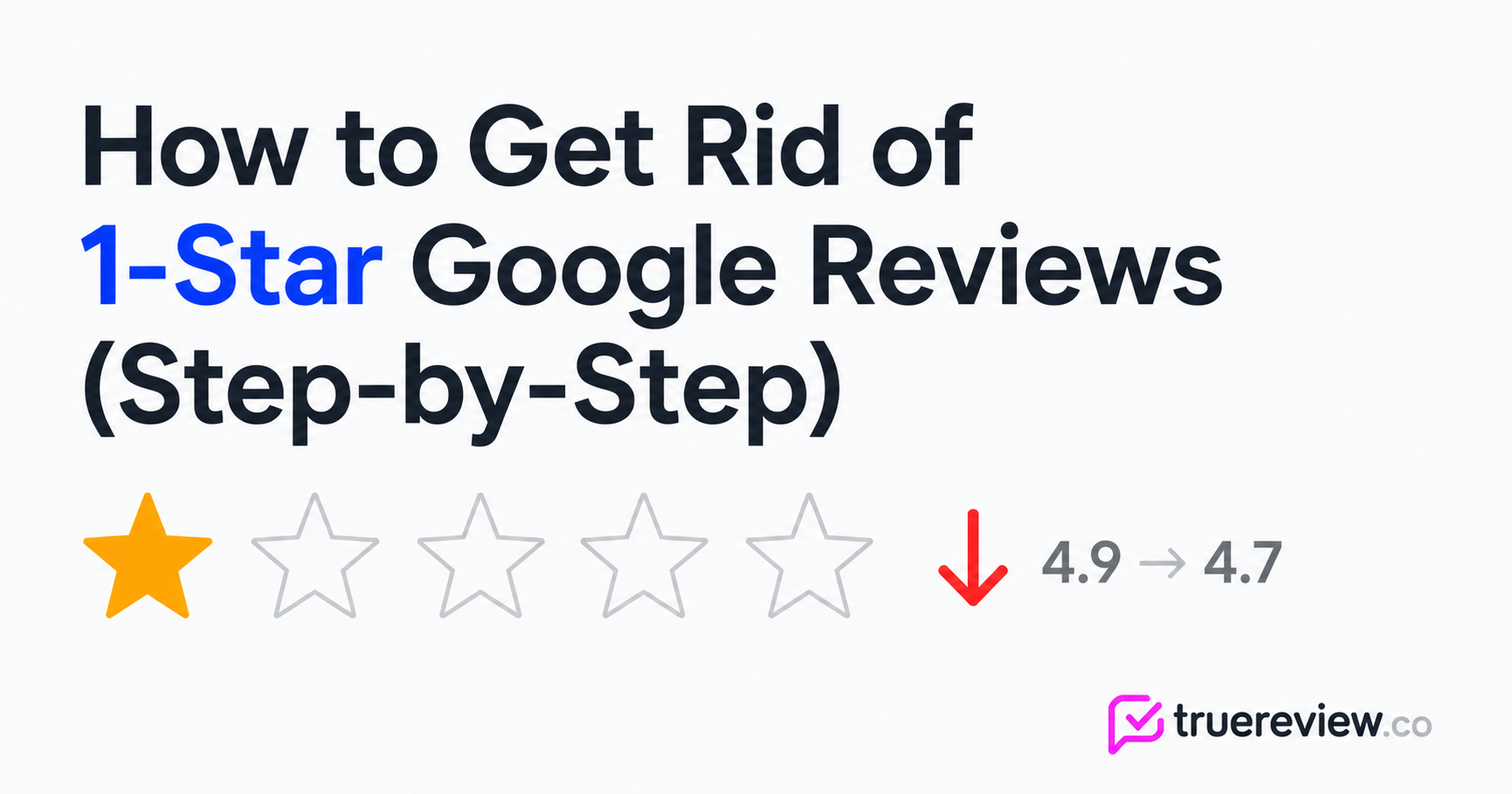
The drop from 4.9 to 4.7 stars from a single 1-star looks small on paper. In practice, it bumps you below the visual threshold where Google highlights a profile as "Top rated" in local pack results, knocks you out of the 4.8+ filter prospects sometimes apply, and signals to anyone scanning the profile that something went wrong recently.

This post covers the specific playbook for 1-star reviews. Some can be removed. Most can't. Both paths have a specific sequence that works, and we'll walk through both.

Why 1-stars hit harder than other bad reviews
One 1-star drags more weight than four 3-stars combined.
It's pure arithmetic. To pull your average back to a 4.8 after a single 1-star lands on a profile with 50 reviews, you need 19 new 5-stars in a row. Most prospects also visually filter for 4-stars-and-up and quietly skip past anything 1-star or 2-star in the reviews list. The damage compounds: lower average, lower visibility, lower trust at a glance.

Step 1: Determine If the 1-Star Qualifies for Removal

Before anything else, walk the review through Google's removal policies. A 1-star review that violates one of Google's content policies can be reported and, with the right category and supporting evidence, removed entirely. A 1-star review that's just an unhappy customer with a real complaint cannot — and trying to report those wastes your one-shot appeal.

1-star reviews tend to cluster into a few specific policy buckets more often than higher-rated reviews. Here's what to look for first.

The four 1-star patterns Google will act on
PATTERN 01
Star-only with no text
A bare 1-star rating with zero context. These by themselves don't violate policy — but they often do when paired with a fake-reviewer pattern (new account, no other reviews, no profile photo). Report as Fake & Misleading.
PATTERN 02
Competitor or former employee
1-stars from documentable conflicts of interest are common after disputes. Cross-reference the reviewer's name against past employment records, business partner lists, or competitor staff pages.
PATTERN 03
Coordinated review-bombing
Multiple 1-stars within a short window from accounts with shared patterns. Google's 2025+ automated detection caught most of these, but report as Spam if you spot one that slipped through.
PATTERN 04
Wrong business or off-topic
Reviewer confused you with another business, or the review is about something unrelated to your service. Report as Off-Topic. Common with chains, franchises, and similarly-named businesses.

What won't qualify, no matter how unfair the review feels: a real customer's real bad experience. If the reviewer was actually there, actually paid, actually had the experience they're describing — even if you remember the interaction completely differently, even if they're factually wrong on details — Google treats their account as a protected opinion. Those 1-stars are why steps 2 and 3 of this post exist.

For the full reporting workflow once you've matched a category — including the supporting-details field most people skip and the appeal stage where most successful removals actually happen — see our pillar guide on removing Google reviews.

Step 2: Respond Publicly Within 24 Hours

Whether or not the review qualifies for removal, respond first. Reporting takes days or weeks; the review is sitting at the top of your profile the entire time.

The response isn't for the angry reviewer. It's for every prospect who lands on your profile over the next month and reads how you handled the situation. A calm, professional reply transforms a 1-star from "this business has problems" to "this business handles problems professionally" in the eyes of the next reader. That shift is the entire point.

The template that works for 1-star responses:

What to avoid in 1-star responses: defensive language, contradicting the customer's account publicly, naming employees, mentioning that you'll report the review, threatening legal action, or anything sarcastic. All of these read as professional in your head and as red flags to the prospect reading them three weeks later.

The full response template, including variations by industry and how to handle reviewers who're obviously trying to bait you, is in our guide on replying to bad reviews.

Step 3: Bury It With Recent Positive Reviews

For the 1-stars that won't come down — which is most of them — the only durable fix is volume.

The math is more aggressive for 1-stars than for other bad reviews because of how heavily they pull your average. Here's what the recovery curve actually looks like at common profile sizes.

Reviews needed to recover from a single 1-star
20 EXISTING REVIEWS
22 new 5-stars
To return from a 4.6 average back to 4.8. At typical local-business velocity, this is 4-12 months of work.
100 EXISTING REVIEWS
10 new 5-stars
To go from a 4.74 back to 4.8. Two to six weeks at decent volume, basically invisible at high volume.
300 EXISTING REVIEWS
~3 new 5-stars
Average barely shifts. The 1-star is statistically irrelevant within days. This is the goal state.

The takeaway from the math: if you have under 50 reviews, a single 1-star is a real recovery project. If you have over 300, it's a footnote. Volume is the only insurance against future 1-stars, and the systems that produce volume have to be running before the next 1-star lands — not started after.

TrueReview shield icon
The volume engine that makes 1-stars irrelevant

TrueReview automates the volume side of the recovery math — SMS and email review requests sent automatically after every job, every appointment, every transaction. The whole product is built so the next 1-star matters less than the last one, because your profile is collecting positive reviews faster than negative ones can land. Start a 14-day free trial and have the volume running before your next 1-star hits.

What to Avoid With 1-Star Reviews Specifically

1-star reviews trigger more impulse mistakes than any other rating. The visible damage to your average and the emotional sting both push owners toward shortcuts that backfire.

Don't do this
Offering the reviewer a refund or discount to remove the review
Violates Google's Rating Manipulation policy. The reviewer keeps the discount and the 1-star. Your profile can be flagged.
Asking employees, friends, or family to leave a 5-star to "balance it out"
Conflict of interest reviews are themselves removable under policy. If Google detects a pattern (shared IPs, shared device fingerprints), it can damage your profile's standing.
Responding emotionally or sarcastically
The reviewer isn't your audience for that response. Every prospect reading your profile for the next 12 months is. A snarky reply lives forever.
Mass-flagging the review through multiple accounts
Google tracks frivolous reporting. Multiple bad-faith flags on a single review can downgrade how Google weighs your future reports. One well-categorized report is the right move.
Buying 5-star reviews from a service
Google's 2025+ detection systems catch these at high rates — especially clusters that arrive within days of a 1-star. The penalty is profile review and possible removal of all recent reviews, including legitimate ones.

FAQ

The most common follow-ups on 1-star Google reviews.
Will Google remove a 1-star review with no text? +
Sometimes, but only when the rest of the reviewer's account shows fake-account patterns — new account, no other reviews, no profile photo, no engagement history. Star-only ratings from real-looking accounts almost never get removed. Report under Fake & Misleading and include the reviewer profile evidence in supporting details.
How long does it take for a 1-star to stop affecting my star average visibly? +
Depends on existing review count. Under 50 reviews, the 1-star visibly drags your average for months. Over 300 reviews, the impact is statistical noise within days. The single biggest variable is how much volume you're running.
Should I report a 1-star from someone I know is a former employee? +
Yes. Conflict of Interest is a legitimate removal category. Include any documentable evidence of the relationship — old employment records, LinkedIn history, shared business addresses. Google reviews these with human moderators when there's evidence.
Can I get the reviewer's name or contact info from Google? +
No. Google only shows you what the reviewer chose to make public. If you need contact info to resolve the issue offline, cross-reference the reviewer's name against your customer records yourself.
Is it worth responding to a 1-star that's clearly fake? +
Yes. Even when you're going to report it, the report can take days or weeks to process. A calm public response neutralizes the impact for any prospect reading the profile in the meantime. If Google removes the review, your response goes with it — nothing lost.
Can I dispute a 1-star if I've already reported it once and Google denied it? +
Yes — there's an appeal stage where most successful removals actually happen. The first decision is usually automated. The appeal goes to a human moderator who reads the supporting evidence. Full appeal walkthrough is in our guide on disputing rejected Google review reports.

The Bottom Line on 1-Star Reviews

1-star reviews come in two flavors. Removable ones (fake-account patterns, conflict of interest, coordinated bombing, wrong-business) get reported through Google's standard process with the right category and evidence. Unremovable ones (real customers with real complaints) get responded to publicly and buried under volume over time.

The single most important shift in handling 1-stars is moving from "how do I get rid of this one" to "how do I make the next one matter less than this one." That's a volume problem, not a removal problem — and volume only happens with a system that asks every customer every time without depending on you to remember.

For the broader playbook on bad reviews that don't qualify for removal, see our guide on how to remove bad Google reviews. For the response template specifically, our guide on replying to bad reviews covers the wording that works. And if a 1-star is sitting on your profile right now and your review velocity isn't where it needs to be, start a 14-day TrueReview free trial — the volume engine that makes the next 1-star matter less is the same one that buries this one.

See Requests In Action!

We'll text you an example of one of the contact types your customers see when you request reviews.

Demo sent!
Please add a valid phone number.

Msg & data rates may apply. US & Canada only. By submitting your number, you agree to receive SMS messages from TrueReview. Text STOP to opt out.

More articles you might like

View more articles