BLOG POST
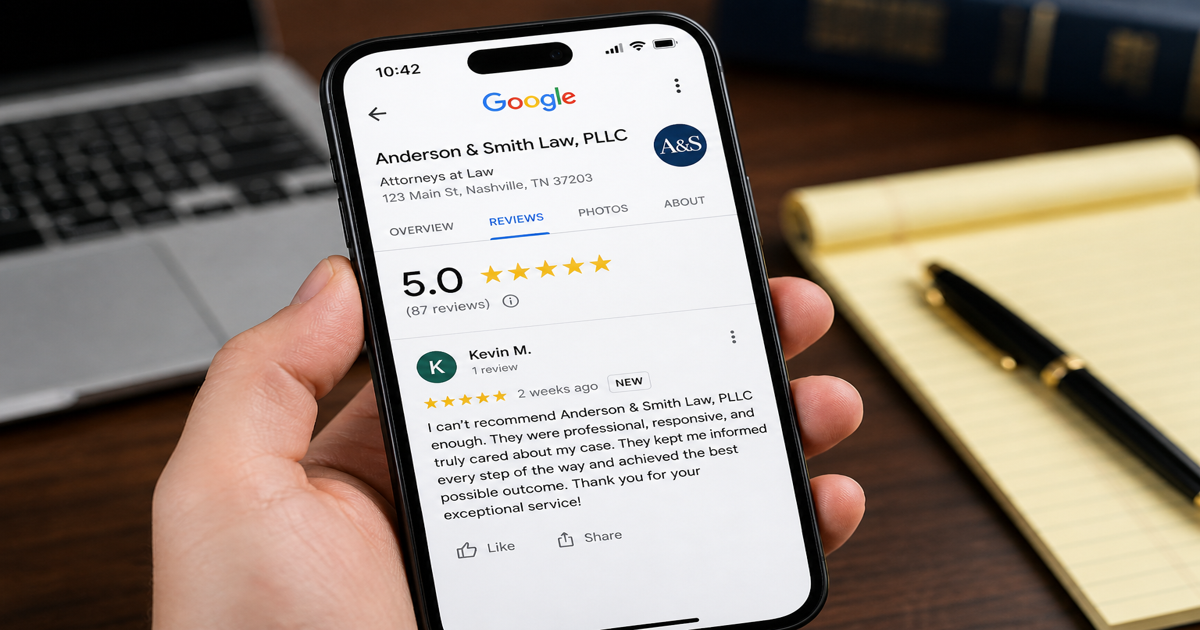
When a potential client has just been in a car accident, gotten served divorce papers, or received a letter from the IRS, the first thing they do is the same thing everyone else does: they pull out their phone and start searching. And before they call you, they read your reviews.
For most local businesses, online reviews are a nice-to-have. For law firms, they're the difference between a packed calendar and an empty one. The American Bar Association has reported for years that more than 80% of consumers research attorneys online before reaching out, and the vast majority of that research starts with Google. If your firm uses Clio, see our detailed Clio software review. Volume takes time to build — see our breakdown of how long for a law firm to hit 100 reviews.
But reviews for law firms aren't the same as reviews for plumbers or restaurants. You're operating under bar association ethics rules, attorney-client privilege, and a level of public scrutiny most businesses never face. A single misstep — soliciting a review the wrong way, responding to criticism without thinking, offering the wrong kind of incentive — can land you in front of a disciplinary committee.
This guide walks through everything law firms need to know about online reviews: why they matter, where to focus, how to get more of them ethically, how to handle the bad ones, and how to build a system that runs without consuming your time.
Three things make legal reviews uniquely high-stakes.
The purchase decision is emotional and high-trust. When someone hires a lawyer, they're often scared, angry, or grieving. They're handing over a problem they can't solve themselves and trusting you with the outcome. Reviews are the closest thing they have to a referral when they don't have a personal one.
The dollar value per client is high. A new personal injury client can be worth tens of thousands in fees. A family law retainer is rarely under $5,000. Compare that to a restaurant where each review represents a $40 dinner — the ROI on review generation for a law firm is in a completely different league.
Local search ranking depends on it. Google's local pack — those three businesses that show up on the map when someone searches "personal injury lawyer near me" — is heavily influenced by review quantity, recency, and rating. If you're a four-star firm with 12 reviews and your competitor has 4.7 stars and 180 reviews, you're invisible in the searches that matter most.
The firms that take reviews seriously dominate their local market. The ones that don't quietly lose clients to competitors who do.
Most attorneys think "Google reviews" and stop there. Google is the most important platform, but it isn't the only one, and depending on your practice area, ignoring the others is a mistake.
Google Business Profile is the heaviest weighted platform for local SEO and the first thing prospects see when they search your firm name. Every law firm needs a claimed, optimized Google Business Profile with a steady stream of recent reviews.
Avvo is specific to attorneys and still drives meaningful traffic, especially for personal injury and family law. Many prospects who don't know how to evaluate a lawyer use Avvo's rating system as a shortcut. We'll cover Avvo in depth in a separate post on how to get more Avvo reviews.
Martindale-Hubbell carries weight with referring attorneys and corporate clients more than consumer clients. If you do business law, M&A, or work with other firms, this matters. If you're a solo personal injury attorney, it matters less.
Lawyers.com feeds into the same ecosystem as Martindale and shows up in legal directory searches.
Facebook still matters for older demographics and certain practice areas — estate planning, family law, immigration. The reviews don't help SEO directly but they do influence consumers who research on social.
Yelp is less critical for law firms than for restaurants but still appears in search results and matters in some metros more than others.
The right strategy isn't to chase reviews on every platform. It's to dominate Google first, then build a presence on the secondary platforms that matter for your practice area. We'll go deep on platform comparison in a future post on Avvo vs Martindale-Hubbell vs Google.
This is where law firms differ from every other type of local business, and it's the part most generic review-management advice gets wrong.
The ABA Model Rules — and every state's version of them — regulate how attorneys can solicit testimonials, what they can say in marketing, and how they can respond to client communications in public. The big ones to know:
ABA Model Rule 7.1 prohibits false or misleading communications about your services. A review that misrepresents results, or your response that exaggerates them, can violate this rule even if technically true.
ABA Model Rule 7.2 governs advertising and (in some states) restricts what you can give in exchange for recommendations. Offering a discount, a gift card, or anything of value in exchange for a review can be a violation depending on your jurisdiction.
ABA Model Rule 1.6 is the confidentiality rule, and it's the one that gets attorneys in the most trouble with online reviews. When a former client posts a negative review, the instinct to defend yourself by sharing the actual facts of the case can violate your duty of confidentiality — even if the client opened the door by posting publicly.
State variations matter enormously. California, New York, and Florida all have their own twists. Texas is more permissive than most. Some states require specific disclaimers on testimonials.
We'll cover the practical mechanics of all of this in dedicated posts on how to ethically ask clients for Google reviews and whether lawyers can offer incentives for reviews. For now, the headline rule is: you can ask for reviews, you should ask for reviews, and you can do it ethically as long as you understand the boundaries.
The biggest mistake law firms make isn't asking the wrong way — it's not asking at all. Most attorneys feel awkward requesting reviews and assume happy clients will leave them organically. They won't. Studies of consumer review behavior consistently show that satisfied clients leave reviews far less often than dissatisfied ones unless explicitly prompted.
A few principles that work for legal practices specifically:
Ask at the right moment. For transactional work — wills, real estate closings, simple bankruptcies — the ideal moment is right after the matter closes successfully. For litigation, it's after a favorable resolution, not the day of. For personal injury, wait until the settlement is paid, not when the case is signed.
Make it easy. A client who has to log in, find your firm, click through three screens, and write something thoughtful will close the tab. A direct link delivered by text or email that drops them at the review form takes seconds.
Use SMS for response rates. Email open rates for review requests hover around 20%. SMS open rates are above 90%, and response rates are 3-5x higher. For law firms specifically, where clients are often older or less digitally fluent, the simplicity of a text matters even more.
Stay neutral in your ask. Don't say "please leave us a 5-star review." Say "if you were happy with our representation, we'd appreciate hearing about your experience." This protects you from ethics complaints and from looking like you're fishing for a specific outcome.
Don't pay or trade for reviews. This is non-negotiable. It violates Google's terms of service, FTC guidelines, and most state bar rules. The risk is not worth the handful of extra reviews.
The firms that consistently grow their review counts treat the request as a step in the client lifecycle, not a one-off favor. It's built into the closing process, automated where possible, and tracked.
Every law firm gets a bad review eventually. How you respond matters more than the review itself.
The first rule: don't respond when you're angry. Wait at least 24 hours. Most disciplinary complaints from review responses come from attorneys who fired off something defensive in the first hour after seeing a one-star review.
The second rule: never confirm representation in your response. This sounds counterintuitive, but in some jurisdictions, simply confirming that the reviewer was your client can be a confidentiality violation. Stick to general language: "Our firm takes all client feedback seriously…" rather than "When you came to us about your divorce…"
The third rule: don't engage with the substance. Don't refute the facts. Don't share your side of the case. Don't explain what really happened. Even if the review is wildly inaccurate, your response is not the place to litigate it. Public arguments with former clients almost always make the firm look worse, regardless of who's right.
A safe template that works for most situations:
"Thank you for sharing your feedback. We take all concerns about our representation seriously and would welcome the opportunity to discuss your experience directly. Please contact our office at [phone] so we can address this privately."
That's it. It signals professionalism to future readers, demonstrates that you respond to criticism, and avoids the confidentiality and ethics traps that come from saying anything substantive.
If a review is genuinely defamatory — provably false statements of fact, not opinion — you have legal options including takedown requests to Google and, in extreme cases, defamation suits. But those are last resorts. We'll cover the full playbook in a dedicated post on responding to negative reviews as a lawyer.
Different practice areas face different review dynamics.
Personal injury is the most competitive review environment in legal. The firms with the most reviews and highest ratings dominate Google's local pack and capture the bulk of high-value cases. Volume matters enormously here.
Family law has the most emotionally charged reviews. Divorces and custody cases produce strong feelings on both sides, and reviews from the losing spouse — who was never your client — can show up. Strategy here focuses on volume of legitimate reviews to dilute outliers.
Criminal defense faces a unique challenge: many clients don't want to publicly associate their name with the firm that represented them in a criminal matter. Review requests need to be handled with extra care, and some clients may prefer to leave initials or first-name-only reviews.
Estate planning and probate clients tend to be older, more relationship-driven, and very willing to leave reviews when asked. Conversion rates on review requests are typically among the highest in legal.
Business and corporate law depends less on consumer reviews and more on referrals, M-H ratings, and peer reputation. Reviews still matter for SEO but the strategy looks different.
Immigration often involves multilingual clients, family networks, and clients who don't speak English as a first language. Review requests in the client's preferred language dramatically improve response rates.
We'll publish dedicated guides for personal injury, family law, and criminal defense firms in the coming weeks.
The firms that consistently grow their review counts have one thing in common: they've stopped relying on memory. Every closed matter, every satisfied client, every favorable outcome triggers a request automatically — usually through their legal CRM software connected to a review platform.
A good system has four parts:
Trigger. Something — usually a status change in your case management system — fires off the request at the right moment.
Delivery. The request goes out by SMS (preferred) or email, with a direct link to your Google Business Profile.
Follow-up. A gentle reminder a few days later catches the clients who meant to leave a review but forgot. Without this, you leave most of your potential reviews on the table.
Filtering. A short prescreen — "How would you rate your experience, 1-5?" — lets you route happy clients to public review platforms and unhappy clients to a private feedback form. This is legal and ethical when done right (you're not gating reviews, you're just giving unhappy clients a private channel first), but it has to be implemented carefully.
The math on automation is straightforward. A solo attorney who closes 10 matters a month and asks every client manually might get 1-2 reviews a month. The same attorney with an automated system typically gets 5-7 — and never has to remember to ask.
TrueReview integrates with most legal practice management systems including MyCase, Clio, PracticePanther, and others, so review requests fire automatically when a matter changes status.
Online reviews are no longer optional for law firms. They drive local search rankings, they shape the impression every prospect has before they ever call, and they're the closest thing to a referral that most clients have when they're searching for a lawyer at the worst moment of their life.
The firms that win the next decade in legal marketing won't be the ones with the flashiest websites or the biggest ad spend. They'll be the ones that systematically built up hundreds of authentic, recent reviews while their competitors hesitated.
The ethics rules are real, but they're not a barrier — they're a framework. Once you understand them, asking for reviews ethically is straightforward. Once you have a system, growing your review count is automatic.
If you're starting from scratch, focus on three things this month:
Everything else compounds from there.
Want to automate review requests for your law firm? Start a free 14-day trial of TrueReview — no contracts, no setup fees, and integrations with the legal practice management software you already use.