BLOG POST
A modern restaurant runs on a stack of software — and the tools you choose shape your margins, your guest experience, and how visible you are when someone nearby searches "restaurants near me." This guide walks through the core categories of restaurant technology, what each one does, and how the pieces connect, with particular attention to the feedback and review layer that turns happy guests into the public reviews that drive discovery.
Whether you run a single independent location or a growing group, the goal is the same: a connected stack where the POS, reservations, online ordering, and feedback tools talk to each other instead of sitting in silos.
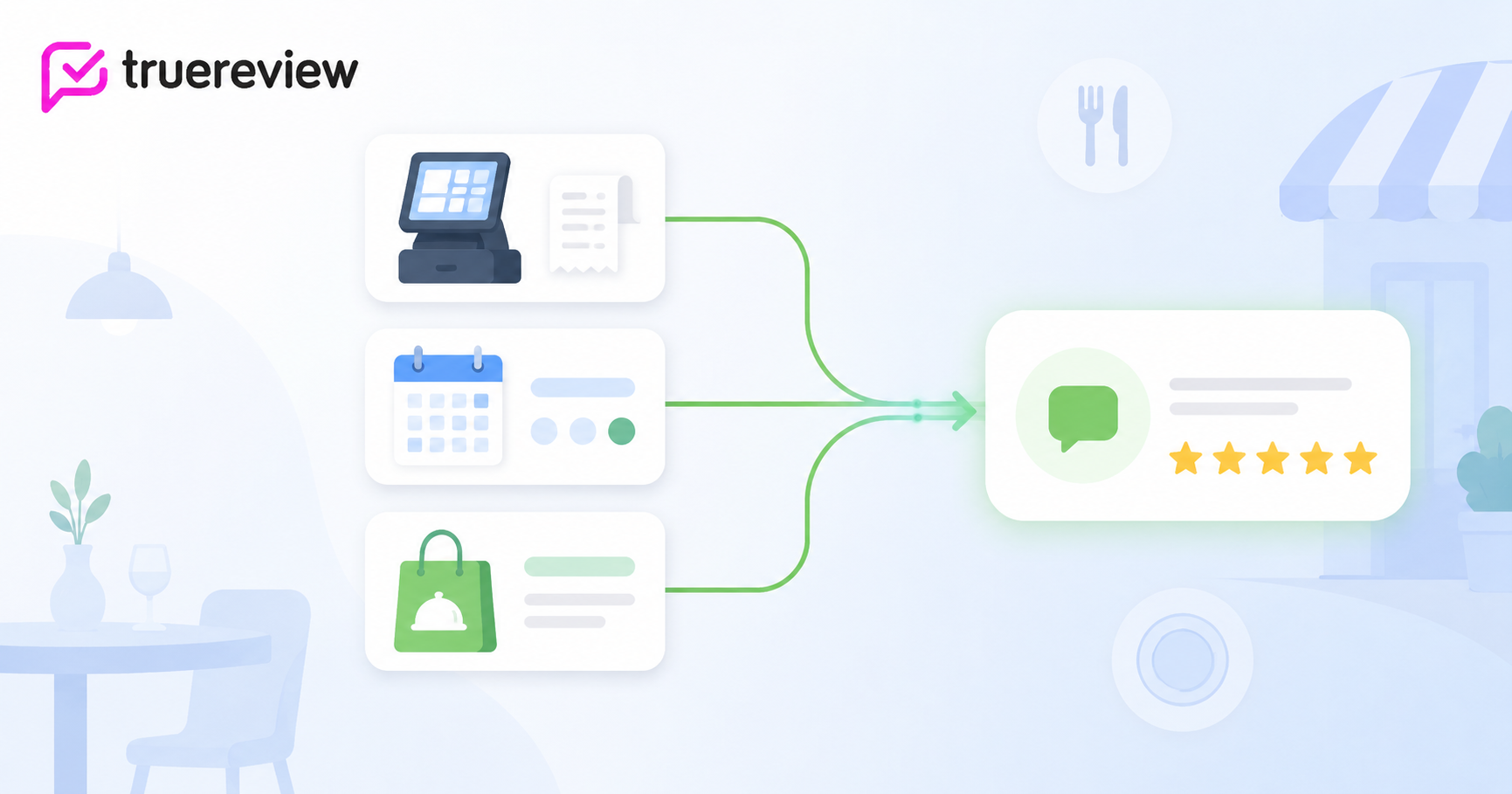
The hub of the stack. Toast, Square, Clover, and Lightspeed handle orders, payments, and increasingly tipping, digital receipts, and basic guest data capture. Your POS choice matters beyond transactions because it is often where guest contact info first enters your system — the raw material for review requests later.
OpenTable, Resy, Yelp Reservations, and Tock manage bookings and, critically, capture guest emails. For full-service restaurants, the reservation platform is one of the most reliable sources of contact info you can feed into an automated review pipeline.
First-party online ordering (through your POS or a dedicated provider) captures contact info and keeps margins intact. Third-party marketplaces like DoorDash and Uber Eats drive volume but keep the guest relationship — and the reviews — on their own platform, a structural challenge worth planning around.
Kitchen display systems, inventory and food-cost software, and scheduling tools run the back of house. They don't touch guests directly, but they shape the experience guests end up reviewing.
Loyalty programs and email/SMS marketing tools deepen the guest relationship and, like reservations, expand the pool of guests whose contact info you hold — which is exactly the pool you can ask for reviews.
The layer that captures guest sentiment and converts it into public Google reviews and faster issue resolution. This is where TrueReview operates, and it is the category most directly tied to inbound discovery — because Google reviews are what win the local 3-pack.
Most restaurant technology improves operations or margins. The feedback and review layer is different: it directly drives new guest acquisition. A diner deciding where to eat tonight Googles nearby restaurants, scans the top results' review counts and recent reviews, and picks in under two minutes. A restaurant with strong, recent reviews wins that moment for free; a thin or stale profile loses it.
That is why a review-generation tool often delivers more measurable top-line impact per dollar than another operational system — it compounds. More reviews lift local ranking, which drives more visits, which produce more reviews. For the full playbook, see our guide on how to get Google reviews for restaurants.
The restaurants that get the most out of their technology treat it as a connected pipeline, not a pile of disconnected apps. The pattern looks like this:
Each piece is more valuable when it connects to the next. A POS that captures emails is wasted if nothing asks those guests for a review; a review tool is more powerful when it fires automatically off your existing systems. For where the resulting reviews should live, our overview of the best restaurant review sites is a useful companion.
Ready to turn restaurant feedback into a steady flow of Google reviews? Start your free 14-day trial of TrueReview — automated SMS and email review requests for the customers whose contact info you capture, POS and reservation-platform integrations via direct API or Zapier, QR code generation for receipts and table cards, location-specific pipelines for multi-location operations, and Review Radar™, which flags reviews that appear to violate Google policy so you stay in control of how you respond. A credit card is required to start your trial; no setup fees, no contracts.