BLOG POST
If you run marketing or operations for a brand with dozens or hundreds of locations, you already know the quiet chaos of business listings. A store relocates, a phone number changes, a franchisee edits their own Google profile, and suddenly your name, address, and hours are saying three different things across Google, Apple Maps, Bing, and a long tail of directories nobody on your team has ever opened.
Listings management software exists to fix that at scale: push one clean record from a central dashboard and keep it consistent everywhere customers look. The category is crowded, though, and the platforms differ more than their homepages suggest. Some own direct publisher relationships, some distribute through data aggregators, and some are one-time citation builders rather than always-on sync engines.
This roundup compares the platforms multi-location teams evaluate most often - Uberall, Synup, Yext, Moz Local, and BrightLocal - on the things that actually matter operationally: directory coverage, sync and duplicate suppression, multi-location workflow, and pricing. We will also be honest about where reviews fit, because listings and reviews are two different jobs.
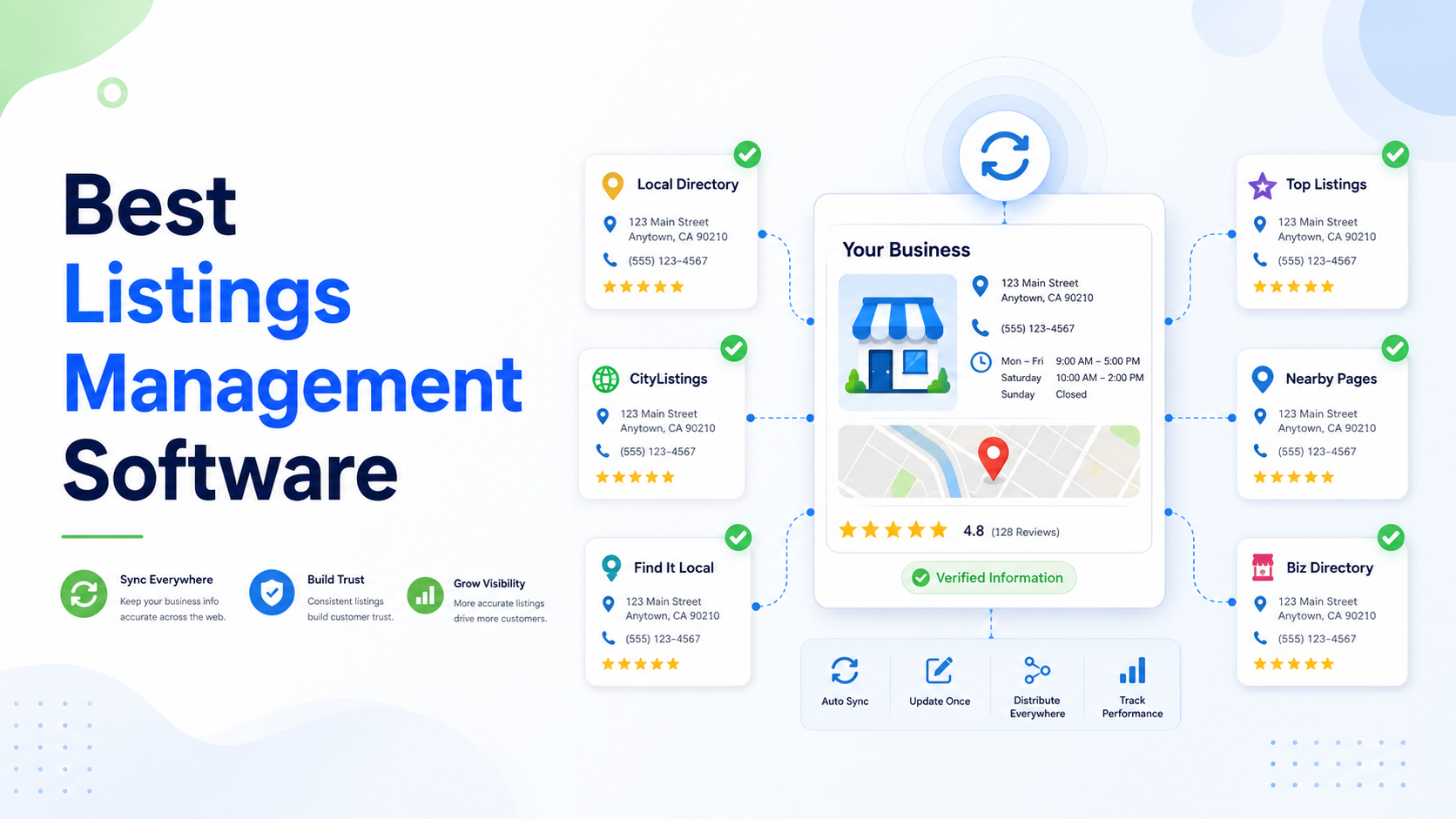
At its core, a listings platform takes one authoritative record for each location - your NAP (name, address, phone), hours, categories, photos, and attributes - and distributes it to search engines, maps, voice assistants, and directories. When something changes, you edit it once and the platform propagates the update rather than making someone log into 40 profiles by hand.
Good tools add three things on top of that: they detect and suppress duplicate listings that confuse customers and dilute local rankings, they protect profiles from unauthorized edits, and they report on visibility and accuracy per location and in aggregate. What they generally do not do is generate or manage the reviews attached to those profiles - that is a separate discipline, which we cover further down.
Coverage is the first filter, but bigger is not automatically better. A "200+ directories" claim only helps if those directories reach your customers, and a handful of high-traffic destinations - Google, Apple Maps, Bing, Facebook - drive most of the value for most local brands. What matters is whether a platform hits the core maps and search surfaces reliably, and whether it reaches the industry-specific or regional directories your category depends on.
There are two broad distribution models to understand. Aggregator-based tools push your data to a small set of data partners (such as Foursquare, Data Axle, or TomTom) that in turn feed hundreds of downstream sites. Direct-distribution tools maintain first-party API connections to each publisher, which can mean faster updates and verified accuracy on the destinations they support. Neither is strictly superior; they trade breadth against directness.
| Platform | Best for | Coverage & model | Pricing (approx.) |
|---|---|---|---|
| Uberall | Large, international multi-location brands | Reportedly 150+ directories globally; bulk upload via spreadsheet or API; profile protection and duplicate suppression | Quote-based / custom |
| Synup | Agencies and franchises managing many locations | Reportedly 200+ platforms; single dashboard, bulk updates, per-location plus aggregate reporting | From ~$79/mo, tiered by location count |
| Yext | Teams that want direct, verified distribution | Direct publisher network, reportedly ~40+ to 100+ publishers by tier; duplicate suppression included | From ~$199/location/yr self-serve; enterprise custom |
| Moz Local | Value-focused SMB and mid-market teams | Aggregator model via a smaller set of data partners (Google, Apple, Facebook, Bing, Foursquare, TomTom); duplicate suppression in all tiers | From ~$14/location/mo, billed annually |
| BrightLocal | Teams that want to own citations, not rent sync | Citation Builder submits to hundreds of sites; one-time builds you keep, plus a broader local SEO suite | Citations ~$2-3/site; SEO suite from ~$39/mo |
Directory counts, tiers, and prices change often and vary by contract, region, and location volume. Verify current pricing and the exact directory list on each vendor's site before deciding.
Sync is the difference between a listings tool and a one-time citation service. With continuous sync, the platform holds the "source of truth" for each location and re-asserts it whenever a publisher's copy drifts - so if a franchisee or a well-meaning customer edits your Google hours, the correct data is pushed back. Uberall, Synup, Yext, and Moz Local all operate on this always-on model. BrightLocal's Citation Builder, by contrast, is closer to a one-time submission: it places accurate citations you then own outright, which is attractive if you want permanence without a recurring per-location fee, but it does not continuously police those listings for you.
Duplicate suppression is the other half of accuracy. Duplicate profiles - two Google listings for the same store, an outdated Bing entry from a prior owner - split your reviews, confuse customers, and can suppress local rankings. Most of the platforms here advertise duplicate detection and suppression, but they handle it differently: some suppress automatically on the publishers they control, others surface duplicates for you to resolve, and coverage of suppression varies by directory. When you demo a tool, ask specifically which directories it can suppress duplicates on, how long suppression takes, and whether it is included in your tier or an add-on.
For a deeper primer on how listings accuracy and citation building fit into local search overall, our guide to business listings management walks through the fundamentals without the vendor pitch.
For a franchise or multi-unit operator, the platform's day-to-day workflow often matters more than a headline directory count. The questions that decide whether a rollout succeeds are practical: Can you bulk-import and bulk-edit locations from a spreadsheet or API? Can you set roles and permissions so a regional manager updates only their stores while corporate keeps brand standards locked? Can franchisees request changes without being able to overwrite approved data? And does reporting roll up to a portfolio view while still letting you drill into a single store?
If your locations are structured as a franchise with local owners, weigh permission controls and change-approval workflows heavily; if you run corporate-owned units, bulk operations and rollup reporting usually matter more. Either way, run a pilot with a handful of real locations before committing the whole portfolio - the demo always looks smoother than a live rollout. You can see how a review dashboard approaches the same many-locations problem on our manage multiple businesses page.
Pricing in this category is genuinely hard to compare because vendors use different units. Moz Local and Yext price largely per location; Synup prices in tiers by location count; Uberall and enterprise Yext are quote-based; BrightLocal's Citation Builder is a one-time per-site fee that sits outside the subscription model entirely. A "$14 a month" tool and a "$799 a month" tool can work out to similar per-location economics once you account for how many locations each covers.
To compare apples to apples, normalize everything to cost per location per year, then layer in what is actually included at that price. Watch for the common gaps: duplicate suppression, review monitoring, richer reporting, and API access are sometimes add-ons rather than standard. With enterprise or reseller deals, ask for an itemized quote that separates the platform fee from any management fee, and confirm who owns the account and the underlying profiles if you ever switch vendors.
Because these numbers move and vary by contract, treat every figure in this article as a starting point for your own diligence, not a quote.
Here is the honest boundary: listings put you on the map, but reviews are what convince someone to choose you once they find you. The two live side by side on the same Google, Facebook, and directory profiles, yet they are different jobs handled by different tools. Listings management keeps your NAP accurate and suppresses duplicates. It does not ask your customers for reviews, monitor what they say, or help you respond.
That review side is where TrueReview fits, and it is worth being clear about scope: TrueReview is review-generation and reputation software, not a listings syndicator. It does not push your business data to directories or manage citations - the platforms above do that. What it does is automate review requests by SMS and email, consolidate reviews from across platforms into one dashboard with alerts, and help teams reply, all from a single account that can span many locations. Its Review Radar feature also flags incoming reviews that appear to violate Google's review policies, so your team can decide how to handle them.
Crucially for a multi-location operator, both accuracy and reputation compound at the location level. Clean listings help customers find each store; a steady flow of recent, authentic reviews helps each store convert that visibility into visits. Many brands run a listings platform for the first job and a review tool for the second.

Once a listings platform has your locations consistent, TrueReview handles the review side - requests, monitoring, and responses across every location from one dashboard. See plans and pricing or start a free 14-day trial.