BLOG POST
If you searched for “DealerRater,” you might be a car buyer comparing dealerships before you walk onto a lot. But most people who want to actively grow a DealerRater presence are on the other side of the desk: sales managers, service directors, and marketing leads trying to earn more reviews for their store. This guide is written for that dealer-side audience.
DealerRater is one of the most established review platforms in the automotive world, and it works a little differently from Google or Facebook. It separates sales and service, ties reviews to individual salespeople, and syndicates content across a network that reaches millions of shoppers. Understanding those mechanics is the difference between hoping reviews trickle in and building a repeatable system that earns them.
Below, we break down how DealerRater works, why the sales-versus-service split matters, when to ask, how salesperson-level reviews function, and how to connect the whole thing back to Google — all without cutting corners or gaming the system.
DealerRater launched in 2002 and was acquired by Cars.com (now part of Cars Commerce) in 2017. That ownership matters because reviews you earn on DealerRater don’t stay in one place — they syndicate across the Cars.com network and, according to the company, appear on partner destinations that reach a large share of in-market shoppers. A single strong review can therefore show up in more than one place a buyer is researching.
Every review goes through a verification process before it publishes, which is part of why DealerRater content tends to carry weight with shoppers. Your dealership’s overall rating is calculated from lifetime review scores, but recent reviews are weighted more heavily. In practical terms, that means a store can’t coast on a great year from the past — a steady, current flow of reviews is what keeps your rating healthy and your profile near the top of local results.
DealerRater also runs a tiered certification program for dealers who want reputation tools, automated review requests, and reporting. You don’t need a paid tier to receive reviews, but the paid features exist to help you request and manage them at scale. Verify current tier names, features, and pricing on DealerRater’s site before you budget for them, since these change over time.
One of the most useful things about DealerRater is that it treats sales and service as distinct experiences. A buyer who loved the negotiation but hasn’t been in for an oil change yet is reviewing something different from a longtime owner who trusts your service lane. Recognizing this split changes how — and when — you ask.
Sales reviews tend to be emotional and high-stakes. Someone just spent a significant amount of money, and the memory of a smooth (or rocky) buying experience is fresh. Service reviews, on the other hand, come from repeat interactions and often reflect trust built over time. Both matter to shoppers, but they answer different questions: “Will this dealership treat me fairly when I buy?” and “Will they take care of me after I do?”
The mistake many stores make is running a single, generic review request for everyone. A more effective approach is to tailor the ask to the department. A sales customer should hear about their salesperson and the buying process; a service customer should hear about their advisor and the visit. This isn’t gating — you still ask everyone and let them say whatever they want — it’s simply making the request relevant so more people respond. For a wider view of managing both streams, see our guide to automotive reputation management.
Timing is the single biggest lever you control. Survey data that DealerRater has shared points to a simple truth: customers are far more likely to write a review when their salesperson personally asks them to. A request that lands while the experience is still fresh — and comes from the person they actually worked with — converts dramatically better than a cold, automated blast weeks later.
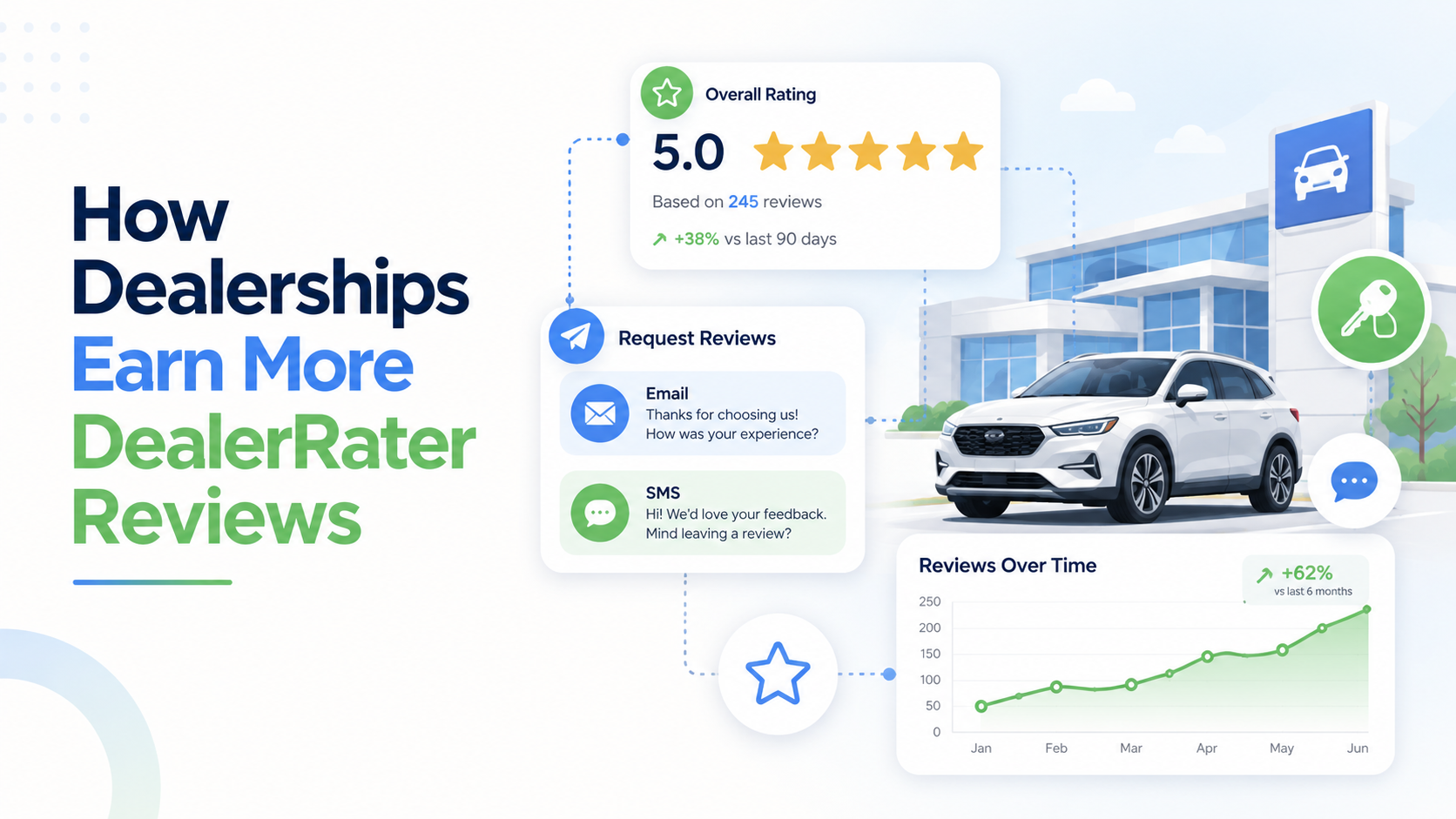
For sales, the window is short. The best time is right after delivery, when the customer is still excited about the car. For service, ask once the vehicle is returned and the work is explained, when relief and satisfaction are highest. In both cases, the in-person ask plants the seed and the follow-up text or email closes the loop with a direct link so nobody has to hunt for your profile.
Here’s a simple, compliant sequence any store can run:
Note that last step. It’s tempting to survey customers first and only route the happy ones to a public review, but that practice — review gating — runs against Google’s policies and the FTC’s 2024 Rule on Consumer Reviews. Ask everyone, let the chips fall, and fix the underlying experience if too many reviews disappoint. Your rating will be more durable for it.
DealerRater’s standout feature is that reviews attach to individual employees, not just the store. Reviewers can name and rate the salesperson or advisor who helped them, and each employee can have a profile with a photo, bio, and their own accumulated reviews. This is a genuine advantage — and an underused one.
When customers can call out a person by name, three good things happen. The review gets more specific and believable (“Maria walked me through every number” reads better than “great dealership”). Salespeople get personally invested in earning them, because the reviews follow their name and can help their careers. And shoppers get to “meet” your team before they arrive, which lowers their guard.
To make this work, complete every employee profile with a real photo and a short bio, and coach your team to say their own name during the ask: “If you have a minute, a review mentioning me by name really helps.” A little friendly internal recognition — celebrating the advisor with the most five-star reviews this month — keeps the habit alive without turning into a numbers game that pressures anyone to cut corners. For more team-level tactics, see our roundup of car dealership marketing ideas.
Earning reviews is only half the job; responding to them is what turns your profile into a trust signal. Shoppers read responses as closely as reviews, because a thoughtful reply tells them how you’ll treat them if something goes sideways.
For positive reviews, keep it brief, specific, and human — thank the customer, mention the salesperson or the vehicle, and invite them back for service. For negative reviews, resist the urge to argue in public. Acknowledge the concern, apologize where warranted, move the detailed conversation offline, and — once you’ve genuinely resolved the issue — you can politely ask whether they’d be willing to revisit their review. Never demand an edit or make resolution conditional on one.
Occasionally you’ll see a review that looks fake or clearly breaks platform rules — a competitor’s smear, or something that appears to violate Google’s review policies when it shows up there. You can flag content to the platform for review, but understand that removal is never guaranteed and is decided by the platform, not by you or any vendor. Focus your energy on the reviews you can actually influence: the real ones from real customers.
DealerRater and Google reviews aren’t either/or — the strongest dealerships build both. Most car shoppers still start on Google, so a healthy Google Business Profile is non-negotiable, while DealerRater gives you automotive-specific credibility and salesperson-level depth that Google can’t match.
DealerRater offers ways to connect Google to its dealer panel so you can respond to reviews from more than one source in one place, and certified dealers have had options to encourage positive Google review counts as well. Availability and mechanics of these features change, so confirm what’s current with DealerRater directly. The broader principle holds regardless: don’t treat any single platform as an island. Whatever tool you use to request reviews, point some customers toward Google and some toward DealerRater so both profiles stay fresh, and monitor them together rather than logging into five dashboards.
If you are mapping where reviews sit alongside your CRM, DMS, and service scheduler, our comparison of car dealership software shows how the reputation layer connects to the rest of the stack.
That last point — monitoring everything in one place — is where a dedicated review-generation platform earns its keep, especially for groups running multiple rooftops. If you’re weighing options built specifically for auto, our automotive solutions overview and our TrueReview vs. Widewail comparison are useful starting points.

TrueReview automates review requests by SMS and email with customizable delays and follow-ups, imports your customer list, and consolidates reviews from Google, Facebook, and more into one dashboard with alerts. It sends neutral requests to everyone — no gating — and manages opt-outs for you. Start a free 14-day trial.
A quick note on scope: TrueReview helps you request, monitor, and respond to reviews across platforms, and its Review Radar™ can detect incoming reviews that appear to violate Google’s review policies so your team can decide what to do. It does not post to DealerRater on your behalf or report reviews to any platform for you — those actions stay in your hands and the platform’s. Used alongside your DealerRater strategy, it’s the connective tissue that keeps every profile fed.