BLOG POST
Search "car dealership software" and you get a wall of names that don't do the same job. DealerSocket, VinSolutions and Elead are sales CRMs. CDK Global and Reynolds and Reynolds are dealer management systems that run the whole store. Xtime handles the service lane. Widewail, Podium and TrueReview live in a different lane again: reputation and reviews. Lumping them together is how dealers end up paying for overlap they never use.
This guide sorts the category into the buckets that actually matter to a dealership marketing manager, explains what each type of tool is for, and is honest about where the lines blur. It also covers the part most roundups skip: how customer reviews thread through the sales and service process, and which tool owns that piece.
A quick note up front. If you landed here shopping for one product, know that no single platform does all of it well. Most dealer tech stacks are a CRM plus a DMS plus a scheduler plus a reputation layer, stitched together with integrations. The goal is picking the right tool per job, not finding a mythical all-in-one.
Before comparing specific products, it helps to see the map. Nearly every tool a dealership buys falls into one of these buckets, and confusing them is the most common (and most expensive) mistake when building a stack.
A dealership CRM is the sales team's home base. It captures internet leads, phone-ups and walk-ins, assigns them to salespeople, and automates follow-up so no opportunity goes cold. This is the category the keyword "DealerSocket" belongs to, so it's worth being clear: DealerSocket is a CRM, not a reputation platform. If you found this page hoping to compare review tools, the CRMs below are adjacent infrastructure, not competitors to a review solution.
DealerSocket. A long-established automotive CRM, now part of Solera. It covers lead management, desking, marketing automation and equity mining, and it's known for deep configurability. Reviews across software directories describe it as feature-rich but with a learning curve. Pricing is quote-based and typically scales by users and modules.
VinSolutions Connect CRM. A Cox Automotive product, tightly tied to the broader Cox ecosystem (Autotrader, Dealer.com, vAuto). It emphasizes lead automation, a mobile app, and AI-assisted follow-up. Popular with dealers already inside the Cox stack.
Elead (Elead CRM). Now under the CDK/Elead umbrella, Elead is widely used for its call-center-style BDC tooling and service-plus-sales lead handling. Reportedly strong on process discipline and phone workflows.
DriveCentric. A newer, AI-forward CRM that leans into video, texting and a modern interface. Often shortlisted by dealers who find legacy CRMs clunky.
None of these is a "wrong" choice. The right CRM usually comes down to which DMS and OEM programs you're already committed to, and how your BDC likes to work. For a broader look at growing the top of the funnel, see our car dealership marketing ideas.
The DMS is the operational core of the store, handling accounting, parts and inventory, F and I, and payroll. It's a different animal from a CRM: heavier, deeply integrated, and far harder to switch. The two dominant names are CDK Global and Reynolds and Reynolds, with Dealertrack (Cox Automotive) also in the mix.
You don't shop for a DMS the way you shop for a review tool. These are multi-year commitments with significant switching costs, and the buying decision usually sits above the marketing manager. What matters for marketing and reputation is that your DMS is the system of record for customer data, so any reputation tool you choose should be able to receive that data (directly or through a middleware layer) to trigger review requests after a sale or service visit.
One practical note: the DMS integration landscape has historically been gated, and data-access terms have been the subject of litigation in recent years. When evaluating add-on tools, confirm how they'll get customer contact data out of your DMS, and at what cost.
Fixed ops (service and parts) is where many dealerships make their steadiest margin, and the service lane has its own software category. Xtime, a Cox Automotive product, is the best-known online service scheduler, covering appointment booking, service reminders, multi-point inspections and payment. myKaarma is another widely used option emphasizing communication and payments, and most DMS platforms and some CRMs include their own scheduling modules.
Service scheduling matters to reputation for one big reason: the service visit is a prime review moment. A customer who just had a smooth oil change or a warranty repair is often more willing to leave a review than a buyer three days after signing. A good reputation workflow fires a review request shortly after the repair order closes, which means your scheduler (or DMS) needs to hand off that "just completed" signal to your review tool.
This is the category where reviews are the whole point, and it's where TrueReview lives. These tools automate review requests, consolidate reviews from across platforms into one place, and help you respond. For dealerships specifically, three names come up most often.
Widewail. An automotive-focused reputation platform known for review generation (its "Invite" product) plus a managed, human-assisted review response service. It's positioned squarely at dealers and dealer groups and leans on done-for-you responding. If you're weighing it directly against us, see our TrueReview vs Widewail comparison.
Podium. A broad, multi-industry messaging and reviews platform. Beyond review requests it offers webchat, payments and a shared inbox, so it competes on being a communication hub as much as a reputation tool. Widely used in automotive but not automotive-only.
TrueReview (Ours). Review-generation and reputation software for local and multi-location businesses. It automates review requests by SMS and email with customizable drip campaigns, consolidates reviews from Google, Facebook and many other platforms into one dashboard, and includes an AI response generator, sentiment analysis and embeddable review widgets. It's built compliance-first, sending neutral requests to everyone rather than gating by rating. For the automotive angle specifically, see our automotive reputation page and the deeper automotive reputation management guide.
A fair distinction: Widewail's calling card is managed response as a service, and Podium's is being an all-in-one messaging suite. TrueReview focuses on making high-volume, compliant review generation and multi-location monitoring straightforward and affordable, with integrations to connect it to the rest of your stack. Which fits depends on whether you want done-for-you responding, a broad communication platform, or a focused reputation engine you run yourself.
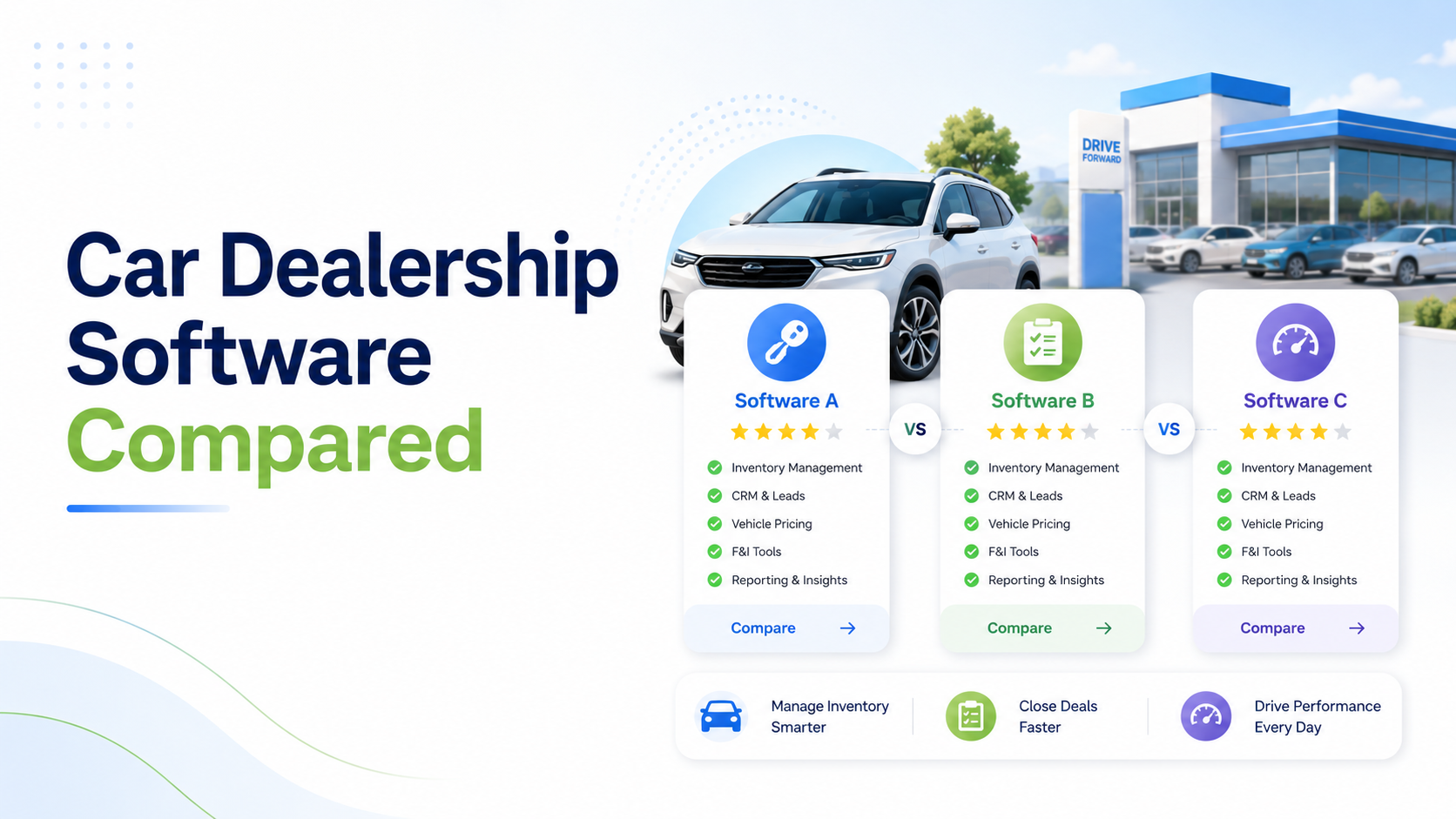
Grouped by job, so you're comparing like with like. Pricing is approximate and changes often, so treat these as ballpark ranges only.
| Tool | Category | Best for | Pricing (approx.) |
|---|---|---|---|
| DealerSocket | Sales CRM | Configurable lead and equity management | Quote-based |
| VinSolutions | Sales CRM | Dealers inside the Cox ecosystem | Quote-based |
| Elead | Sales CRM | BDC and phone-heavy workflows | Quote-based |
| CDK Global | DMS | Full-store operations for larger dealers | Custom/enterprise |
| Reynolds and Reynolds | DMS | Integrated, single-vendor operations | Custom/enterprise |
| Xtime | Service scheduling | Online service booking and fixed ops | Quote-based |
| Widewail | Reputation and reviews | Managed, done-for-you review responses | Quote-based |
| Podium | Reputation and reviews | All-in-one messaging plus reviews | From ~$399/mo |
| TrueReview (Ours) | Reputation and reviews | Compliant, high-volume review generation and multi-location monitoring | Tiered; 14-day free trial |
Pricing is approximate and for orientation only. Verify current pricing and features on each vendor's website before deciding.
A dealership stack only works if the pieces talk to each other. A few things to plan for:
Automotive software pricing is famously opaque. Most CRMs and both major DMS platforms are quote-based and negotiated per rooftop, often bundled with OEM co-op programs. As a rough orientation only: dealer CRM seats are commonly reported anywhere from about $25 to $300 per user per month depending on modules; DMS contracts are enterprise deals negotiated individually; and reputation tools range from a few hundred dollars a month up, depending on volume and whether managed response is included.
TrueReview uses transparent tiers (Starter, Small Business, and Premium) with a 14-day free trial that includes up to 250 requests, so you can test review generation before committing. Because pricing across all these vendors changes, always confirm current numbers on the vendor's own site.
Reviews aren't a bolt-on afterthought; they're part of the funnel. Most car buyers read dealership reviews before they ever call, and star ratings feed directly into local map rankings. That means the reviews your reputation tool generates today become the social proof that wins tomorrow's up.
The cleanest workflow looks like this: the CRM works the lead and closes the deal, the DMS records the transaction, and a reputation tool automatically requests a review at the right moment, after delivery for sales, or after the repair order closes for service. Requests go out by SMS and email, responses get monitored in one dashboard, and negative feedback gets a fast reply. Do that consistently across every rooftop and your review volume and average rating climb over time, which is exactly what shows up in your automotive reputation management results.
Put simply, here is how the reviews layer plugs into the day-to-day flow of a dealership without adding manual work for your sales or service staff.

TrueReview handles the reputation piece, automated, compliant review requests and one-dashboard monitoring, while your CRM and DMS do the rest. It's not a CRM or a DMS, and it doesn't pretend to be. Start a free 14-day trial.