BLOG POST
This article discusses professional conduct rules in general terms. It is not legal advice, and bar rules vary by jurisdiction. Confirm your own state's requirements before implementing any client communication or review solicitation programme.
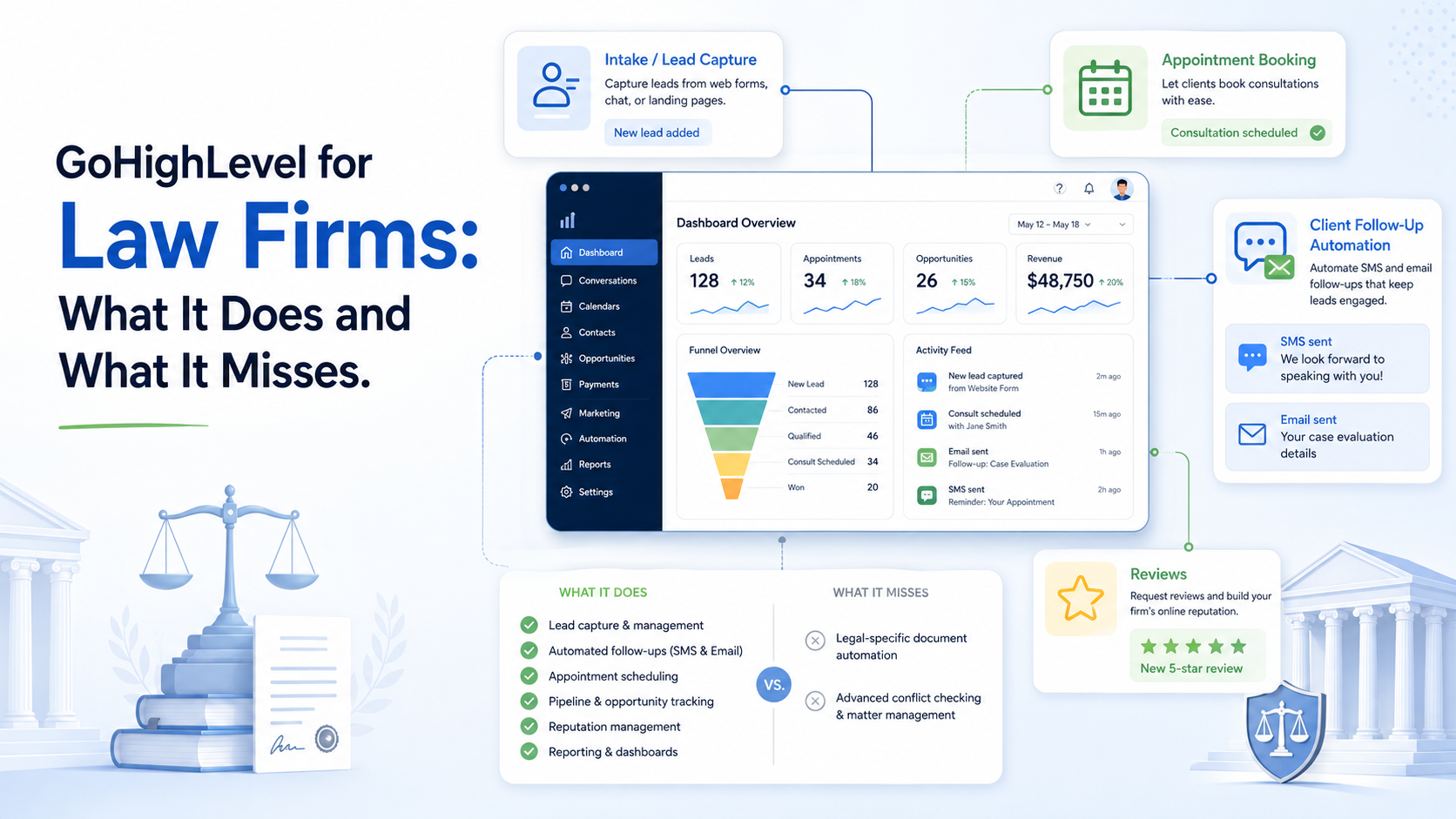
Law firms are sold GoHighLevel as an intake-and-marketing engine, and for that job it is decent. The question is what it does not do, and whether the gaps matter for a firm.
Intake speed. The strongest argument, and the numbers behind it are stark: a prospective client with an urgent legal problem contacts multiple firms and typically retains one of the first to respond substantively. Automatic acknowledgement by SMS the moment a form is submitted, missed-call text-back while you are in court, and instant routing to whoever is on intake duty all convert enquiries that would otherwise go elsewhere.
Consultation scheduling. Booking calendars that let a prospect self-schedule an initial consultation, with automated reminders that cut no-shows. For firms where the intake coordinator plays phone tag for two days, this alone justifies the cost.
Nurture for long decision cycles. Estate planning, business formation and family law all involve prospects who research for months. Automated educational sequences keep the firm present without anyone remembering to follow up.
Referral source tracking. Pipelines and custom fields let you see which referral sources and campaigns produce signed matters rather than just enquiries.
It is not practice management. No matter management, no conflict checking, no trust accounting or IOLTA compliance, no document assembly, no time and billing, no court calendaring. If you use Clio, MyCase, PracticePanther or Smokeball, GoHighLevel sits in front of it as a marketing layer. You will run both.
It is not built with confidentiality in mind. Nothing about GoHighLevel is designed around privileged communication. If prospective client details flow into a marketing CRM, think carefully about what gets stored in contact notes, who on your team and your agency's team can see it, and what your engagement and privacy disclosures say. This is a genuine consideration, not a formality — and worth raising with whoever manages your account if that is an outside agency.
Here is the specific weakness for firms.
GoHighLevel's reputation module natively covers Google Business Profile and Facebook. Google matters enormously for legal — the local pack drives a large share of firm enquiries. But it is not the whole picture.
Prospective clients researching a lawyer check Avvo, Lawyers.com, Martindale-Hubbell and Justia. Those profiles rank well for attorney-name searches and carry weight precisely because they are legal-specific. A firm with a strong Google presence and an empty Avvo profile looks incomplete to anyone who checks.
Wider review sources in GoHighLevel require the Online Listings add-on at $30/month per sub-account, and that is oriented around listings consistency and monitoring rather than routing a satisfied client to your Avvo profile at the right moment.
Attorney-level attribution is also missing. Reputation reporting is per sub-account. In a firm with several attorneys, reviews often name the individual lawyer — and that individual's profile is what a prospect finds when they search the name on the retainer. A firm that cannot see review performance per attorney cannot manage it.

TrueReview for law firms ships native Avvo and Lawyers.com review widgets alongside Google, with per-attorney attribution so each lawyer's profile can be tracked and grown separately.
This is the part generic marketing software ignores entirely, and it is the part that carries actual risk for a firm. Rules vary by jurisdiction, so treat the following as issues to check rather than as answers.
Confidentiality applies to your response, not just the review. The most common trap is not asking for a review — it is replying to a negative one. Model Rule 1.6 and its state equivalents restrict disclosing information relating to the representation, and a client's public complaint does not automatically waive that. Several state bars have disciplined lawyers for responding to online criticism with case details. We have written a fuller guide to responding to negative reviews as a lawyer.
Even confirming someone is a client can be a disclosure. In some practice areas — family, criminal, immigration, bankruptcy — the existence of the representation is itself sensitive. A review request sent to the wrong list, or a public reply that acknowledges the relationship, can cause real harm.
Incentives are generally restricted. Offering anything of value for a review runs into advertising and solicitation rules in most jurisdictions, and into platform terms of service besides.
Timing and pressure. Asking a client for a review while the matter is ongoing, or while they still owe fees, raises questions about voluntariness that are best avoided. Most firms ask at matter closure.
Attribution and testimonials. Some jurisdictions require disclaimers on client testimonials, particularly where results are mentioned. Check your state's advertising rules on what must accompany a testimonial you display on your own website.
The practical implication for any software choice: you need control over exactly who gets asked and when, and you need it to be reliable. A misfiring automation in a family law practice is a different order of problem than a misfiring automation in a pizza restaurant.
GoHighLevel is a competent intake and marketing layer for a law firm, and the speed-to-lead automation is worth real money in any practice area where prospects shop several firms at once. It is not practice management, and its review coverage is built for local businesses rather than for a profession whose clients research on legal directories.
If reputation rather than enquiry volume is your constraint — which it is for most established firms — the platform solves the problem you do not have. Our complete guide to online reviews for law firms covers the compliance side in more depth.
If legal directory coverage and per-attorney reporting are what you need, that is a different tool. Start a free 14-day trial of TrueReview — native Avvo, Lawyers.com and Google coverage, per-attorney attribution, and precise control over who gets asked and when.