BLOG POST
If you run reputation management for 5 to 50 clients inside GoHighLevel, you already know the platform economics are excellent. Unlimited sub-accounts from $297, usage rebillable at cost on Unlimited and with markup on Agency Pro. Nothing else in the category comes close on price at that scale.
What nobody costs properly is the labour. This is about that — where the time actually goes, and what can be done about it.
We make review software and compete for part of this work, so read the recommendation section with that in mind. We are not going to claim to be cheaper than Agency Unlimited at scale, because we are not.
Every client account needs the same sequence: connect the Google Business Profile to the right location, toggle review requests on in sub-account settings, customise the SMS and email templates with the client's name and voice, build the review request workflow, wire the trigger to whatever system marks a job complete, and test it end to end.
A snapshot gets you the workflow and templates. It does not get you the Google Business Profile connection, the client-specific copy, or the integration wiring. Realistically a snapshot covers perhaps 70% of the work and the remaining 30% is the fiddly, per-client part that cannot be templated.
This is the cost that compounds. You load a snapshot in January. In March, one client wants a different follow-up delay. In May, another wants a different review link. In August, you improve the base template and push it to new accounts — but the twelve existing ones keep the old version, because snapshots do not sync retroactively.
Eighteen months later you have twenty clients on eleven different configurations, and any change to your standard process means touching each one by hand. Every agency running GoHighLevel at scale hits this. There is no built-in mechanism that solves it.
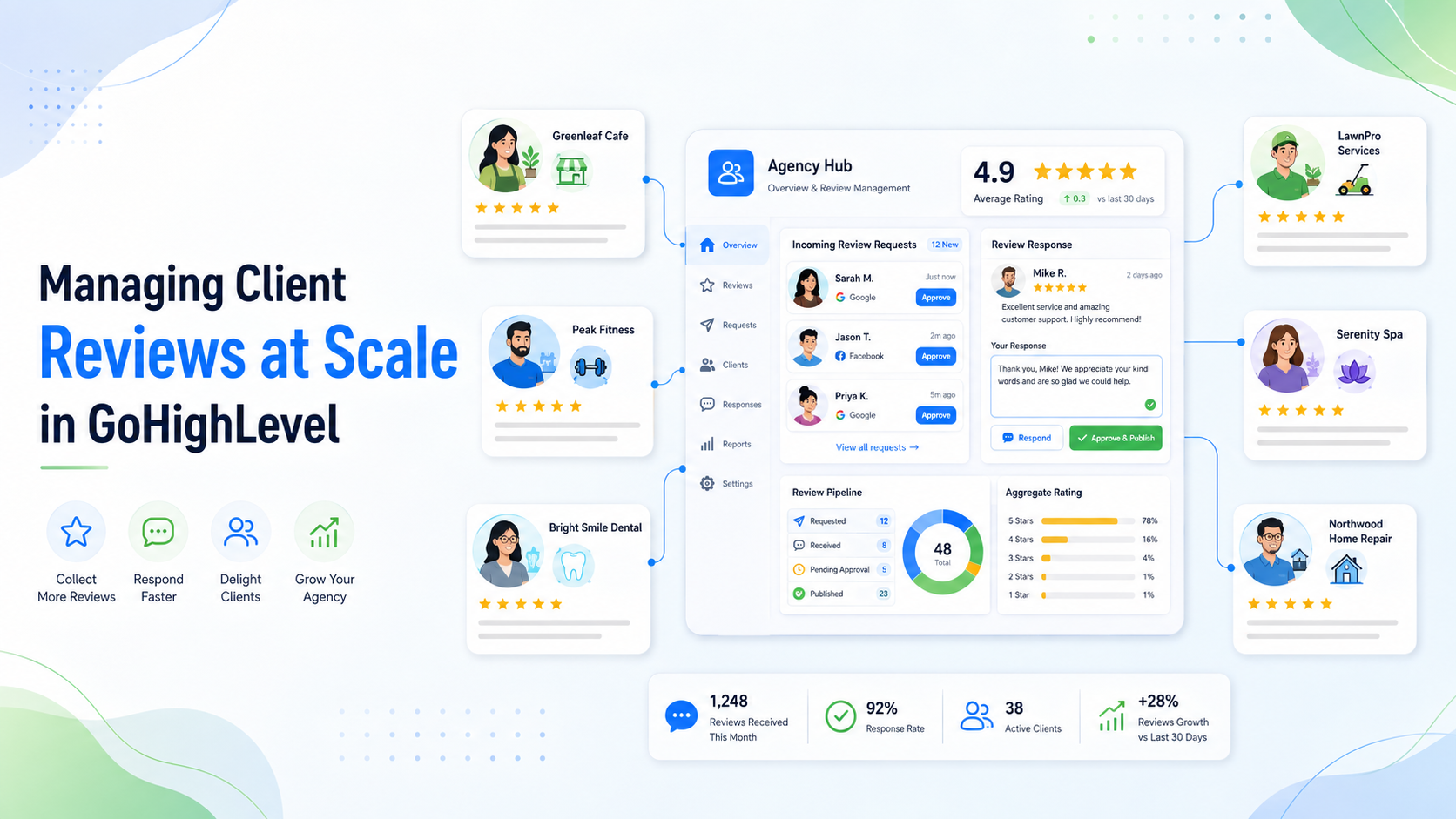
The one that hurts most, because it recurs. Reputation reporting is per sub-account with no cross-account roll-up. Preparing for client calls means opening each sub-account, reading the reputation dashboard, and transcribing the numbers — new reviews, average rating, requests sent, response rate — into whatever report you send.
Call it 10 to 15 minutes per client per month. At twenty clients that is four or five hours of pure transcription, monthly, forever. It is also the least valuable work anyone on your team does.
On the $297 plan you can white-label the platform itself, which handles the interface. Review request emails are a separate question: whether they come from a domain that looks like the client's business matters, because a review request from an unfamiliar sender gets ignored. Sender domain configuration is another per-account setup item, and a dedicated IP is $59/month per domain if deliverability becomes an issue.
If your client's own staff need access — a branch manager who should see their location's reviews and nothing else — you are managing users inside each sub-account individually.
Practical mitigations, in order of payoff.
Version your snapshots. Keep a dated master snapshot and a written changelog of what changed and when. When you improve the base workflow, you at least know which clients are on which version.
Standardise naming ruthlessly. Identical workflow names, tag names and custom field names across every sub-account. This is what makes any future bulk work or API automation possible at all.
Automate the reporting pull. If you have technical capacity, the API is the answer to the transcription problem. GoHighLevel's v2 API allows 100 requests per 10 seconds and 200,000 per day per app per resource, which is ample for pulling monthly reputation data across every sub-account into a spreadsheet or a reporting tool. Note that basic API access is included on Starter and Unlimited, while Agency API keys require Agency Pro — on lower tiers you are working with location-level keys, which means handling each sub-account separately.
Resist per-client customisation. Every bespoke tweak is a permanent maintenance liability. Offer two or three standard configurations and hold the line.
Rebill deliberately. On Unlimited you can pass usage through at cost; on Agency Pro you can mark it up. If you are on $297 and absorbing SMS costs for twenty clients, that is margin you are choosing to give away. Note the fixed 5% location-level markup on carrier fees applies regardless of your rebilling setting.

TrueReview for agencies addresses the specific operational costs above — location cloning, unlimited teammates with per-location permissions, custom sender domain per client, and client-ready insight reports. It does not replace GoHighLevel, and at large client counts Agency Unlimited plus rebilling will cost you less. The case for adding it is time, not price.
Adding a second system to an agency stack needs justifying. The honest cases:
Reputation is a standalone product line. If you sell review management as its own retainer rather than bundling it, the reporting and setup overhead is a direct margin drag on a specific service. Fixing it has measurable ROI.
Your clients need non-Google review sites. Contractors on Angi and HomeAdvisor, agents on Zillow, firms on Avvo, practices on Healthgrades. GoHighLevel's native coverage is Google and Facebook; wider sources go through the Listings add-on at $30/month per sub-account, which handles monitoring rather than request routing.
You have multi-location clients. A client with eight branches becomes eight sub-accounts with no roll-up. That is where the reporting cost stops being annoying and becomes untenable.
Client-facing reporting is a differentiator for you. If your retention depends on the quality of the monthly report, hand-transcribed numbers are a weak spot.
Stay entirely inside GoHighLevel if reputation is a bundled extra rather than a priced service, if your clients only care about Google, if they are single-location, and if you have the API capacity to automate the reporting pull yourself. In that situation a second subscription is overhead without a matching return.
GoHighLevel's agency economics are genuinely excellent and the sub-account isolation is the right architecture for client work. The costs it does not show you are setup repetition, configuration drift and monthly reporting that scales linearly with headcount.
Cost those hours honestly at your team's rate before deciding anything. For a lot of agencies the answer is to stay put and automate the reporting via the API — our guide to automating review requests with the GoHighLevel API covers the mechanics. For agencies where reputation is a real product line, the maths often points the other way.
If setup repetition and monthly reporting are the hours you want back, that is the specific problem worth solving. See TrueReview for Agencies — location cloning, per-location permissions, custom sender domain per client, and client-ready insight reports without the per-account transcription.