BLOG POST
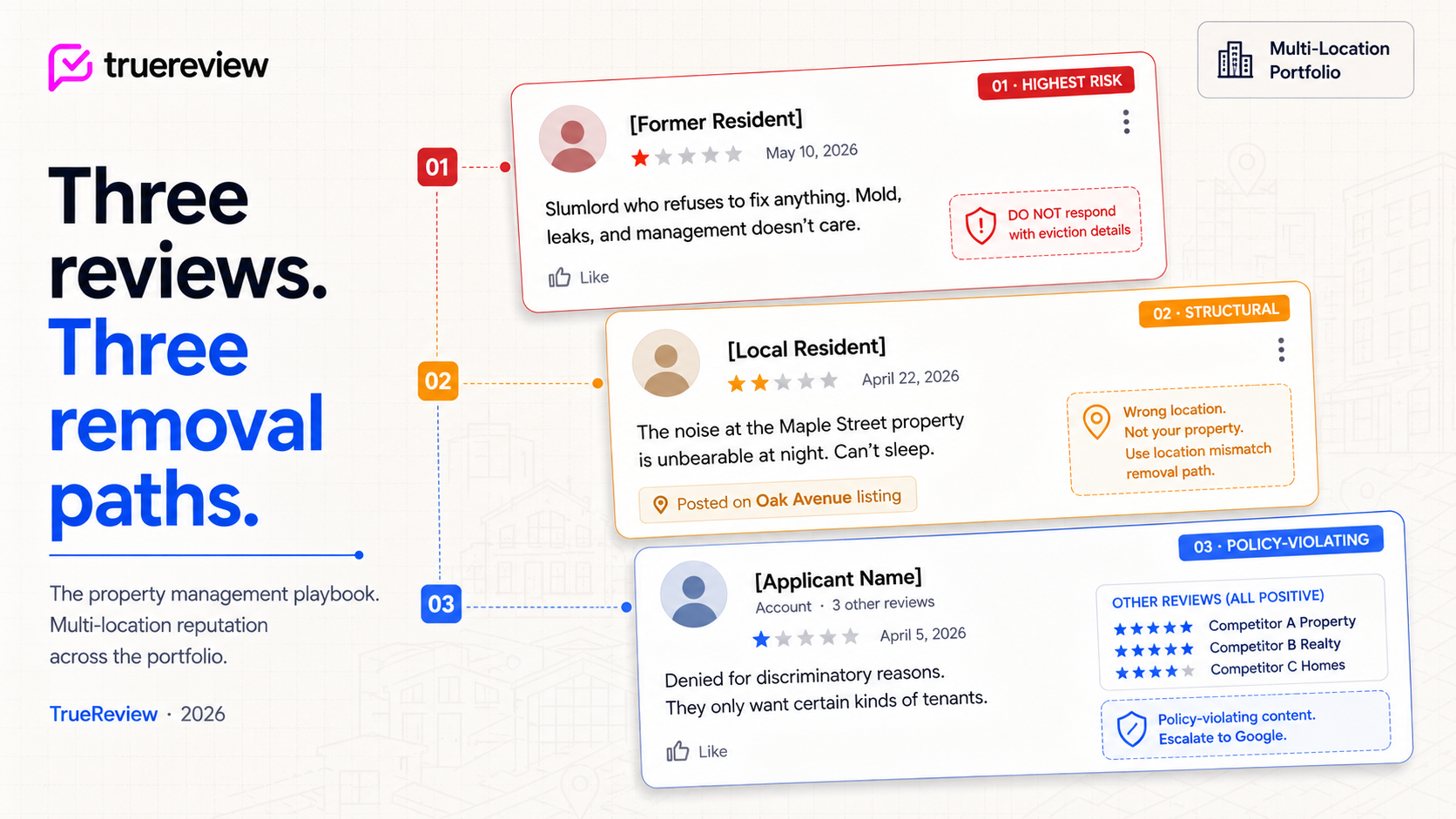
Three reviews land on your Google Business Profile this month.
Each of these reviews needs a different response. Different removal path. Different documentation. Different legal exposure. And if you handle any of them with the wrong template — particularly the first one — you can create written evidence that exposes you to a Fair Housing retaliation claim larger than the original review ever could be.
This is the playbook for property management companies navigating the specific review patterns that target your industry, the multi-location workflow that makes managing them across a portfolio possible, and the regulatory awareness that distinguishes a professional response from a liability-creating one.
The reviews property management companies receive don't look like the reviews other businesses receive. The asymmetry matters because it changes which removal paths work and which response approaches create liability.
The evicted-tenant retaliation review. A former tenant — usually one who was evicted for cause (non-payment, lease violations, property damage) — leaves a negative review weeks or months after they've left. The review is often emotional, sometimes factually inaccurate, and frequently includes serious allegations about the property condition, your business practices, or your character. The reviewer is real. They had a real relationship with you. The review reflects their genuine perspective on a real situation, even when the facts are wrong.
The wrong-location review. A real tenant, owner, or applicant leaves a review about a real experience — but on the wrong Google Business Profile listing. Property managers running 5, 15, or 50 buildings have separate listings for each location. Tenants searching "[Your Company Name]" in Google often click into the most-visible listing rather than the one specifically tied to their building. Reviews land on the wrong listing and look misleading or false to a casual reader who doesn't know the underlying confusion.
The disgruntled-applicant rant. A rental applicant who was denied for legitimate screening reasons (credit, income, prior eviction history, lease violations at previous addresses) leaves a one-star review claiming they were discriminated against, harassed, or treated unfairly. The applicant often has no documented relationship with your records — they may have inquired but never formally applied, or applied to a different property entirely. The reviewer's other Google activity often gives away the pattern (negative reviews for multiple competing PM companies in the same market, no other consumer reviews).
Each pattern has a different removal path under Google's policies. Each has a different response constraint. Each carries a different regulatory awareness — particularly the first one, where the Fair Housing Act's retaliation prohibitions intersect with public response language in a way most property managers underestimate.
This is the pattern that creates the largest hidden liability for property management companies — not because the reviews themselves are devastating, but because the responses can be.
The Fair Housing Act prohibits retaliation against tenants who exercise fair housing rights. 42 U.S.C. § 3617 makes it unlawful to "coerce, intimidate, threaten, or interfere with" any person on account of their having exercised fair housing rights. Retaliation claims against property managers have produced six-figure settlements — Downey Property Management paid $225,000 in a 2018 California case involving rent increases and parking changes targeted at a family associated with an evicted tenant who had a disabled child.
A negative public review response from a property manager is a written, time-stamped, permanent record. If that response contains information about why a former tenant was evicted — particularly information that could be construed as factually inaccurate, retaliatory in tone, or as disclosing personal details about the tenant — it becomes evidence in any subsequent retaliation case.
The risk pattern: a property manager responds to a negative review from an evicted tenant by writing "this individual was evicted for repeated non-payment of rent and unauthorized occupants." If that former tenant had previously requested a reasonable accommodation for a disability, complained about discrimination, or otherwise exercised a fair housing right — and the eviction came within months of that activity — the public response now sits as documented evidence in a potential retaliation claim. The eviction may have been legitimate. The public confirmation of the eviction in language that could be read as retaliatory is the exposure.
The compliant response approach: address-anyone-reading language that doesn't confirm any specific tenancy, doesn't describe any eviction circumstances, and moves the actual conversation off the platform.
Compliant template for an evicted-tenant retaliation review:
The reviews from genuinely evicted former tenants are almost never removable through Google's policies. They describe the reviewer's real experience with your company. Removal isn't usually the path — restraint in the response is. The post-eviction review is the one where doing nothing wrong on the response side is more valuable than getting the review removed.
This pattern is the property management industry's structural quirk. The same company often has separate Google Business Profile listings for each property — one for the apartment complex on Maple Street, another for the building on Oak Avenue, a third for the duplex portfolio. Tenants searching for the company in Google often land on the most-visible listing in their search results and leave reviews there, regardless of which property their experience was actually about.
The result: a real review describing a real experience, attached to the wrong listing.
For Google's content policies, this often qualifies as "Off topic" — the review isn't about the experience at the location where it's posted. Report category in the Reviews Management Tool: "Off topic" or, depending on the specifics, "Misleading content."
Documentation that supports the report:
The success rate on wrong-location removals is meaningfully higher than on most other review categories because the violation is structural — there's a clear mismatch between the review content and the listing's actual scope. Google's review handlers can verify the discrepancy from the review text alone in many cases.
Two preventive measures matter more than reactive reporting:
Clear listing names that distinguish each property. A listing called "Your Company - Maple Street Apartments" makes wrong-location placement less likely than a listing called simply "Your Company." Each listing's name should make the property unambiguous to a tenant searching for "where do I leave a review."
Post-tenancy review requests with direct links to the correct listing. When you send a review request after a tenant moves out (or after a lease renewal, or after a maintenance interaction), the request should include a direct link to that specific property's listing. Removes the guesswork. Tenants don't have to navigate to the right listing — they land on it.
The third pattern is the one Google's policies were most clearly designed for. A reviewer with no documented relationship to your company leaves a one-star review claiming an experience that doesn't match your records.
For property management specifically, two sub-patterns appear:
The rejected-applicant rant. Someone applied to rent from you, was denied for legitimate reasons (credit, income, eviction history, lease violations elsewhere), and leaves an angry review framing the denial as discriminatory or unfair. Sometimes they applied; sometimes they only inquired; sometimes neither.
The competitor-adjacent pattern. A reviewer with no relationship to your company at all leaves a negative review while leaving positive reviews for direct competitors in the same market. The pattern is the same one B14 and B17 covered for other industries — competing companies or their staff posting reviews to suppress competitor profiles.
For both sub-patterns, the report categories are:
Documentation matters more than report volume:
For the full taxonomy of Google's review policies and the categories that apply to each pattern, our policy violations checklist breaks down every category. For the specific question of fake reviews and the extortion patterns that sometimes appear alongside them, our fake Google reviews post covers documentation in depth.
Property management companies with more than 5 locations have a structural challenge most other industries don't face: monitoring, triaging, and responding to reviews across a portfolio where each location has its own Google Business Profile, its own review stream, and its own rating trajectory.
The challenge isn't theoretical. Google's recommended structure — one listing per physical location, never combined — means a 20-property portfolio produces 20 separate review streams. A negative review posted on Location 14 at 9 PM on a Saturday can sit unnoticed for days if the workflow assumes someone manually checks each listing.
Three operational moves matter:
Review Radar — included in TrueReview's Small Business and Premium plans — scans incoming reviews across all locations against Google's content policies and surfaces the ones that may qualify for removal under conflict-of-interest, off-topic, fake content, or harassment categories. For property management portfolios specifically, the cross-location pattern recognition matters: a single reviewer leaving negative reviews on 4 of your 20 properties shows up as a single pattern in a centralized tool, while it would appear as 4 isolated reviews in manual monitoring.
Review velocity is the proactive complement to removal. For property management specifically, it has compounding effects.
Each property's listing accumulates its own reviews independently. A property with 4 reviews after a year is fragile to a single negative; the same property with 40 reviews has the negative absorbed in the pattern. Across a 20-property portfolio, the velocity strategy multiplies: 20 properties accumulating reviews at a steady rate is 20 separate signals of operational quality that prospective tenants and property owners encounter when researching the company.
The mechanism that works for property management:
The combined velocity across these three triggers produces steady review accumulation on each property's listing, which builds the rating trajectory and absorbs occasional negatives. The strategy works particularly well for property management because the natural touchpoints are frequent — most other industries have one or two interaction moments per customer relationship; property management has many.
For the broader review-removal landscape and the methods that work, our pillar guide on removing Google reviews covers every legitimate path. For the specific question of fake reviews and the documentation that supports their removal, our fake Google reviews post walks through the patterns in detail.
The property management company that handles reviews well treats the response as the primary risk, the removal path as a tool for specific qualifying patterns, the multi-location workflow as a centralized operational discipline, and review velocity as the strategic priority that absorbs everything else.
The company that handles reviews badly responds to evicted-tenant reviews with the eviction details (creating retaliation exposure), ignores wrong-location reviews because they're too small to fight (letting the rating drift on listings that shouldn't have those reviews at all), treats every disgruntled-applicant rant as an emergency (burning out the team on issues that should have routine handling), and monitors locations one-by-one (missing patterns that span the portfolio).
The asymmetry in property management's review landscape — between what reviewers can say and what property managers can safely respond — is structural, regulatory, and operational. Most other industries face one or two of these constraints; property management faces all three simultaneously, and across an unlimited number of locations.
For multi-location reputation tooling built specifically for the property management workflow — centralized monitoring across the portfolio, conflict-of-interest detection for the patterns that target the industry, role-based access for on-site managers, and Review Radar for early policy-violation alerts across every location — start a free trial of TrueReview or visit our property management industry page for the full feature set.
The review that mattered most in the opening of this post — the evicted-tenant retaliation review — is also the one most property managers handle worst. The reviews that come down are the ones reported correctly under the categories that apply. The reviews that stay up — particularly the ones from genuinely upset former tenants — are handled by restraint in the response, velocity in the surrounding listing, and the operational discipline of treating the public response as evidence rather than as a debating platform. The career exposure on getting that wrong is real, even when nobody talks about it.