BLOG POST
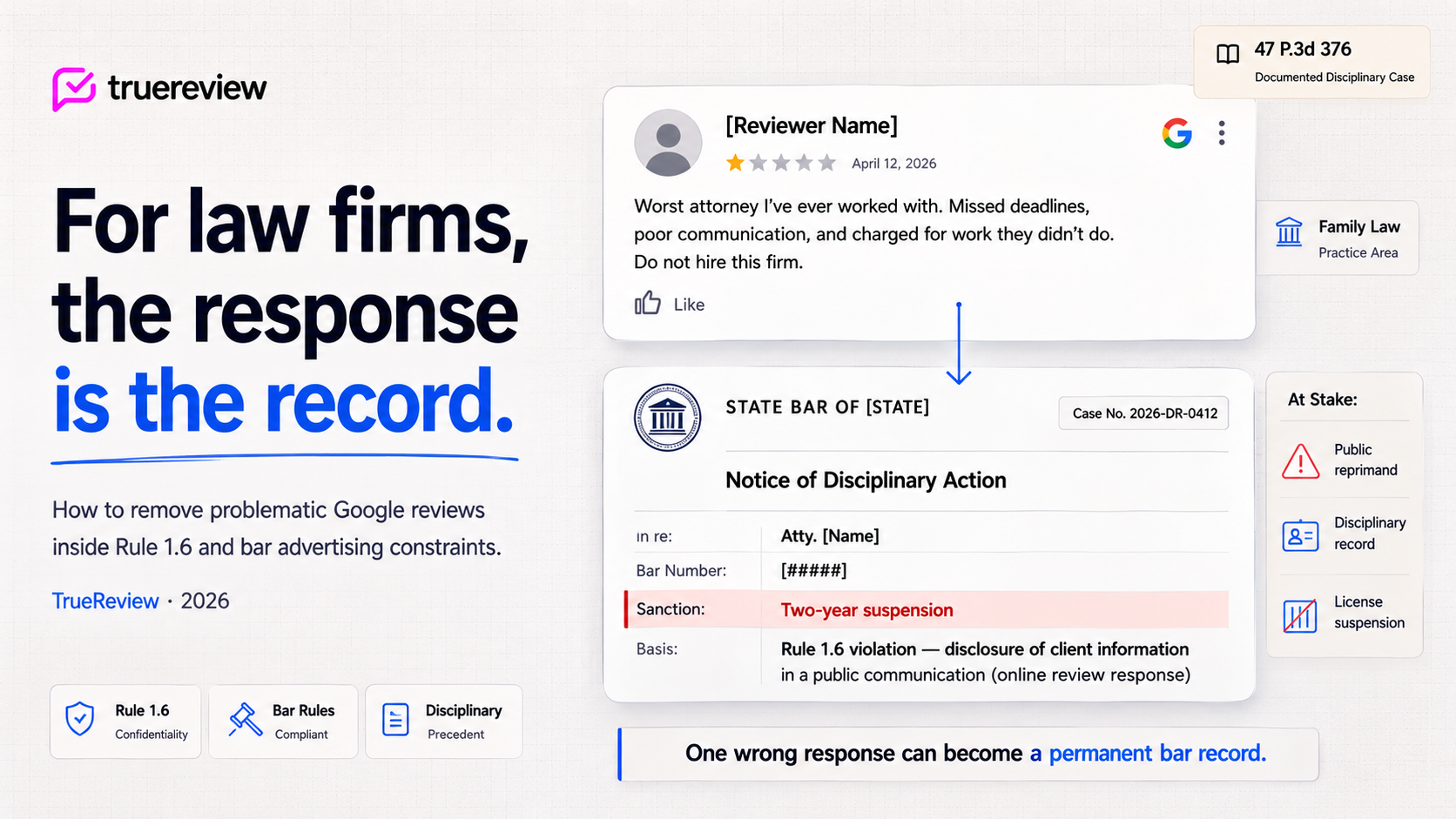
That case is the legal-profession equivalent of what HIPAA enforcement is for dental practices. Different rules, same lesson: the way an attorney handles negative reviews can produce more career exposure than the reviews themselves ever would. State bar disciplinary records are full of attorneys sanctioned for responding to reviews in ways that breached client confidentiality — even when the underlying review was untrue.
This post is the practical playbook for law firms navigating Google reviews inside the constraints of ABA Model Rule 1.6 (confidentiality), state bar advertising rules, and the particular hazard of opposing-counsel attack reviews. The removal path is the main lever available. Confidentiality limits the response path. Bar advertising rules limit both. Knowing the boundaries is more than half the work.
Restaurants and dental practices receive reviews from people who walked through their doors. Law firms receive reviews from a wider, more adversarial set of authors:
Disappointed clients who lost their case — even when the outcome was correct on the law and the firm's representation was diligent. Family law, criminal defense, and civil litigation are the practice areas most prone to this. Every divorce produces at least one party who feels the outcome was unfair.
Opposing parties in litigation — the spouse on the other side of a divorce, the defendant in a personal injury case, the plaintiff who lost. These people often had no formal relationship with the firm at all, and yet they encountered the firm in an adversarial role and remember it.
Opposing counsel — or their staff, paralegals, or contractors. This is the attack pattern most unique to legal practice. In jurisdictions where it has been examined, opposing counsel leaving negative reviews about a competing firm is often itself a violation of the bar's professional conduct rules. That doesn't always stop it, but it does mean the reviews can be addressed through bar channels in addition to Google's reporting flow.
Former employees — paralegals, associates, or support staff who left under contentious circumstances and have detailed knowledge of the firm's operations, which they sometimes weaponize through fake "client" reviews.
The asymmetry is the post's central insight: reviewers can say what they want publicly; lawyers can say almost nothing back. That asymmetry has reshaped how legal reputations form online, and the firms that handle it well are the ones that focus on the removal path and the velocity path — not on responding their way out of trouble.
Before drafting any response or filing any removal request, three frameworks apply.
A response should be possible to address to anyone reading the firm's listing, not specifically to the reviewer. No confirmation of representation. No reference to the underlying matter. No reference to outcomes. No comparison to other firms. No disclosure of any confidential information regardless of how peripheral it might seem.
What never goes in a public response under any circumstances:
If you feel the urge to publicly correct false statements, your obligation under Rule 1.6 says no. The forum for correcting falsehoods about your firm is not the Google review thread. It's the bar complaint process (if the reviewer is opposing counsel), the defamation framework (if the statements are factually false and damages can be shown), or your firm's website and content strategy (where you control the language entirely).
The pattern is recognizable. A firm wins a contested matter. Days or weeks later, an unfamiliar account leaves a one-star review claiming "terrible legal representation" or "the worst attorneys in the city" — often with no specific details, or with details that don't match any of your matters. The account has a handful of reviews on competing firms (all positive) and a single negative review on yours.
This is the conflict-of-interest review pattern Google's policies are designed for. The report category is "Posted by a competitor or someone with a conflict of interest." Documentation matters more than report volume:
In family law and personal injury — the two practice areas where this pattern appears most often — the documentation effort is substantial but worthwhile. A successful conflict-of-interest removal eliminates the review and creates a track record with Google's review-handling team that makes future reports easier to process.
When the documentation supports it, two paths can run in parallel:
Google reporting flow — submit through the Reviews Management Tool under "Conflict of interest." Documentation in the report should reference the reviewer's other Google reviews (with URLs), the timing pattern, and the lack of correspondence with your firm's records.
State bar complaint — if the reviewer can be identified as an attorney or staff member at a competing firm, the bar complaint runs separately. The bar's investigation has different authority and different consequences. Even when Google leaves the review up, a bar finding against the opposing counsel carries professional weight.
The Pistotnik case (cited in the opening) is the clearest precedent for what happens when an attorney crosses lines around review management. The disciplinary panel found improper delegation and dishonesty. Bar investigations into similar conduct happen regularly; they're just less publicly visible than civil cases.
Beyond the conflict-of-interest pattern, these are the categories that consistently produce removals for legal practices:
For the full taxonomy of Google's review policies and the specific reporting categories, our policy violations checklist covers each category in detail.
What's almost never removable, regardless of how unfair it feels: a genuine former client who is unhappy with a legal outcome and writes a factually inaccurate but opinion-framed review. "My attorney was incompetent" is opinion under most platform standards, even when the work was competent. "The court system is rigged" is off-topic. But "Atty. Smith yelled at me in the conference room" is the reviewer's account of their experience, and platform policies generally preserve it unless other elements (harassment, conflict of interest, off-topic content) apply.
For most law firms, most of the time, defamation litigation against a negative reviewer is the wrong path. The cost-benefit math rarely supports it. But there are specific cases where it becomes the right tool.
A defamation case for a review requires false statements of fact that have caused measurable damages. Opinion isn't actionable. "Worst lawyer in town" is opinion. "Atty. Smith stole $50,000 from his trust account" is a factual claim that, if false, may support a defamation claim — though even then, anti-SLAPP statutes in some states create substantial procedural risk for the plaintiff.
The cases where defamation litigation makes sense:
Specialist firms — RM Warner Law, Minc Law, and similar internet defamation practices — handle these cases regularly. Most general practitioners refer them out. The cost of a defamation matter typically starts at $5,000-$10,000 for cease-and-desist work and runs significantly higher for litigation. The reputational cost of an unsuccessful defamation case can exceed the cost of the original review, since the litigation itself becomes a public record. Both factors counsel measured judgment about when the path is worth taking.
For most negative reviews — even most clearly false ones — the better path is the removal report (where it applies) and the review velocity strategy (which matters more than any single review).
The removal path is reactive. Review velocity is the proactive complement, and for most law firms, the higher-leverage piece of online reputation work.
Google's local ranking weights both volume and recency of reviews heavily. A firm with 8 reviews accumulated over five years is fragile to a single negative; a firm with 80 reviews and steady recent additions has every individual review absorbed in the broader pattern. Family law and PI firms in particular benefit from systematic post-matter review requests, sent at the moment of resolution when client satisfaction is highest.
The mechanism that works: an automated text or email request sent within 24 hours of matter resolution, with a one-tap link to the firm's Google review page. The conversion rate from "satisfied client received request" to "review posted" is typically 15-25% when friction is low.
TrueReview handles this workflow for law firms and other professional services. Review Radar — included in TrueReview's Small Business and Premium plans — runs alongside the request automation: scanning new reviews against Google's content policies, flagging the ones that may qualify for removal under the conflict-of-interest, off-topic, or harassment categories, and surfacing the right report path. The opposing-counsel attack pattern in particular benefits from early detection, since the documentation effort is more effective when initiated quickly while reviewer behavior across competing firms is still freshly visible.
For the broader review-removal landscape, our pillar guide on removing Google reviews covers every legitimate path. For the specific question of removing fake reviews — including the pattern recognition for fake-from-non-clients — our fake Google reviews post walks through the documentation in detail.
The law firm that handles negative reviews well treats confidentiality as a hard floor, state bar rules as the boundary on response language, and the removal path as the main lever for cases that qualify. The firm that handles them badly responds in ways that reveal client information, escalate disputes publicly, or — like the attorney in the Pistotnik case — outsources the problem to a "reputation management" service whose methods produce more career exposure than the original reviews ever could.
The asymmetry between what reviewers can say and what attorneys can respond is the structural reality of the legal profession's review landscape. The firms that adapt to it — focusing on removal where applicable, response within strict limits, and review velocity from satisfied real clients — manage the asymmetry. The firms that fight it tend to make it worse, often with disciplinary consequences.
For legal-industry reputation tooling that handles both the velocity side and the conflict-of-interest detection that matters most to law firms, start a free trial of TrueReview or visit our legal industry page for the full feature set. The reviews that come down are the ones reported correctly under the categories that apply. Everything else, regardless of how it feels, stays — and is solved by what comes next, not by what came before.