BLOG POST
Tax and bookkeeping is one of the most trust-dependent industries in local search. When a small business owner Googles "CPA near me" or "tax preparer [city]," they're not picking a vendor for a $50 transaction — they're picking someone who will see their financial records, file with the IRS on their behalf, and potentially advise on decisions worth tens of thousands of dollars. That decision happens almost entirely on the basis of online reviews.
Yet most tax and bookkeeping firms are doing review collection backwards: they ask during tax season when clients are stressed, they forget to ask their year-round bookkeeping clients entirely, and they treat reviews as a marketing afterthought rather than the trust-building engine that actually drives new client acquisition. This guide is the 2026 playbook for fixing that.
Three realities make this industry uniquely review-dependent:
Trust is the entire product. Unlike a restaurant or a haircut, the customer can't easily evaluate the quality of tax or bookkeeping work themselves. They rely on reviews from past clients as their proxy for accuracy, reliability, and professionalism. 97% of consumers read online reviews before choosing a local business — and for high-trust services like financial work, that number rounds up to "every single prospect."
Client relationships are long. A bookkeeping client typically stays with their firm 5–10 years. A tax preparation client stays with the same CPA for an average of 7+ years. Every new client you acquire compounds — meaning reviews aren't just driving one transaction, they're driving a multi-year revenue stream.
Local search is the primary acquisition channel. "CPA near me," "tax preparer [city]," "bookkeeper [neighborhood]" are pure local SEO queries. The firms that show up in Google's Local Pack (the 3-result map view) capture the majority of inbound calls. Local Pack rankings depend heavily on review quantity, recency, and average rating — and most firms in this space have 8–15 reviews when they should have 80–150.
A few benchmark stats:
Here's the most counterintuitive insight for this industry: don't ask for reviews during tax season.
January through April 15 is when your clients are most stressed, most likely to be experiencing a payment shock from their return, and least likely to leave a positive review. Operators who blast review requests during tax season see lower response rates and a higher rate of negative reviews — exactly the opposite of what they wanted.
The right review-asking windows for tax and bookkeeping firms:
For tax preparation clients:
For bookkeeping clients:
For new clients of either:
What doesn't work:
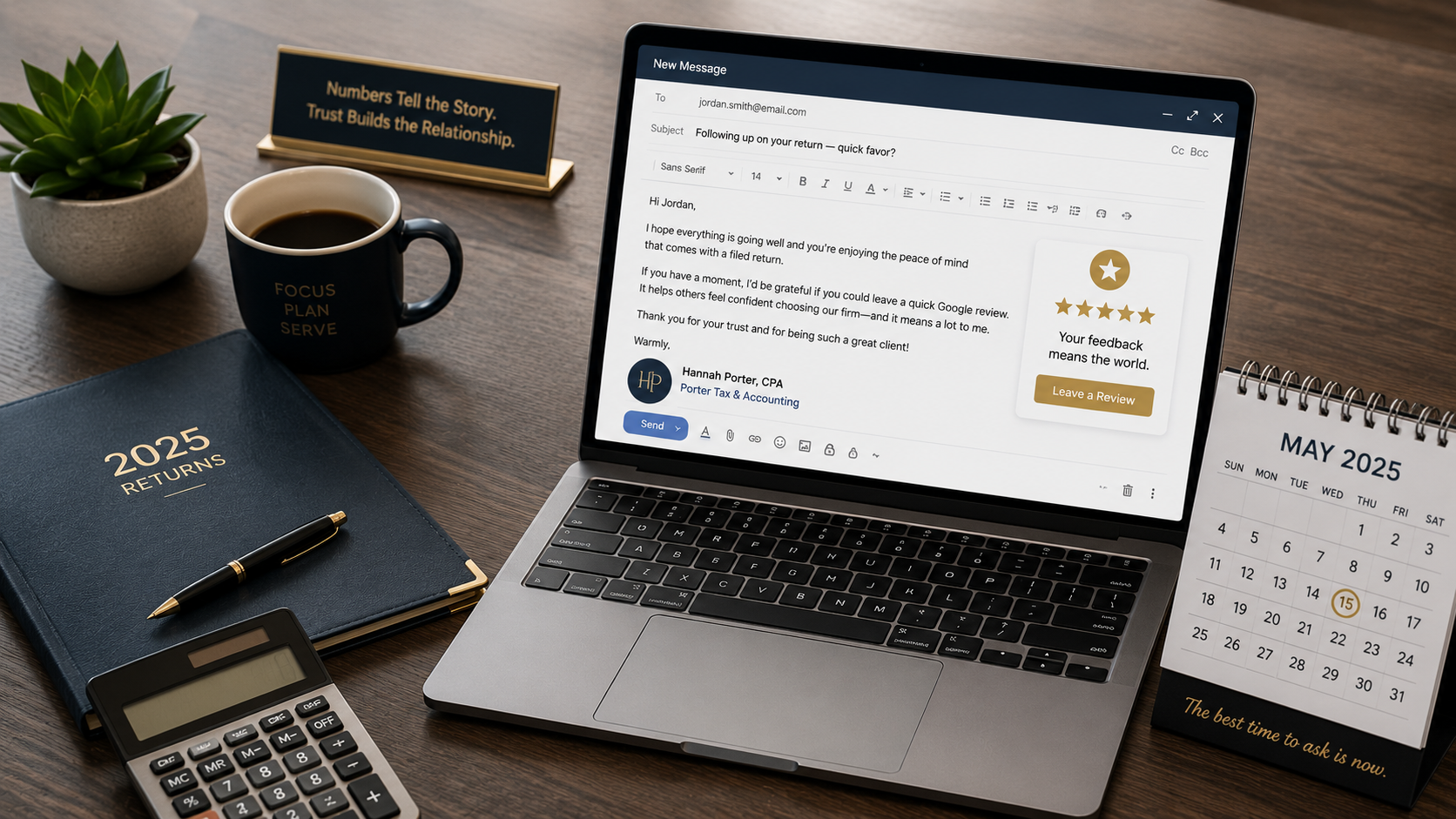
1. Post-filing thank-you email (2–4 weeks after return). Personal email from the preparer (not marketing automation), thanking the client for trusting you with their return and asking for a review. Include a direct Google review link.
2. Year-end close email (bookkeeping clients). Once you've closed out the prior year's books, send a wrap-up email summarizing what you did and asking for a review. The "year in review" framing works much better than a generic ask.
3. Refund-received congratulations message. For tax clients getting refunds, send a quick congratulations SMS or email when you know the refund has been issued. "Hope the refund landed safely — if you have 30 seconds, we'd appreciate a quick Google review."
4. New-client check-in at 60 days. Schedule a 2-month check-in for every new client. After confirming they're happy with the service, ask for a Google review. New clients are most likely to be in the "I love these guys" honeymoon phase here.
5. Renewal-trigger ask (bookkeeping clients). When a client renews their annual or quarterly bookkeeping contract, fire an automated thank-you email a few days later that includes a review request.
Post-filing tax client email (2–4 weeks after return):
Subject: Following up on your return — quick favor?
Hi [name], hope you're settling back into things now that your [year] taxes are filed.
If you've been happy with how we handled it, would you mind leaving us a quick Google review? Reviews from clients like you are the single best way to help other small business owners find us when they're looking for a tax preparer.
[Leave a Review button]
Either way, thanks for trusting us with your return this year.
— [Preparer name]
Bookkeeping client year-end close email:
Subject: Your [year] books are closed
Hi [name], wanted to confirm that your books are fully reconciled and closed for [year]. Everything is ready for your tax preparer when the time comes.
If you have 30 seconds, a quick Google review would mean a lot to us. We're a small firm, and reviews from clients like you are what help other small business owners find us.
[Leave a Review button]
Thanks for another great year working together.
Refund-received SMS:
Hi [name] — hope the refund landed safely! If you have a minute, would you leave us a quick Google review? It really helps a small firm like ours: [link]
New-client 60-day check-in email:
Subject: Two-month check-in
Hi [name], wanted to check in now that we've been working together for about two months. How's everything going from your end?
If we've been delivering what you hoped for, would you consider leaving us a quick Google review? Means a lot for a small firm like ours.
[Leave a Review button]
If there's anything we could be doing better, please let me know directly — happy to jump on a call.
Renewal thank-you email:
Subject: Thanks for renewing, [name]
Hi [name], thanks for renewing your bookkeeping plan with us for another year. We're glad the partnership is working for you.
If you have a moment, a Google review would be the best way you could support us. Especially valuable when other small business owners are evaluating bookkeepers.
[Leave a Review button]
Asking during tax season. January–April is the worst time to ask. Stress is high, satisfaction is low, and you'll get fewer reviews and more negative reviews. Wait until 2–4 weeks after the return is filed.
Ignoring bookkeeping clients entirely. Bookkeeping clients are the highest-value review source you have — they've been with you for years, trust you, and write detailed reviews. But most firms forget to ask them because there's no obvious "completion event" to trigger the request. Build the asks around year-end close, renewals, and major milestones instead.
Generic, marketing-automation-y messages. Tax and bookkeeping clients respond to personal outreach, not branded marketing emails. Send the request from the preparer or bookkeeper's actual email — not from "marketing@yourfirm.com."
Skipping the credential signaling. Reviews that mention your specific credentials ("CPA," "EA," "QuickBooks ProAdvisor") help with SEO and trust signaling. You can't script this (Google's 2026 policy prohibits asking for specific mentions), but credential-aware clients tend to mention them naturally if you have a professional positioning.
Offering free service hours for reviews. Google's 2026 policy explicitly prohibits offering anything of value in exchange for reviews. For tax/bookkeeping specifically, FTC regulations on financial-services reviews are also strict. The risk isn't worth it.
Not separating individual from business client reviews. Individual tax clients write different reviews than small business clients. Ideally, your review base shows both — signaling to prospects that you handle both types of work. Make sure you're asking both segments.
A regional CPA firm serving 280 individual clients and 95 small business clients integrated TrueReview with their TaxDome practice management system. Their workflow:
In 14 months, their Google review count grew from 23 to 192. Average rating sat at 4.9. The interesting metric: their inbound new-client inquiries from "CPA near me" and "bookkeeper [city]" type searches nearly tripled. The firm climbed from position #7 in the Local Pack to position #1 for their city.
The biggest shift wasn't tactical — it was timing. They stopped asking during tax season (where they'd been getting low response rates) and concentrated their asks in May, June, July, and at year-end close. The same clients, asked at the right moment, were dramatically more responsive.