BLOG POST
Endocrinology has one of the most underleveraged review opportunities in healthcare. The patient base is unusually engaged — type 1 diabetics track their glucose every five minutes through CGMs, thyroid patients monitor their TSH closely, hormone-management patients chart their symptoms over months. These patients are detail-oriented, data-driven, and unusually willing to share their experiences when asked. Yet most endocrinology practices have thin review profiles relative to their clinical excellence — fewer reviews than dental practices a third their size, in markets where new-patient wait times routinely run 3-6 months.
The gap exists because endocrinology, like family medicine, lacks the dramatic transformation moments that drive reviews in surgical or aesthetic specialties. Patients leave their quarterly diabetes check with slightly adjusted insulin doses; they leave their thyroid follow-up with a slightly tweaked medication. The work is operational maintenance of long-term metabolic health — not the kind of single-event experience that produces obvious "I have to share this" reviews.
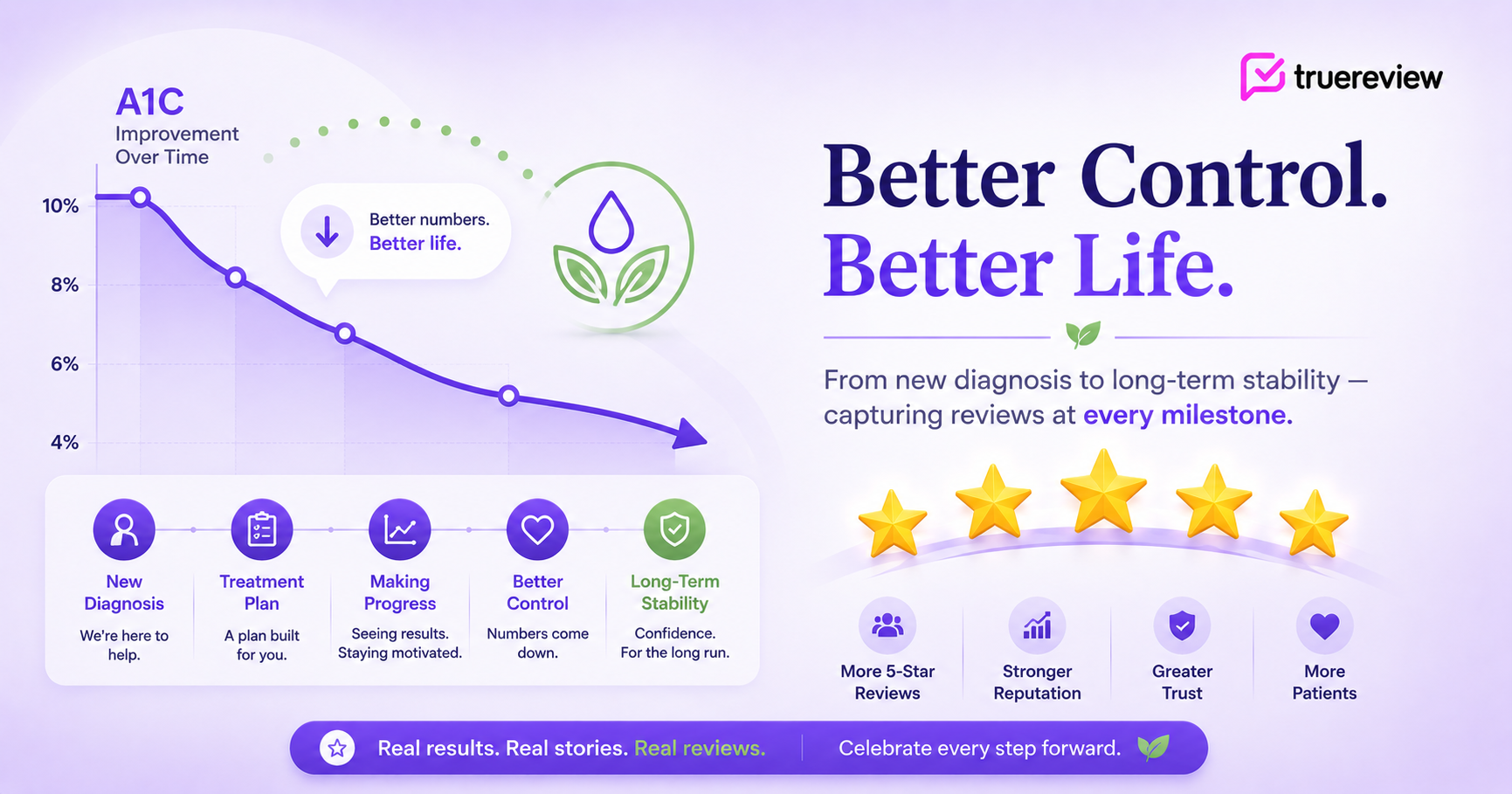
But the moments do exist. The diabetic patient whose A1C dropped from 10.2 to 6.8 over a year of careful management. The thyroid patient who finally feels normal after struggling for years before getting properly diagnosed. The PCOS patient whose cycles regulated and who got pregnant after working with the right specialist. These outcomes happen routinely in well-run endocrinology practices — they just aren't being captured as reviews because the practices aren't asking systematically at the right moments.
This guide is the practical playbook for endocrinology practices, diabetes-focused clinics, thyroid specialty groups, and pediatric endocrinology practices: when in the chronic management arc to ask, how to handle the wait-time dynamics that affect this specialty more than most, how to navigate the HIPAA framework, and how to wire the whole thing into the practice management software endocrinology practices typically run.
A note on HIPAA: Endocrinology practices are HIPAA-covered entities, and review requests have specific rules about what message content is allowed. This post focuses on endocrinology-specific tactics; for the full HIPAA framework — what counts as PHI, how to handle responses, what vendors need a BAA — see our companion post on HIPAA-compliant Google reviews for medical practices. Every tactic below is designed to fit within those rules.
Three characteristics of endocrinology make Google reviews unusually decisive for new-patient acquisition:
Long new-patient wait times intensify the review-driven decision. Endocrinology is supply-constrained in most US markets. A new patient calling around for an endocrinologist often hears "next available is in 4 months" from multiple practices. Reviews become decisive in this environment because patients are choosing where to invest their long wait — and a practice with strong reviews wins this decision over practices with thin ones. The wait time itself becomes a review topic, with patients who finally got in often writing detailed reviews about why the wait was worth it.
Chronic management patients have unusually long lifetime value. A new diabetic patient often becomes a 10-20 year relationship with quarterly visits, CGM management, medication adjustments, and complication prevention. The lifetime revenue from one new patient typically runs into tens of thousands of dollars. The math of review investment is unusually favorable because the per-patient horizon is so long.
Referral patterns make reviews compound across multiple sources. Endocrinology practices receive referrals from primary care (the largest source), OB/GYN (gestational diabetes, PCOS), oncology (thyroid cancer follow-up), cardiology (T2D management), and bariatric surgery (post-op diabetes resolution). Referred patients still typically Google the practice and the specific endocrinologist before booking — and a strong review profile validates the referral, while a thin one can cause referred patients to second-guess and shop around (often to other practices with shorter wait times, which makes the review-driven validation especially important for keeping referral pipeline clients).
The combined effect: endocrinology practices in the top 10% of Google reviews in their market typically capture 4-6x the inbound new-patient inquiries of practices in the bottom 50% — and the gap matters more in this specialty than in many because the long wait times mean every captured prospect represents a substantial future revenue stream.
Endocrinology has unusual case-mix variation that requires different ask windows for different patient types.
At meaningful clinical milestones for diabetes patients. The classic moment: A1C dropped to target after several quarters of work. Reviews captured at this moment tend to mention specific clinical improvements ("my A1C went from 10 to 6.5 in 18 months"), which is exactly the content that converts other diabetic patients researching practices. Send the request 1-2 weeks after the milestone visit when the patient has had time to absorb the news but the moment is still fresh.
At the conclusion of titration phases. Patients on new insulin pumps, new CGM systems, or new automated insulin delivery (AID) systems go through titration phases — typically 3-6 months — where the practice and patient work together to optimize the technology. Reviews from successful titration completion are particularly powerful for prospects considering similar technology adoption.
For thyroid patients: at clinical stabilization. Hashimoto's, Graves', hypothyroidism, hyperthyroidism, post-thyroidectomy thyroid replacement — these conditions go through diagnosis, treatment initiation, dose titration, and stabilization phases over 6-18 months. Ask at the stabilization milestone when the patient feels meaningfully better and their labs have normalized.
For thyroid cancer survivors: at the 1-year survivorship milestone. A particularly emotional review window. Thyroid cancer patients who reach the 1-year mark of post-treatment surveillance with continued normal results often write detailed reviews about the experience of being well-cared-for through diagnosis and treatment.
For PCOS patients: at meaningful reproductive or symptom milestones. Cycle regulation, fertility outcomes, weight management progress, hormonal balance — PCOS care has multiple potential milestone moments. Ask when the patient hits a clear positive outcome.
For osteoporosis patients: at successful bone density improvement. Osteoporosis treatment arcs are 1-2 years before bone density improvements show up. Ask when DEXA results show meaningful improvement.
For pediatric endocrinology patients: at growth or developmental milestones. Growth hormone deficiency treatment, type 1 diabetes management in children, congenital adrenal hyperplasia management — each has parent-perspective milestone moments. Reviewer is the parent.
Quarterly cadence for long-term stable patients. Patients in long-term steady-state management (well-controlled diabetes, stable thyroid replacement, steady hormone optimization) don't have natural milestone moments every visit. Use a 6-month or annual cadence, asking at moments of significant continued improvement.
For new-patient consultations specifically: wait until the second visit. First endocrinology visits are often diagnostic — ordering labs, reviewing history, planning workup. Reviews captured here are thin because the patient hasn't yet experienced ongoing care. Wait until the second visit (typically 2-3 months later when labs have come back and a treatment plan is underway).
Never on the day of a difficult diagnosis. New diabetes diagnosis (type 1 in particular), new thyroid cancer diagnosis, new pituitary tumor finding — patients leaving these visits aren't in the right frame of mind for review requests. Skip them from the day's automated batch and reconsider the timing carefully.
Never during active diagnostic uncertainty. Patients in the middle of dynamic testing (cosyntropin stimulation, dexamethasone suppression, oral glucose tolerance), awaiting biopsy results from FNA, or in active workup of unexplained symptoms aren't in the right frame of mind.
Never after billing surprises. Endocrinology billing can surprise patients — separate charges for in-office labs, dynamic testing fees, CGM-related charges, prior authorization issues affecting medication coverage. Resolve concerns before asking.
This is the dynamic specific to endocrinology that other specialties don't have to the same degree: new-patient wait times of 3-6 months are the norm in many markets. This affects review collection in two opposing ways.
The downside: Patients waiting months for a first appointment can become frustrated, and the wait itself can color their first review. Some practices generate negative reviews specifically about access — "had to wait 5 months for an appointment" — that have nothing to do with the actual quality of clinical care.
The upside: Patients who waited a long time and then received excellent care often write more enthusiastic reviews than patients with short waits, because the wait-then-relief experience produces higher emotional contrast. Reviews that include the wait time positively ("worth the wait" or "I waited 4 months and would do it again") are particularly powerful for prospects who are about to face the same wait — they validate that the wait is worth it.
A few practical implications:
Don't apologize for the wait time in templates. Some practices' SMS templates explicitly apologize for new-patient wait times. This often backfires by reminding patients of the wait without context. Just thank patients for their patience naturally.
Encourage the "worth the wait" narrative naturally at completion. When a patient mentions in a visit that the appointment was worth the wait, capture this through your review request shortly after. Their fresh wait-was-worth-it framing converts other waiting prospects.
For practices with shorter wait times: emphasize this as a differentiator naturally. Practices that have systematically managed their access — through additional providers, optimized scheduling, or telehealth — should let satisfied patients reference this in reviews when natural.
Address access-driven negative reviews carefully. A response that explains "we're working to expand our capacity" reads as defensive. A response that acknowledges the systemic supply issue ("Endocrinology has nationwide capacity constraints, and we're committed to expanding our team to serve more patients") reads as accountable.
Endocrinology isn't one practice type. The right approach varies meaningfully by sub-segment.
General adult endocrinology (the largest segment). Mixed case load — diabetes management, thyroid disease, osteoporosis, hormone disorders, adrenal and pituitary disorders. Standard timing applies for milestone moments; quarterly cadence for stable chronic patients.
Diabetes-focused endocrinology. Heavy concentration of T1D and T2D patients, often substantial CGM and pump management volume. Reviews tend to mention specific technology integration, A1C improvements, and the practice's responsiveness to data review. Encourage these specifics naturally.
Thyroid specialty practices. Often combine endocrinology with thyroid surgery (when paired with head and neck surgeons) or with thyroid ultrasound and FNA capabilities. Reviews tend to mention specific thyroid outcomes — feeling normal again after years of struggle, successful cancer surveillance, complete resolution of Graves' disease.
Pediatric endocrinology. Parents as reviewers. Reviews tend to mention how the practice handled the child's experience, parent education quality, and family-centered care. Wait for clear improvement before asking — growth outcomes, diabetes management stability, developmental milestones. Standard pediatric review dynamics.
Reproductive endocrinology (REI/fertility). This is typically a distinct sub-specialty with its own fellowship training and substantially different patient experience (IVF cycles, fertility treatment, recurrent pregnancy loss). The review dynamics are different enough that REI practices benefit from a more fertility-specific approach (the high-emotion fertility journey, the success-story narrative, the failed-cycle sensitivity) than a general endocrinology playbook addresses.
Hormone optimization practices (T-replacement, BHRT-focused). Some endocrinology practices focus on hormone optimization for adults (testosterone replacement, BHRT, peptide therapy). Reviews tend to mention specific symptom resolution. Some compliance considerations overlap with the functional/integrative practice landscape — be careful about FTC-style outcome-claim republishing.
Multi-provider endocrinology groups. Larger practices with multiple endocrinologists, NPs, PAs, certified diabetes educators (CDEs), and certified diabetes care and education specialists (CDCES). Reviews need per-provider attribution so each provider sees their own patient feedback.
Hospital-affiliated endocrinology. Often interfaces with bariatric surgery programs, oncology (for thyroid cancer), and cardiology. Reviews may end up on hospital-wide profiles. Coordinate with hospital marketing on profile management.
Telehealth endocrinology. Growing segment, particularly for diabetes management where in-person physical exam isn't always required. Reviews come from across geography. Multi-state licensure considerations affect advertising.
The standard rules apply: short, personal, with a direct review link, no specific clinical references in the message itself.
Post-milestone (diabetes A1C improvement, thyroid stabilization, etc.):
Hi {First Name}, hope you're doing well! If you have a few minutes, a Google review of {Practice Name} would mean a lot — your story might help someone else dealing with similar issues find their way to us: {Review Link}
Post-titration-completion (CGM, insulin pump, AID, hormone protocols):
Hi {First Name}, glad to hear the new system is working well. If you have a moment, a Google review of {Practice Name} would help others considering similar technology find a practice that supports them: {Review Link}
Post-stable-quarterly visit (long-term steady patient, 6-month cadence):
Hi {First Name}, thanks for being part of {Practice Name}. If you have a moment and haven't shared your experience, a Google review would be appreciated: {Review Link}
The reminder (5-7 days after the first request):
Hi {First Name}, just a quick reminder — if you have a minute, we'd really appreciate a Google review for {Practice Name}: {Review Link}. Thanks again!
Subject line options:
Email body (post-milestone):
Hi {First Name},
So glad to hear how things have been going. We always want to know how the work we do is showing up in your life.
If you have a few minutes, would you mind leaving us a Google review? Honest feedback from patients like you helps other people in {City} who are dealing with similar issues find a practice that might help — and your story might be exactly what someone needed to read before scheduling their first appointment.
[Leave a Google Review →]
Thanks so much,{Practice Name}
A HIPAA note: keep messages generic about specific clinical detail. Don't reference specific A1C values, thyroid lab numbers, hormone levels, diagnoses, or medications in the message itself. The patient can write whatever they want about their own care; you can't reference clinical detail in your message to them. "Hope you're doing well" is fine; "Hope your A1C is staying in the target range on the new pump" is a HIPAA exposure.
Verbal asks work particularly well in endocrinology because the relationship between the endocrinologist and the patient is often unusually long and personal — patients have typically spent years in care, the practitioner who finally got their numbers under control feels meaningful in their health story.
The key is asking at milestone visits, not at every visit.
A standard script that works at milestone visits:
"Looks great — your numbers have come a long way. Hey, before you head out — we live and die by Google reviews in this practice, and they're how new patients find us through the long wait times in this specialty. If you've been happy with how things have gone, would you mind leaving us a quick review? I'll have the office text you the link in a couple hours so you don't have to look it up. Even a few sentences about your journey and where you are now would help — your story is how the next person dealing with what you went through finds their way to us."
A few things working in this script:
"Long wait times in this specialty" acknowledges the supply-demand reality and gives patients a real reason to help — by writing reviews that help future patients understand the practice is worth the wait.
"Your journey and where you are now" prompts the before-and-after framing that produces story-rich reviews. Endocrinology patients have often been on long journeys with their conditions; the framing invites them to share that journey.
"The next person dealing with what you went through" invokes the future-prospect framing. Patients who experienced the long search for the right specialist remember it; the framing gives them concrete motivation to help others.
For pediatric endocrinology practices, the verbal ask shifts to the parent: "Looks great — your daughter has come a long way. If you've been happy with the care she's received, a Google review would help other families navigating similar diagnoses find us."
Train every endocrinologist, NP, PA, MA, and front-desk staff member on the same brief script. Inconsistency kills review velocity in any practice; in endocrinology specifically, consistency across providers matters because patients often interact with multiple staff members across visits (the physician, the CDE, the lab tech, the front desk).
Most endocrinology practices use one of a few EHR systems: Epic (dominant in hospital-affiliated practices and large groups), eClinicalWorks, athenahealth, NextGen, AdvancedMD, Allscripts, or specialty-friendly platforms. Diabetes-focused practices sometimes integrate with CGM management platforms (Glooko, Tidepool, Dexcom Clarity, LibreView) for data review workflows.
Setup patterns:
Direct integrations where available. A few endocrinology-relevant EHRs have direct integrations with review request tools. Worth asking your EHR vendor what's supported.
Zapier connection. Most modern EHR and practice management systems expose webhooks or have Zapier integration. When a patient is checked out, a milestone is documented, or a treatment phase is completed, Zapier passes the patient's contact info to your review request tool. TrueReview connects via Zapier to most endocrinology-relevant practice management systems.
Direct API integration. For larger endocrinology groups with technical resources, direct API integration provides flexibility for complex per-provider, per-condition-type filtering.
For Epic-integrated practices. Epic supports HL7 message-based integrations and modern API integrations through its App Orchard / Showroom marketplace. Hospital-affiliated endocrinology groups using Epic typically need IT involvement to configure review request workflow integrations.
Manual triggering for milestone-based asks. Many of the highest-leverage review moments in endocrinology — the A1C-dropped-to-target moment, the thyroid stabilization moment, the successful titration completion — aren't simple "appointment completed" events. They require the clinician or staff to designate that a specific visit was a meaningful milestone. The cleanest workflow: a flag in the EHR or scheduling system that staff set when they identify a milestone moment, which triggers the review request 1-2 weeks later.
CSV import. For practices on older systems, weekly batch uploads work as a fallback.
The trigger that matters: pick the operational signal that means this patient just hit a meaningful milestone. Avoid triggering off every appointment (which catches stable management patients in non-milestone visits) or off invoice paid (which can lag for insurance billing). Manual milestone designation works better in this specialty than fully automated triggering.
For multi-provider practices, configure per-provider attribution so each endocrinologist sees their own patient reviews and can monitor their individual review profile. CDEs and CDCES who form long-term educational relationships with patients should be acknowledgeable in reviews when natural.
Endocrinology practices benefit substantially from embedded reviews because new-patient prospects facing long wait times want to validate that the practice is worth waiting for. A prospect researching diabetes care who lands on your website should see specific reviews from past diabetes patients describing similar journeys.
A few specifics for effective embedding:
Filter by condition or sub-specialty when possible. A prospect researching thyroid care who lands on your site and sees specific reviews from past thyroid patients converts at multiples of the rate they would on generic reviews. If your widget supports content tagging or organizing reviews by condition, use it.
Display reviews mentioning specific endocrinologists by name. Reviews that say "Dr. Patel finally figured out my hormone issue after years of being dismissed" are unusually credible and useful.
Date-stamp reviews visibly. Recent reviews carry weight in both Google's local ranking algorithm and prospect conversion. For endocrinology specifically, recent reviews also reinforce the practice's continued availability — a 3-year-old positive review doesn't tell prospects whether the practice is still accepting new patients today.
Include reviews that mention wait times positively. "Worth the wait" reviews are particularly powerful for prospects who are about to face the same wait. Surface these specifically in your embed if your widget supports content filtering.
Surface reviews from successful long-term management. Reviews from patients with 5+ years of relationship with the practice are unusually credible because they speak to the durability of the care quality.
Surface response activity. Embedded review widgets that include your responses demonstrate engagement and signal an attentive practice.
TrueReview's review widget supports filtering, source attribution, date display, response visibility, and per-provider organization, which makes the endocrinology embed setup straightforward.
Endocrinology generates a few specific types of negative review more than other healthcare categories: wait time complaints (the most common), prior authorization frustrations (medications denied or delayed by insurance, which patients often blame on the practice), billing surprises around in-office labs and dynamic testing, communication breakdowns about lab results, and chronic condition outcome dissatisfaction (patient's diabetes or thyroid still feels uncontrolled).
A few principles:
Don't disclose clinical details in responses. A response that explains "Actually, your thyroid labs are within normal range" is a HIPAA exposure regardless of factual accuracy.
Don't argue prior authorization issues publicly. PA denials are typically driven by the insurance company, not the practice. Public response that says "your insurance denied this" reads as deflection and creates a sense that the practice and patient aren't aligned.
Don't argue wait times defensively. Acknowledge the systemic constraint without making excuses. "Endocrinology has nationwide capacity constraints, and we share your frustration with the wait times in this specialty" reads more accountably than "we're working as hard as we can."
Reference your patient communication and follow-up policies. Practices with formal lab result communication standards, callback policies, or chronic disease management protocols can reference these in negative review responses.
Move it offline. Provide a phone number — typically the practice manager or patient liaison.
A safe response template for endocrinology negative reviews:
Thank you for sharing your feedback, {Name}. We take all patient concerns seriously and are committed to working with our patients on their long-term endocrine health. Federal privacy regulations prevent us from discussing specifics publicly. Please call our office at {phone number} so we can address your concerns directly.
For wait-time-specific negative reviews:
Thank you for sharing your feedback. We recognize that endocrinology faces nationwide capacity constraints that affect access for many patients, and we share your frustration. We're committed to expanding our capacity to serve more patients. For specific situations, please call our office at {phone number}.
For positive reviews, keep responses warm but generic:
Thanks so much, {Name}! We appreciate you taking the time to share your experience.
Resist the urge to confirm clinical specifics ("So glad we got your A1C under control!"). Generic warmth is fine and avoids HIPAA exposure.
A few practices that show up in endocrinology review marketing but should be avoided:
Asking patients on days with new diagnoses. New T1D, new thyroid cancer, new pituitary tumor — wait significantly before any review communication.
Asking patients in active diagnostic workup. Patients waiting for dynamic testing results, FNA biopsy results, or imaging follow-up aren't in the right frame of mind.
Asking patients with active prior authorization disputes. Resolved or not, the experience affects the review.
Personalizing requests with the specific clinical detail. "Hope your A1C is in target range" is a HIPAA exposure if combined with the patient's identifiable contact info.
Filtering by visit type to bias your review base. Asking only patients with specific high-revenue conditions biases your review base.
Asking referring providers for reviews. Referring physicians are business partners, not patients. Reviews from them can be challenged as misleading and create anti-kickback concerns.
Incentivizing reviews. Free CGM training, supplement discount, or any other incentive in exchange for reviews violates Google's policies and creates federal anti-kickback compliance issues for healthcare specifically.
Buying reviews. Healthcare is a category Google watches for review fraud. The risk-reward math is terrible.
Letting one bad review go unanswered. Especially in endocrinology, where prospects facing long waits scrutinize practice profiles carefully before committing, an unanswered negative review reads as either avoidance or absence.
An endocrinology practice running a well-built Google review program has all of these in place:
Practices that get all of this right typically dominate the local 3-pack on Google for "endocrinologist [city]," "diabetes specialist [city]," "thyroid doctor [city]," and similar searches within 12-18 months. The compounding effect on inbound new-patient inquiries shows up in months 4-6 and continues to grow — and the increased review depth specifically helps with the long-tail condition-specific searches that motivated patients use ("Hashimoto's specialist [city]," "type 1 diabetes endocrinologist near me").
Practices that don't get it right tend to depend on referrals alone — which works until competing practices invest in their review profiles and start capturing the search-driven new-patient inquiries that supplement referral pipelines.
Ready to systematize Google reviews at your endocrinology practice? Start your free 14-day trial of TrueReview — generic-by-default templates designed for healthcare, BAAs available for endocrinology practices, integrations with most endocrinology-relevant EHR and practice management systems via Zapier or direct API, manual milestone-flagging support for the highest-leverage review moments in chronic disease management, per-provider dashboards for multi-endocrinologist practices, and embeddable review widgets that let you organize reviews by condition or sub-specialty. No setup fees, no contracts.