BLOG POST
Property management is one of the most reputationally complex businesses in local services. The review dynamics don't look like restaurant reviews or contractor reviews or even other real estate reviews — they're shaped by long-term tenant relationships, maintenance request friction, owner-vs-management tensions, and fragmentation across half a dozen review platforms. Most generic review-collection advice doesn't apply, and applying it anyway often produces worse outcomes than doing nothing.
The reputation challenge matters enormously to property management economics. Prospective tenants research properties carefully before signing leases — Google reviews, ApartmentRatings, Apartments.com listings, Yelp, Reddit, neighborhood forums. A property with strong reviews attracts higher-quality applicants and reduces vacancy time substantially; a property with weak reviews has to compete on price, often dropping rent below market to fill units. The economics of multifamily are unforgiving: every week of unnecessary vacancy on a 200-unit property represents tens of thousands in lost revenue, and reputation-driven application volume directly affects vacancy rates.
The property management companies that have figured out review collection — calibrated to the unique tenant-relationship dynamics, the multi-platform fragmentation, and the distinctive review topics that prospective tenants actually care about — end up with profiles that drive sustainable lease-up velocity at market rents. The companies that haven't tend to depend heavily on paid ILS marketing (Apartments.com, Zillow Rentals, Rent.com), paying $20-100+ per qualified lead while their better-reviewed competitors capture organic search and direct visit traffic for free.
This guide is the practical playbook for multifamily property management companies, single-family rental operators, student housing managers, senior living communities (non-medical), and HOA management firms: when in the tenant relationship to ask, how to handle the unusual polarization that defines property management reviews, how to navigate the multi-platform review landscape, how to manage Fair Housing considerations in responses, and how to wire the whole thing into the property management software (Yardi, AppFolio, RealPage, Buildium) that the industry runs on.
A note on Fair Housing and regulatory context: Property management is regulated by the Fair Housing Act, state landlord-tenant laws, and sometimes additional local rental ordinances. Review responses must avoid anything that could be interpreted as discriminatory based on protected classes. This post focuses on operational review collection strategy; for any specific compliance question, consult your fair housing counsel before deploying. Brief callout for HOA managers: HOAs are governed by state nonprofit corporation law and the association's CC&Rs — different framework than tenant relationships.
Three structural characteristics make Google reviews unusually challenging — and unusually decisive — for property management:
Reviews capture cumulative experience, not single transactions. A tenant who's lived in a property for 14 months writes about the cumulative experience of those 14 months — maintenance responses across dozens of work orders, neighbor relationships, parking situations, gym maintenance, package delivery handling, pest control adequacy, the leasing office's responsiveness over time. Property managers who optimize for individual transactions miss the point; tenants integrate the entire experience and review it holistically.
Reviews are unusually polarized. Tenants who are very happy or very unhappy write reviews; middle-of-the-road tenants rarely do. The math means most property GBPs show distributions skewed toward 1-star and 5-star with thin middle. This makes review acquisition particularly challenging — the comfortable, content tenants who would balance the polarization don't write reviews on their own.
The platform landscape is fragmented. Unlike most local services where Google reviews dominate, property management has at least four competing review systems: Google, ApartmentRatings, Apartments.com (whose listings include reviews), and Yelp, with Rent.com, Zillow Rentals, Facebook, and Reddit playing supporting roles. Each platform has different reviewer demographics, different content patterns, and different ranking dynamics. Strong on Google but weak on ApartmentRatings produces a different reputation profile than strong on both — and prospective tenants often check multiple platforms.
The combined effect: property management companies in the top 10% of Google reviews in their market typically capture lease-up velocities 30-50% faster than companies in the bottom 50% — and the gap matters more in this category than in many because vacancy economics are so unforgiving and prospective tenants research more carefully than in most service categories.
Property management has unusually clear timing dynamics, but applying them requires distinguishing between very different tenant lifecycle moments.
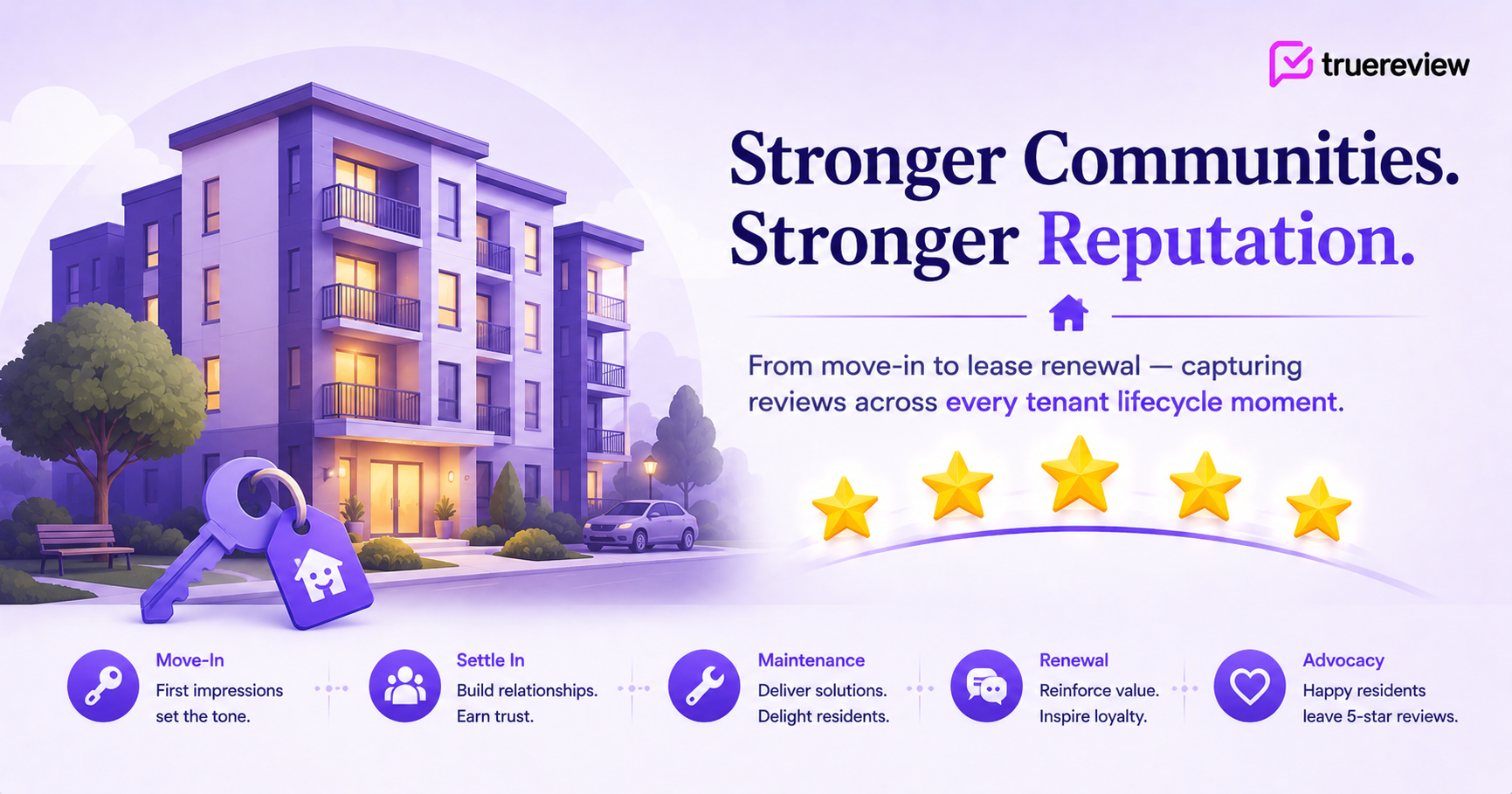
At the move-in honeymoon (week 2-3 after move-in). New tenants in their first weeks at a property are often unusually positive about the experience — they've just been through the leasing process, they're excited about their new home, they haven't yet had any maintenance issues or neighbor problems. Reviews captured at this window tend to focus on the leasing experience, the move-in process, and first impressions of the property and staff. These are honest reviews but they capture only part of the experience. Use them as one part of the review pipeline rather than the whole thing.
After successful maintenance request resolution. This is the highest-leverage review moment property management has. A tenant submits a maintenance request, the maintenance team responds quickly and resolves the issue cleanly, and the tenant is left with a positive interaction with the management company. Reviews captured 2-4 days after maintenance completion tend to mention specific maintenance staff (often by name) and the responsiveness of the team — exactly the content prospective tenants want to see. Set up automated workflows that fire on closed maintenance work orders for tenants who didn't have escalations or unresolved follow-ups.
At lease renewal. Tenants who renew their leases are voting with their staying — they're satisfied enough to commit to another 12 months. Reviews captured at the renewal moment carry weight because the tenant has chosen to stay. Reach out 1-2 weeks after lease signing.
At anniversary milestones. Tenants who reach 1-year, 3-year, 5-year residency anniversaries have unusual long-term experience to share. Reviews from long-term residents are particularly powerful for prospective tenants because they speak to the durability of the property quality over time. Mark these milestones in your property management system and reach out at each.
At successful move-out (when amicable). Some tenants move out for reasons unrelated to property satisfaction — job relocation, family expansion, lifestyle changes, home purchase. These tenants often had positive experiences and are willing to leave reviews if asked. The window: 2-4 weeks after move-out, after the security deposit has been returned cleanly. Skip from this batch any move-outs involving security deposit disputes, evictions, lease breaks, or contentious move-outs.
Never during active maintenance issues. A tenant with a pending maintenance request, unresolved repair, or active complaint isn't in the right frame of mind for review requests. Filter these out of automated workflows.
Never during rent collection issues. Tenants behind on rent or in active eviction proceedings shouldn't receive review requests. The likelihood of negative reviews is high and the reputational damage from inappropriate review requests is greater than any potential review value.
Never after rent increases. Annual rent increases — especially substantial ones — temporarily sour tenant sentiment regardless of actual property quality. Wait 60-90 days after rent increase notifications before resuming review requests for affected tenants.
Never during property issues (system outages, major maintenance). When the elevator's been broken for a week, the gym is closed for renovation, or the AC is out building-wide, asking for reviews invites negative content.
Never during contentious move-outs. Tenants leaving under any kind of dispute — security deposit disagreement, eviction proceedings, lease break, neighbor dispute resolution — are highly likely to write negative reviews if asked. Skip them entirely.
Most property management companies underuse the single highest-leverage review acquisition opportunity in their workflow: closed maintenance work orders. The dynamics make this unusually powerful:
Tenants notice maintenance responsiveness more than almost any other property attribute. A maintenance request that gets resolved quickly produces measurable goodwill. A maintenance request that lingers produces measurable resentment.
The workflow creates a clear ask window. Work order opens → maintenance team responds → issue resolved → work order closed. The "work order closed" event is a natural automated trigger.
Specific staff get named in reviews. Reviews mentioning the maintenance technician by name ("Carlos was great — fixed everything in 30 minutes") are unusually credible and useful, and they reinforce the value of investing in good maintenance staff.
The review topic is exactly what prospective tenants care about. "How responsive is maintenance?" is one of the most common questions prospective tenants ask. Reviews specifically addressing this directly answer the question.
A practical implementation:
A standard SMS template for post-maintenance review requests:
Hi {First Name}, glad we got that taken care of for you! If you have a moment, a Google review of {Property Name} would mean a lot — your feedback helps other people deciding to make {Property Name} their home: {Review Link}
A standard email review request template for post-maintenance:
Hi {First Name},
Glad we got your recent maintenance request handled. We hope everything's working well now.
If you have a few minutes, would you mind leaving us a Google review? Honest feedback from residents like you helps prospective tenants get a real picture of what living at {Property Name} is like — and we genuinely appreciate the support.
[Leave a Google Review →]
Thanks,{Property Name}
The maintenance-completion ask is the single most consistent review-driver in property management. Companies that systematically capture this opportunity build review profiles steadily; companies that don't tend to depend on the unreliable timing of organic reviews from happy tenants.
Fewer maintenance complaints start upstream, with the materials that hold up between turnovers — flooring is the usual culprit. For a full breakdown, see the best carpet for rental property.
Move-in honeymoon (week 2-3 after move-in):
Hi {First Name}, hope you're settling in! If you have a moment, a Google review of {Property Name} would mean a lot — your feedback on the move-in process and your first impressions helps other people deciding to make {Property Name} home: {Review Link}
Post-maintenance (2-4 days after work order closed):
Hi {First Name}, glad we got that taken care of for you! If you have a moment, a Google review of {Property Name} would mean a lot: {Review Link}
Post-renewal (1-2 weeks after renewal signing):
Hi {First Name}, thanks for renewing with us! If you have a moment, a Google review of {Property Name} would help others see what makes our community a place worth staying: {Review Link}
Anniversary (1+ years residency):
Hi {First Name}, thanks for being part of {Property Name} for the past {number} year{s}! If you have a few minutes, a Google review would mean a lot — your perspective as a long-term resident is exactly what prospective tenants want to hear: {Review Link}
Post-amicable-move-out (2-4 weeks after move-out, deposit returned):
Hi {First Name}, hope you're settling in at your new place! If you have a moment, a Google review of {Property Name} would mean a lot — your perspective on your time with us would help future residents: {Review Link}
The reminder (3-5 days after first request):
Hi {First Name}, just a quick reminder — if you have a minute, we'd really appreciate a Google review for {Property Name}: {Review Link}. Thanks!
Subject line options:
Email body (anniversary milestone):
Hi {First Name},
Thanks for being a resident of {Property Name} for the past {number} year{s}. Long-term residents like you are what make a community feel like home, and we genuinely appreciate having you here.
If you have a few minutes, would you mind leaving us a Google review? Honest perspectives from residents who've lived with us for a while are exactly what prospective tenants want to hear — and they help us continue building the kind of community you've been part of.
[Leave a Google Review →]
Thanks so much,{Property Manager name}{Property Name}
The anniversary template is one of the most distinctive review opportunities in property management. Long-term-resident reviews carry unusual weight with prospective tenants because they speak directly to the question prospects most want answered: "Will I still be happy here in 2 years?"
Property management isn't one industry. The right approach varies meaningfully by sub-segment.
Class A multifamily (luxury, urban high-rises, suburban premium). High-touch, high-expectation tenants. Reviews tend to focus on amenity quality (gym, pool, lounges, package management), staff responsiveness, and building maintenance. The bar for satisfaction is high, but successful execution generates strong reviews. Class A properties benefit from emphasizing concierge-level service quality in review request communications.
Class B/C multifamily (workforce, affordable, suburban garden). Different expectation set. Reviews tend to focus on maintenance responsiveness, staff helpfulness, neighborhood quality, and value-for-rent. The "well-maintained for the price point" review is unusually powerful in this segment.
Single-family rentals (SFR). Distributed properties, individual tenants, often less amenity-driven. Reviews tend to mention specific property managers (in companies that assign managers to portfolios), maintenance team quality, and individual property characteristics. The fragmentation challenge is severe — each property may have its own GBP, but with low individual review volume, it's hard to reach competitive thresholds. Some SFR operators consolidate reviews at the management company level rather than at individual property GBPs.
Student housing. Cyclical patterns tied to academic year. Move-ins concentrated in August/September, move-outs in May/June. Reviews skew toward students and parents (parents often co-sign and write reviews about their student's experience). Different review topics — proximity to campus, roommate situations, community management around late-night noise, parental peace of mind. Some specialized review platforms (like Apartments.com's student section) supplement Google.
Senior living (independent and assisted, non-medical). Family decision-makers as primary reviewers — adult children of senior residents researching communities for parents. Review topics shift toward staff caring quality, activities programs, community feel, family communication. Note: this is distinct from skilled nursing facilities (#43), which is medical care. Senior living independent and assisted is residential property management with hospitality elements; reviews matter enormously for the family-decision context.
HOA management. Homeowners as customers, not tenants. Review dynamics fundamentally different — homeowners pay HOA fees, attend board meetings, and have ownership interest in the community. Reviews tend to focus on management company responsiveness to HOA boards, financial transparency, vendor management quality, and community standards enforcement. Many HOA management reviews capture frustration with policies the management company is enforcing on behalf of the HOA board (architectural review denials, fine enforcement) rather than the management company's own decisions.
Commercial property management. B2B tenants (offices, retail, industrial). Reviews appear on business-oriented platforms (Google, BBB) rather than residential platforms. Lower volume but higher impact — a strong commercial review from a major tenant carries weight with other commercial prospects.
Mixed portfolios. Many property management companies handle multiple types — residential and commercial, multifamily and SFR, conventional and affordable. Review strategy needs to differentiate by property type rather than treating everything uniformly.
Property management is unusual in that Google reviews are one of several platforms that matter. Most categories have a dominant review platform with secondary platforms; property management has genuinely multiple platforms that prospective tenants check.
Google. The broadest reach. Prospective tenants researching neighborhoods or specific properties Google search both, and Google's results dominate organic search visibility. Strong Google reviews are essential.
ApartmentRatings.com. Long-established multifamily-specific review platform. Reviews here carry weight with prospects who deliberately seek out apartment-specific reviews. Smaller user base than Google but more focused.
Apartments.com (with reviews). The dominant ILS (Internet Listing Service) for multifamily. Properties pay for Apartments.com listings; reviews on Apartments.com listings influence both visibility within the platform and prospect conversion. The CoStar / Homes.com network includes related platforms.
Yelp. Less dominant for property management than for restaurants, but still a real channel. Some prospects specifically check Yelp for property reviews.
Rent.com / Zillow Rentals. Other ILS platforms with review components.
Facebook. Some property management companies maintain Facebook pages with reviews.
Reddit. Many cities have local renter subreddits where specific properties get discussed. Not a structured review system, but an information source prospective tenants use.
Industry-specific review aggregators. Some prospective tenants use sites that aggregate reviews across platforms (J Turner Research's ORA scores, Modern Message's Community Rewards reviews) for specific markets.
A practical multi-platform strategy:
Multi-platform review monitoring is operationally challenging without unified tools. TrueReview supports unified monitoring across Google, Facebook, Yelp, BBB, and major industry-specific platforms, which lets you respond consistently across platforms without checking each one manually.
Most property management companies use one of the major platforms: Yardi (dominant for large operators), AppFolio (dominant for smaller and mid-size operators), RealPage, Buildium, Entrata, ResMan, or Rent Manager. SFR-focused operators sometimes use AppFolio specifically or specialized SFR platforms.
Setup patterns:
Direct integrations where available. Some property management platforms have direct integrations with review request tools. Worth asking your software vendor what's supported.
Zapier connection. Most modern property management platforms expose webhooks or have Zapier integration. The most useful triggers:
TrueReview connects via Zapier to most major property management platforms.
Direct API integration. For larger property management companies with technical resources, direct API integration provides flexibility for complex routing logic — per-property attribution, work order filtering, tenant lifecycle stage tracking.
CSV import. For smaller operators on simpler systems, weekly batch uploads work as a fallback.
The trigger that matters: pick events that mean the tenant is in the right state for a review request. The work-order-closed event is reliable when filtered properly. The lease-signed event needs a 14-21 day delay for the move-in honeymoon window. The lease-renewed event is a fresh moment of commitment that signals satisfaction. The move-out-completed event needs careful filtering — only amicable move-outs without disputes.
Configure separate workflows for different events:
For multi-property companies, configure routing logic so review requests link to the appropriate property's GBP, not the management company's parent profile. TrueReview's Manage Multiple Businesses feature is specifically designed for multi-property operations like this.
Property management websites and ILS listings benefit substantially from embedded reviews because prospective tenants are actively shopping properties and reading content carefully.
A few specifics:
Embed property-specific reviews on each property's web page. Generic management-company-wide reviews are useful at the company level; property-specific reviews matter on individual property listings.
Surface maintenance-quality reviews prominently. Reviews specifically mentioning maintenance responsiveness convert prospective tenants who care about this dimension (which most do).
Show staff-mentioned reviews. Reviews mentioning specific property managers, leasing agents, or maintenance staff by name reinforce the human dimension of the property experience.
Date-stamp visibly. Recent reviews matter — especially in property management where staff turnover and policy changes can shift reputation rapidly.
Surface long-term-resident reviews. Reviews from residents with 1+ years residency carry unusual weight with prospects evaluating long-term commitment.
Display reviews from across multiple platforms when possible. Some embedded review widgets aggregate Google, ApartmentRatings, and Apartments.com reviews into unified displays on property websites. The diversity of platforms reinforces credibility.
TrueReview's review widget supports filtering, source attribution, date display, and per-property organization for multi-property companies.
Property management generates several specific types of negative review more than most categories:
Maintenance-related complaints. Slow response, unresolved issues, technician issues, recurring problems.
Communication breakdowns. Tenants who feel unheard, leasing office unresponsiveness, packages lost, parking conflicts.
Policy enforcement frustrations. Pet policy violations, parking enforcement, fee disputes, lease violation notices.
Move-out disputes. Security deposit disagreements, cleaning charges, damage assessments, return timing.
Rent increase reactions. Annual rent increases that drive tenant out or reduce satisfaction.
Neighbor and noise issues. Conflicts the management company can only partially address.
Owner-driven decisions blamed on management. Rent levels, amenity reductions, policy changes — tenants often blame management for owner decisions.
A few principles for response:
Don't argue policy enforcement publicly. A response defending why the late fee was assessed, why the pet policy applied, or why the parking rule was enforced reads as defensive and creates additional negative attention.
Don't argue maintenance details publicly. Public response about specific maintenance situations creates a record that can come back in future disputes or in fair housing complaints.
Don't argue financial disputes publicly. Security deposit arguments, fee disputes, and rent payment issues should never be discussed in public review responses. Move them offline immediately.
Don't reference protected classes or potentially discriminatory framings. Fair Housing Act considerations are real. Even unintended language that could be interpreted along protected-class lines creates exposure. Stick to neutral, professional, brief responses.
Don't reveal tenant identifying details. Even confirming someone is a tenant or resident may have privacy implications depending on jurisdiction.
Reference your formal grievance and complaint processes. Property management companies with documented complaint resolution procedures, satisfaction commitments, and grievance escalation paths can reference these in negative review responses.
Move it offline. Provide the property manager's contact directly.
A safe response template for property management negative reviews:
Thank you for sharing your feedback, {Name}. We take all resident concerns seriously and have a formal process for resolving issues. Please contact our property manager directly at {phone number} so we can address your specific situation.
For move-out-related negative reviews:
Thank you for sharing your feedback. We're sorry your departure didn't end on the best note. If you'd like to discuss your specific concerns about your move-out, please contact our property manager at {phone number}.
For maintenance-related negative reviews:
Thank you for sharing your feedback. We're committed to providing responsive maintenance for our residents and have systems in place for tracking and resolving issues. Please contact our property manager at {phone number} so we can review your specific situation.
For positive reviews, keep responses warm but generic:
Thanks so much, {Name}! We're glad you've been happy at {Property Name} and appreciate you taking the time to share your experience.
For positive reviews mentioning specific staff:
Thanks so much, {Name}! We'll pass the kind words along to {Staff Name} — she'll be glad to hear it. Thanks for being part of {Property Name}.
Some reviews cross the line from unfavorable into genuinely reportable — reviews from non-tenants, denied applicants, or content that violates Google's policies. For a step-by-step walkthrough, see our guide on how to remove problematic google reviews for property management companies.
A few practices that show up in property management review marketing but should be avoided:
Asking tenants currently behind on rent. Likelihood of negative reviews is high.
Asking tenants in active eviction proceedings. Same dynamic, plus legal complications.
Asking tenants in active disputes (security deposits, lease violations, neighbor conflicts). Wait until resolution.
Asking after rent increase notifications. Wait 60-90 days.
Asking during property-wide service outages or major maintenance. Wait until resolution.
Asking during negative news coverage of the property. Some properties experience local media attention (crime, building issues). Wait for the news cycle to subside.
Coaching tenants on what to write. "If you could mention how responsive maintenance has been..." crosses into review manipulation that violates Google policies.
Filtering reviews to bias the base. Asking only tenants you expect will leave 5-star reviews creates biased reputation profiles and may attract FTC scrutiny in some configurations.
Tying staff compensation directly to received star ratings. Compensation tied to asking (which staff control) is fine; compensation tied to receiving 5-star ratings specifically incentivizes manipulation.
Posting fake reviews. Property management is heavily monitored by Google for review fraud, and several state attorneys general have prosecuted property management review fraud specifically.
Letting one bad review go unanswered. Especially in property management where prospective tenants scrutinize reviews carefully before signing leases, an unanswered negative review reads as either avoidance or absence.
Public arguments with reviewers. Defensive responses, factual rebuttals, or arguments with reviewers compound the negative attention rather than defusing it.
A property management company running a thoughtful Google review program has all of these in place:
Companies that get this right typically dominate local search for "apartments [city]," "property management [city]," and similar searches within 12-18 months. The compounding effect on lease-up velocity, tenant quality, and rent achievement shows up in months 4-6 and continues to grow.
Companies that don't get this right tend to depend heavily on paid ILS marketing (Apartments.com, Zillow Rentals), paying premium rates for leads while their better-reviewed competitors capture organic search and direct visit traffic at substantially lower cost.
Ready to systematize Google reviews at your property management company? Start your free 14-day trial of TrueReview — automated tenant lifecycle workflows for move-in honeymoon, maintenance completion, renewal, anniversary, and amicable move-out moments; per-property GBP routing and the Manage Multiple Businesses feature for portfolio-wide oversight; integrations with major property management platforms via Zapier or direct API; unified multi-platform monitoring across Google, ApartmentRatings, Apartments.com, Yelp, Facebook, and other relevant review channels; embeddable review widgets that filter by property and surface maintenance-quality and long-term-resident reviews; and Fair Housing-aware response templates and AI-assisted response generation. No setup fees, no contracts.