BLOG POST
Google reviews for B2B IT services don't work the way they do for restaurants, contractors, or salons. Your buyer isn't a stressed homeowner deciding in 30 seconds — they're a CIO, IT director, or operations manager running a multi-vendor RFP over six weeks. They're not skimming star ratings to make a same-day decision. They're doing structured due diligence, comparing you against three or four other shortlisted MSPs, and looking for specific signals that you can be trusted with their company's infrastructure.
That changes everything about how you collect, position, and use reviews. The MSPs winning enterprise and mid-market deals in 2026 understand this — and have built review collection into their account management practice rather than treating it as a marketing afterthought.
Three things make MSP reviews different from consumer-facing reviews:
Reviews are part of vendor diligence, not impulse decisions. A buyer evaluating MSPs typically checks Google reviews alongside Clutch, G2, Cloudtango, and direct reference calls. Your Google reviews are one of several trust signals — but they're often the first one the buyer sees, because Google search is where the vendor research starts. Other recurring-contract service firms use the same playbook — see how bookkeeping firms get more google reviews.
Specificity matters more than volume. A consumer-facing business benefits from 200 reviews that say "Great service!" A B2B IT services firm benefits more from 35 detailed reviews that mention specific services (cybersecurity audits, Microsoft 365 migrations, ransomware response, vCISO engagements). Specific reviews signal capability; generic reviews signal nothing.
The sales cycle gives you natural review touchpoints. MSP customers typically work with you for years on annual contracts, with quarterly business reviews (QBRs) baked into the relationship. That's a structured environment that lends itself to organized review collection in a way one-shot home services never can.
A few stats worth knowing:
Forget the standard "ask 24 hours after service completion" rule from consumer-facing playbooks. For MSPs, the best review-asking moments are tied to your account management cadence, not individual support tickets.
The four high-converting review moments for MSPs:
What doesn't work:
1. Post-project email from the account manager. A personal email from the account manager (not a marketing automation message) after major project sign-off. Personal > automated for B2B.
2. The QBR ask, in-meeting. Build a one-minute review request into your QBR template, at the end of the meeting. "If our service has been working for you, a Google review would mean a lot — particularly because so few of our peers in the industry have current reviews. Would you be willing to leave one this week?"
3. Renewal-trigger email sequence. When a customer signs a renewal, fire a thank-you email 3 days later that includes a review request. The renewal is the trust signal — leverage it.
4. Annual customer success milestone emails. Track customer anniversaries (first year, third year, fifth year on services). Each anniversary is a natural moment to thank them and ask for a review.
5. Referenceable case study to review pipeline. Many MSPs have a few customers willing to be referenced for sales calls. Those same customers should be the first ones asked for public Google reviews — they're already comfortable with public advocacy.
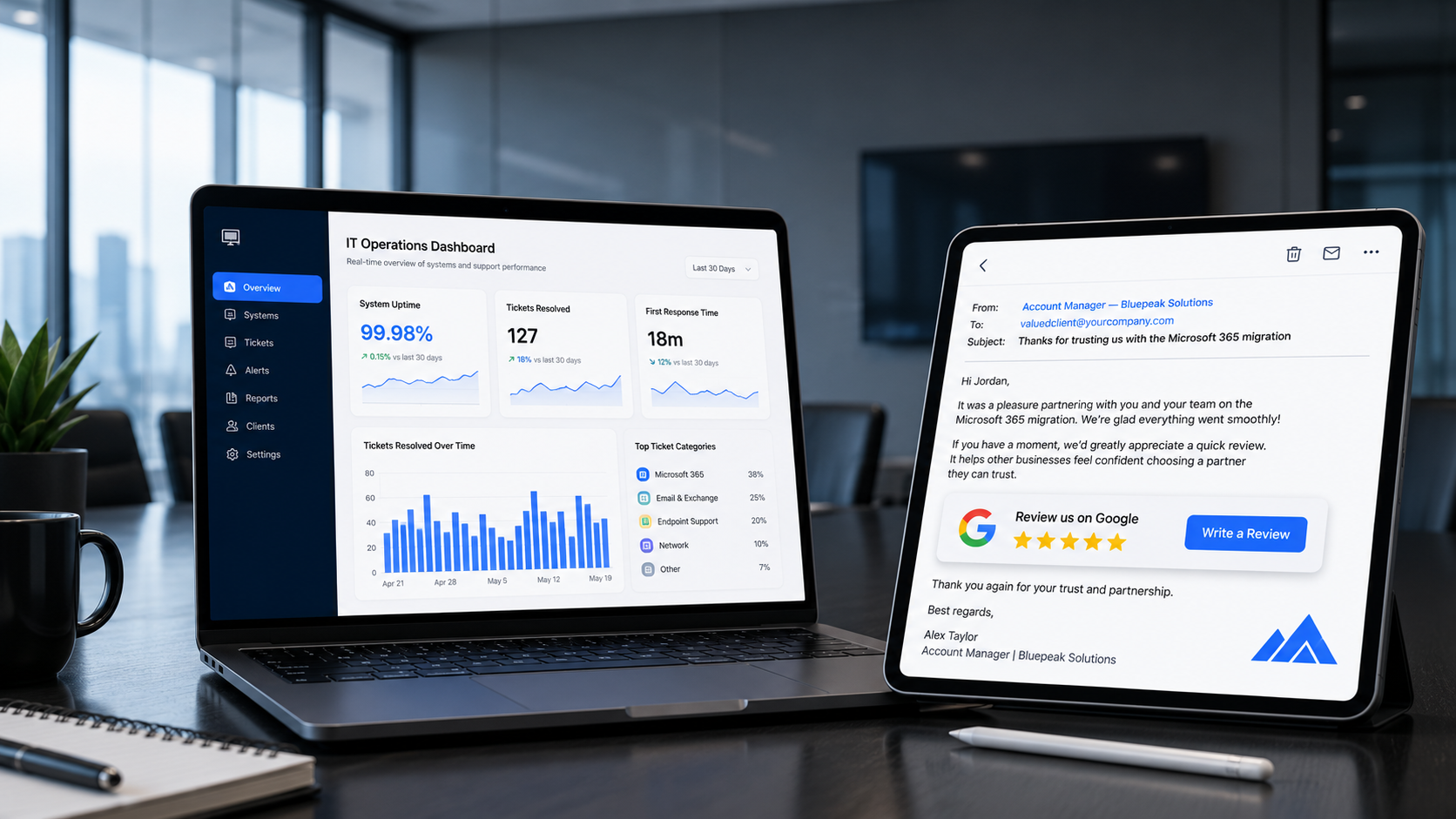
Post-project thank-you (sent by AM):
Subject: Thanks for trusting us with the Microsoft 365 migration
Hi [name],
Now that the migration is wrapped up and the team has had a couple of weeks to settle into the new environment, I wanted to follow up and say thanks for trusting [Company] with the project.
If you've been happy with how it went, would you consider leaving us a quick Google review? Many of the businesses considering an MSP partner check Google reviews as part of their evaluation — your perspective would help others understand what working with us is actually like.
[Leave a Review button]
Either way, thanks for the partnership.
— [Account Manager name]
Post-QBR follow-up:
Subject: Following up on today's QBR
Hi [name],
Thanks for the productive QBR today. Glad the uptime and ticket resolution numbers continue to look strong.
One small ask: if [Company] has been delivering the value we discussed, would you consider leaving a Google review? Detailed reviews from clients like you make a real difference when other businesses are evaluating MSPs.
[Leave a Review button]
Looking forward to Q3.
Renewal thank-you email:
Subject: Thanks for renewing with us
Hi [name], wanted to send a personal note — thanks for renewing your MSA with [Company] for another year. The continued trust means a lot to our team.
If you have a moment, a Google review would be the single best way you could support us. Especially helpful when other mid-market businesses are checking us out during their vendor evaluation.
[Leave a Review button]
Anniversary email (year 3+):
Subject: 3 years working together — quick thank you
Hi [name],
Hard to believe it's been three years since [Company] started managing your IT environment. Wanted to send a personal thank you for the continued partnership.
If you have a few minutes, would you consider leaving us a Google review? Long-term client reviews carry serious weight when other businesses are evaluating MSPs — your perspective could really help.
[Leave a Review button]
Treating reviews as marketing's job. The highest-converting review asks come from account managers, not from marketing automation. Reviews are an account management practice that marketing supports — not the other way around.
Asking technicians' customers about technicians. Tickets close all day, every day. Asking after every closed ticket trains customers to ignore the messages. Reserve review asks for genuine milestones.
Focusing only on Google. Google is important, but for B2B IT services, you're also being evaluated on Clutch, G2, Cloudtango, and Gartner Peer Insights. Build a review strategy, not just a Google review tactic. That said, Google is where most net-new prospects start their research — it's the right first priority.
Generic asks for generic reviews. "Please leave us a review" produces "Great service!" Specific asks produce specific reviews. Mention the project, the service, the milestone — give the reviewer something concrete to write about.
Forgetting compliance contexts. If you work with healthcare, financial services, or government clients, some of your customers can't publicly disclose vendor relationships. Don't push these accounts for public reviews; they may have legitimate confidentiality reasons. Focus your review collection on customers without these constraints.
A mid-sized MSP serving 80 mid-market accounts across the Midwest implemented a structured review-request system tied to their HubSpot CRM. Three review triggers:
They started with 14 Google reviews. After 18 months, they had 96 — all from current or recent customers, all detailed enough to mention specific services. Their average rating sat at 4.9.
The most interesting metric: their inbound sales-qualified-lead volume from organic search doubled over the same period. Prospects were arriving in their CRM having already read 5–10 reviews mentioning the exact services they needed. Sales cycles compressed because the initial trust work was already done.